

First things first: for a basal body temperature chart to be reliable, you need to take your temperature in the morning, right after waking, and at the same time every day. That calls for a certain amount of consistency — skip it and your readings will be off, since almost any activity can nudge your temperature up.
We get plenty of questions about how to chart basal body temperature in our earlier articles on conception, so here's the practical side: how to pin down your ovulation date as accurately as possible. It's an exercise that asks for precision and patience, but it isn't complicated — and its real advantage is that it can reveal the date of ovulation with more or less accuracy. Ovulation has a direct effect on body temperature, thanks to the progesterone released straight after the egg leaves the ovary. That progesterone lifts your temperature slightly just after ovulation and keeps it up until your next period.
By the same logic, it's best to use the same thermometer every time, and to note anything that might push your temperature up — medication, a virus, a cold, and so on. You can take your temperature orally, rectally or vaginally, whichever you prefer, but it's better to stick to the same method each time. The axillary route (under the arm) is less reliable for measuring basal temperature, which needs accuracy to within a few hundredths of a degree: for charting, stick to oral, vaginal or rectal.
It's also worth charting over several cycles to get meaningful information about their regularity, since cycle length can vary from one month to the next: a single cycle won't tell you your ovulation date for every month.

For reference, start taking your temperature on the first day of your cycle — that is, the first day of your period — and the cycle ends on the first day of your next period.
Once you've taken your temperature, plot it on a chart you fill in yourself each day, noting the dates, the times you took it and any remarks: dates of intercourse, pain or symptoms linked to ovulation, your period flow, anything that might raise your temperature, and so on.
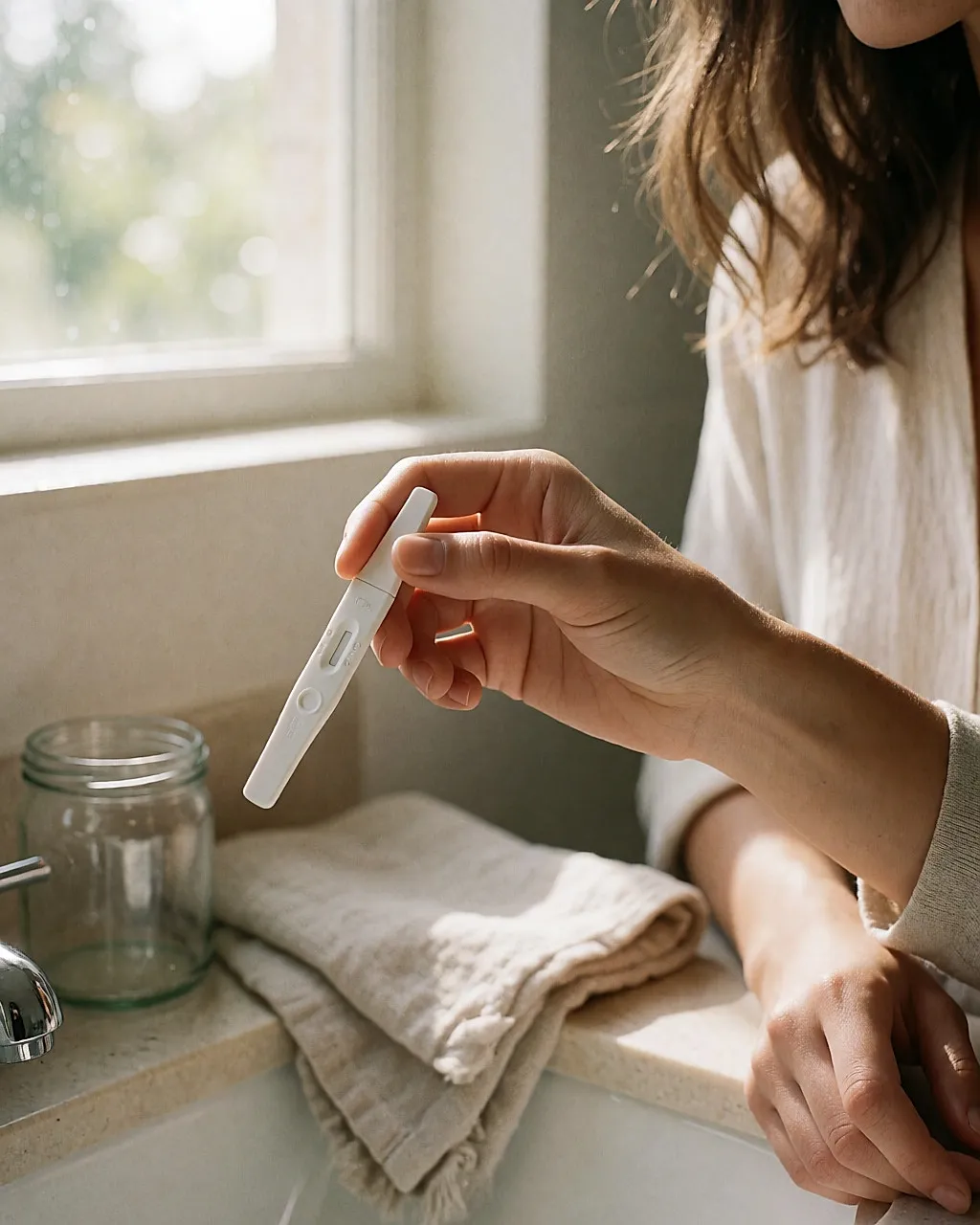
You can also ask your GP for a chart designed for this, and build your curve on it. Even if your results look fairly clear, ask them to take a look after a few cycles, so they can share their observations and advice.
How to read your temperature chart
"Normal" body temperature varies from person to person; it usually sits between 36°C and 36.5°C. Just after ovulation, progesterone pushes it up by a few tenths of a degree — five at most — so it lands at around 37°C. Again, this varies from woman to woman, so note the rise relative to your own usual temperature. In principle it stays elevated until your next period: the corpus luteum stops secreting progesterone, the endometrium sheds, and your period arrives. In early pregnancy, though, progesterone stays present and temperature often stays high; a missed period may point to pregnancy, but only a test or medical advice can confirm it.

Worth noting: the temperature peak tells you that you have ovulated, not that you're about to. That distinction matters, because an egg only lives for around 15 hours at most. So it's better to have intercourse a little before ovulation than on the day after it — or, better still, both.
The chart helps you identify ovulation after the fact and gauge how regular your cycles are; on its own, it doesn't predict the fertile window of the current cycle. It can also flag possible anomalies: anovulation, very irregular cycles, a thermal plateau that's too short (when the stretch during which temperature should stay above normal is too brief). These are all signs that can help your doctor identify possible obstacles to pregnancy, and so offer appropriate care. It's not unusual for a doctor to be the one who suggests temperature charting to women who are finding it hard to conceive.
Finally, ovulation tests can help identify the most fertile period by detecting the LH surge, without confirming the exact date of ovulation on their own — though they give less information about the menstrual cycle than basal body temperature charting.
In practice: keep the thermometer and a small notebook on your bedside table, and take your temperature before your feet touch the floor. Slept badly, fever, woke in the night? Note it down — it's useful information for reading the chart, not a reason to start over.
What it costs
A "basal" thermometer — the kind that shows two decimal places and can pick up a difference of a few tenths — usually costs around £5 to £15. Beyond that, there's nothing essential to buy: a notebook, a printed table or a free version of a tracking app all do the job perfectly well, and some doctors hand out a chart designed for exactly this at an appointment.
Sources
For further reading: NHS resources on tracking your menstrual cycle, guidance from NICE, and information from the Royal College of Obstetricians and Gynaecologists (RCOG). If you're struggling to conceive or you're unsure about your cycle, talk to a healthcare professional — a GP, gynaecologist or midwife: the chart is a tool for discussion, not a diagnosis.


Comments
Your opinion matters: rate the article, react and reply to comments.
Comments are moderated; AI-assisted comments are flagged. Text emoticons (8-), :-), <3…) are automatically shown as images.