
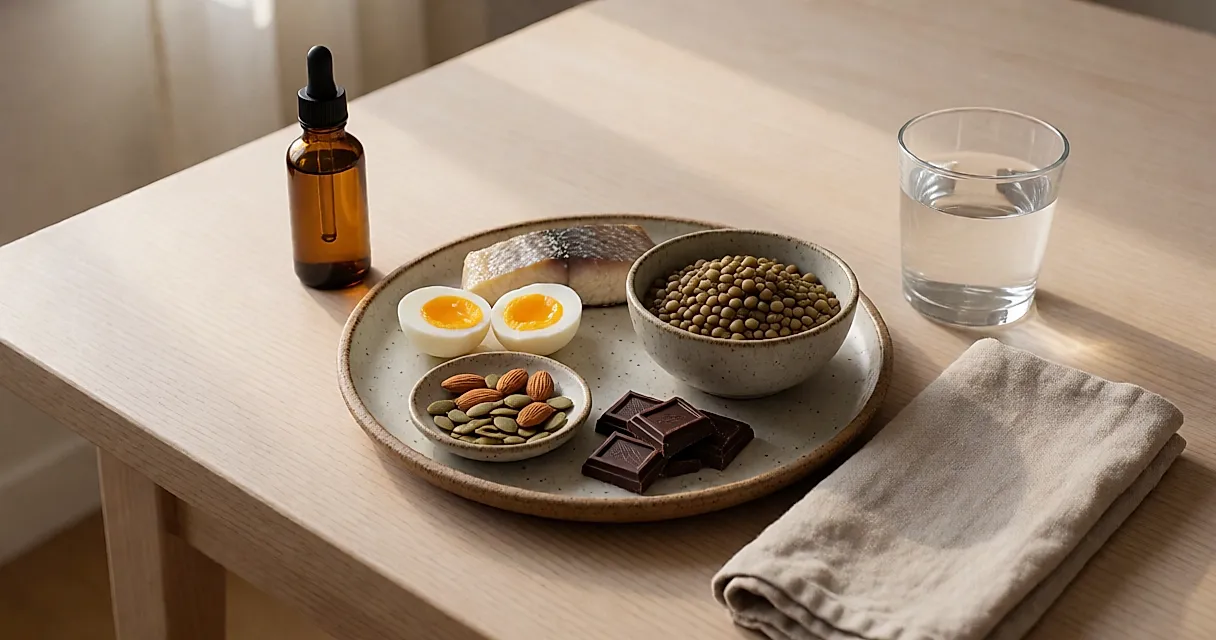
Autumn is not a neutral season. The light fades, the days shorten, and raw salads give way to warmer dishes — often sweeter ones. It is also the point at which supplements start stacking up with very little logic behind them: vitamin D "because it's winter", iron "because I'm tired", magnesium "because everyone mentions it". Let's do the opposite: not a shelf of bottles, but a way of deciding.
Step 1 — Look at your plate and your sleep before you buy anything
Before you spend a penny, look at what the season actually changes in your intake. Vitamin D is made mainly in the skin, with the help of UVB: in autumn and winter, UVB exposure is lower. Food sources do exist — oily fish, eggs, fortified products — but they rarely cover your needs on their own.

Iron depends on what you eat and on your periods. Magnesium is found in wholegrains, pulses, nuts and dark chocolate. In other words: before chasing a capsule, check whether these food groups turn up on your plate regularly.
Then look at your sleep. Some data suggest that a lack of sleep can change appetite and encourage sweet cravings. That is not a side note: no capsule makes up for broken nights. In practice, start there. What the current evidence suggests is that a consistent bedtime and a proper breakfast change more than a bottle bought in a hurry.
Step 2 — One real need at a time
The rule is simple, and hardly anyone follows it: one active ingredient at a time. If you start three products on the same day, you will never know which one is doing anything — or which one is giving you a stomach ache. Pick a single need, write down what you expect from it, set a trial period (a few weeks, not six months) and a date to review it.

On that date, ask yourself an honest question: can you actually feel a difference? If the answer is no, stop. A supplement is not a treatment: it will not "correct" a deficiency that has never been identified. Saying no to half of what you already take is often the most useful thing you can do this season.
Step 3 — What to look for in store or online
When you buy, favour simple forms over formulas padded out with ten ingredients. A dose you can read on the label beats an undecipherable "winter blend". On tolerance, magnesium and iron forms are not interchangeable — your pharmacist can point you in the right direction.

For the rest, apply the same criteria you would anywhere else: an organic certification such as Soil Association confirms organic farming for plant ingredients, but says nothing about the dose or whether the product works. Look at the packaging: glass or a refill rather than throwaway plastic. Loose powders exist for some products. And if the best option for your need turns out to be a conventional product, take it — the compromise will simply be more visible.
A food supplement is neither a medicine nor a diagnosis. It does not replace a varied diet, and it is not something to take "just in case" for months on end. If a symptom persists — tiredness, pain, trouble sleeping — see a healthcare professional rather than adding another bottle to the shelf.

Step 4 — The "ask a professional" rule
A blood test is something a doctor arranges, not an Instagram story. Your GP is the person who diagnoses and decides whether supplementation is needed. Raise it with your pharmacist too: some interactions exist, between iron and certain medicines, or magnesium and certain antibiotics. That is no reason to panic — just to ask before rather than after.
Budget
As a rough guide, expect to pay somewhere in the region of £5 to £15 for a bottle of vitamin D (often drops or small capsules), £10 to £25 for magnesium depending on the form and how many doses you take, and £8 to £20 for iron. Organic, loose or more elaborate formulas tend to sit at £15 to £35. Prices shift with the form, the dose, the brand, the certification and where you shop — pharmacy, health-food shop, supermarket or online, where the gaps can be wide at comparable quality. Check current prices and compare the cost of a useful dose, not the cost of the bottle.
Food supplements do not replace a varied, balanced diet and a healthy lifestyle.



Comments
Your opinion matters: rate the article, react and reply to comments.
Comments are moderated; AI-assisted comments are flagged. Text emoticons (8-), :-), <3…) are automatically shown as images.