
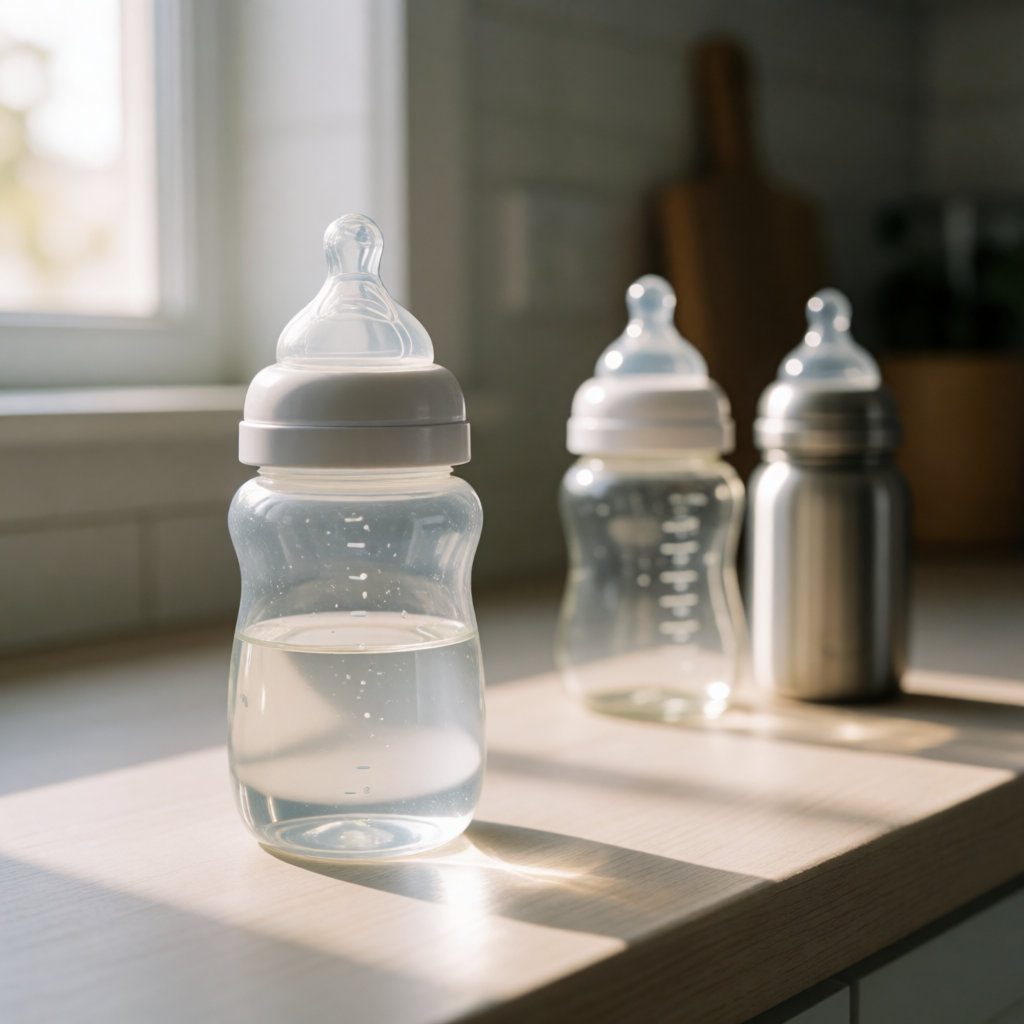
You open the kitchen cupboard, a pile of baby bottles tumbles out, and a small voice whispers: should you be replacing the lot? The question isn't new, but the answers have shifted in recent years. Between what's banned, what's still debated and what's plain common sense, here's where things stand.
What we know today
Bisphenol A (BPA) is a compound used in some plastics. In the UK it has been banned from baby bottles since 2011, following the EU directive in force at the time, and in the EU regulation (EU) 2024/3190 now extends the ban to all food-contact materials, with transition periods. In short: a new bottle bought in the UK today doesn't contain it.
Why so much caution? Because BPA is classed as an endocrine disruptor, and the European Food Safety Authority lowered its reference threshold in 2023. Current data suggest possible effects on hormonal balance, reproduction, metabolism and the immune system, although causality has not been demonstrated in humans at usual exposure levels. For an infant, whose hormonal and immune systems are still developing, it's a risk factor worth watching rather than a foregone conclusion.
One point is often overlooked: a bottle labelled "BPA-free" may contain BPS or BPF, replacement molecules whose effects are even less documented than BPA's own. BPA-free is good news, then, not an absolute guarantee.
The step that matters: heat
Migration of some plastic compounds increases with temperature. That habit applies to plastics, even the newest ones: heat the milk or the water separately, let it cool to lukewarm, then pour it into the bottle. Avoid the microwave for warming milk and, for sterilising, follow the manufacturer's instructions. Never pour boiling liquid straight in. And remember that wear counts as much as the material: a scratched, cloudy or cracked bottle goes in the bin.
A plastic bottle isn't a forever object. Replace it as soon as the material whitens, scratches or keeps a whiff of old plastic. Teats should be changed regularly too, and sooner if they lose their shape.
Glass, stainless steel or plastic?
Glass has a clear advantage: it is inert and releases nothing, even when hot. It is the most durable of the three, and easily passed from one child to the next, provided you check its condition and sterilise it. Its limits? It's heavier, it breaks — so never leave a small child alone with one — and it usually costs a little more. Check for cracks every time you wash it; that's the main risk.
Stainless steel, lighter and shock-resistant, works well for days out, with insulated versions that are handy for long walks or car journeys. Again, it's a purchase that lasts for years.
BPA-free plastic remains the most common, the cheapest and the lightest — so the most practical when you're getting through bottles one after another. If you go for it, choose a hard, transparent plastic with no interior decoration, and respect the maximum temperature the manufacturer gives. Another way to lighten the footprint: buy second-hand glass bottles, easy to sterilise, rather than old plastic whose age and heating history nobody knows.
In practice, remember this
- A new bottle bought in the UK is BPA-free.
- Heat is a major factor in migration.
- Wear matters as much as material.
- Glass and stainless steel are the most durable options; breastfeeding, when it's possible and wanted, remains a solid alternative.
If you have doubts about an old bottle, a model brought back from another country or handed down from an older sibling, have a word with your pharmacist or your GP. No article replaces the advice of a health professional.
Budget
Roughly what you'll pay in the UK:
- BPA-free plastic bottle: around £6 to £18 each, often cheaper in a set;
- glass bottle: £10 to £26 depending on brand and capacity;
- stainless steel bottle: £17 to £35, usually sold singly;
- spare teats: £4 to £8 for two, to be replaced regularly.
Prices vary with capacity, brand, whether there's an anti-colic teat and where you shop. Pharmacies are useful for advice, supermarkets are often the cheapest, and online brands frequently offer spare parts or refills — a way to make your kit last longer without buying everything again. For your budget as for the environment, glass and stainless steel cost more upfront but pay off across several children.
Sources
- ANSES — Bisphenol A, dossier.
- EFSA — Re-evaluation of bisphenol A in food, 2023.
- European Union — Regulation (EU) 2024/3190 on food-contact materials, 2024.
- European Union — Directive 2011/8/EU banning bisphenol A in plastic baby bottles, 2011.




Comments
Your opinion matters: rate the article, react and reply to comments.
Comments are moderated; AI-assisted comments are flagged. Text emoticons (8-), :-), <3…) are automatically shown as images.