

Trying for a baby: giving myself the best chance
However much you know it can take time, every month that ends with a negative test stings a little. And yet the fertile window is tiny: the egg can only be fertilised for twelve to twenty-four hours, while sperm can survive for up to five days in cervical mucus. In practice, that gives you five to six fertile days a month. Understanding this calendar stops you from wearing yourself out with hit-and-miss attempts — and helps you stay calm after two negative tests.
What we know, and what we don't yet know: biology gives solid markers, but it doesn't promise anyone anything. Here's how to tip the odds in your favour, without turning your bedroom into a labour ward.
Spotting your ovulation, without spending every evening on it
On a 28-day cycle, ovulation often falls around day 14, counting from the first day of your period. Except that few cycles are exactly 28 days, and the same body varies from one month to the next. So how do you do this without turning into a Saturday-morning statistician?
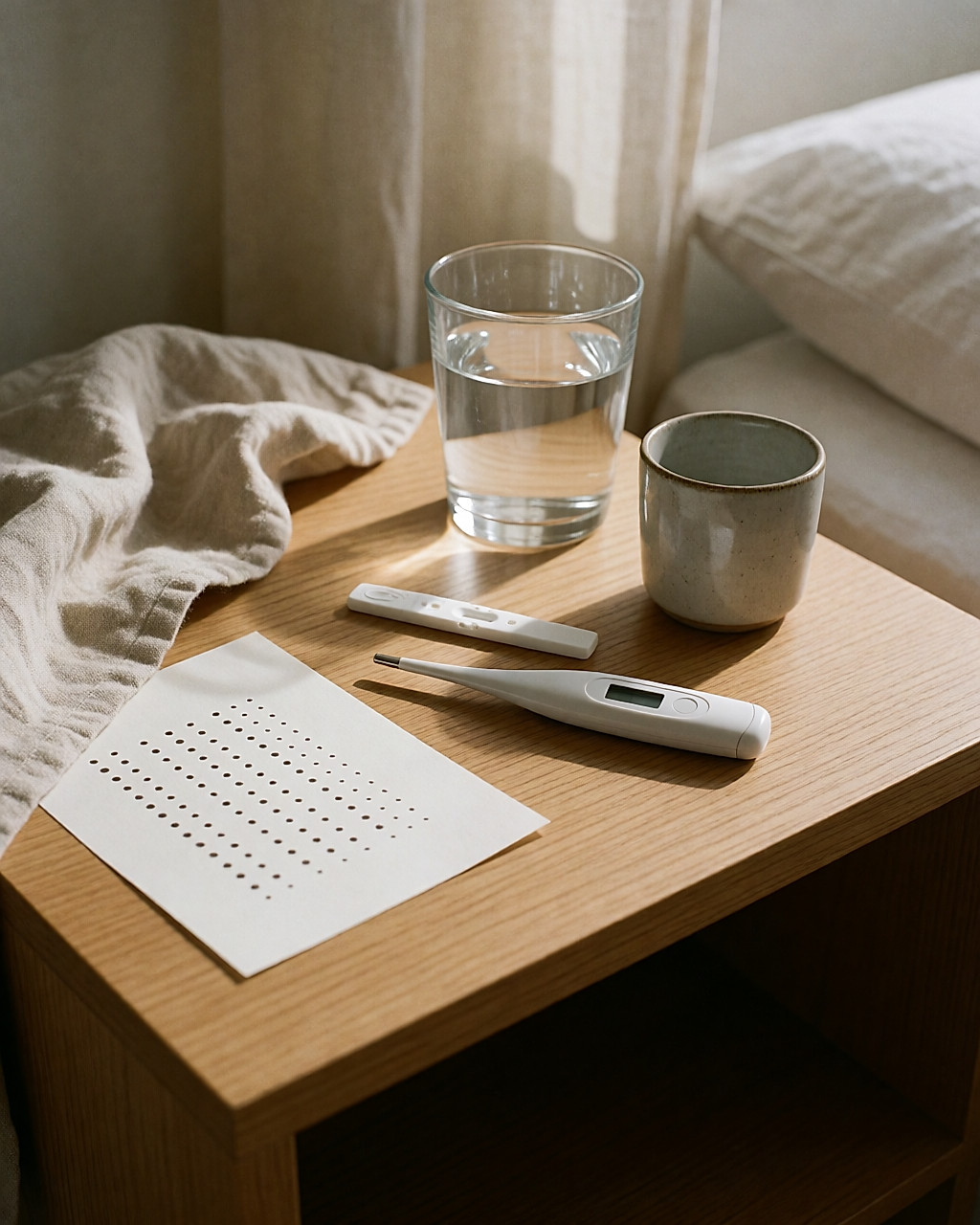
Three tools exist, each with its limits. A temperature chart, taken in the morning on waking before you get up, rises slightly after ovulation: it confirms you've ovulated — but too late to act that month. Urine tests detect a surge in a hormone, LH, and announce ovulation twenty-four to thirty-six hours in advance. Watching your cervical mucus, which is more abundant and stretchier mid-cycle, remains a free and immediate clue.
Tracking apps are handy for keeping a record, as long as you remember they're calculating an average, not your own physiology. In practice, remember this: the most fertile days for sex are the three days before ovulation, and the day itself.
Preparing the ground, body-wise
Smoking is linked to lower fertility in both partners, and to a longer time to conceive. Alcohol works against you too, at a time when zero is already recommended during pregnancy. Stopping or cutting back before you start trying is one of the most worthwhile steps — and it counts just as much for your partner as for you.

When it comes to food, there's nothing extraordinary to do. Both a very low weight and a significant excess weight can disrupt ovulation. Eating a varied diet, without extreme restriction, is usually enough. Folic acid (vitamin B9) is frequently recommended before conception and in early pregnancy: the dose and duration are things to discuss with your GP or midwife, not on a forum.
Mindset matters too. Current data suggests a link between significant stress and time to conception, though we can't untangle causes from consequences. The real trap is turning the bedroom into a labour ward: keep having sex for pleasure, not just for the calendar. Easier said than done, we'll grant you.
And after sex, should you stay lying down?
You've surely heard it: stay lying down, legs in the air, "so it holds". Nothing proves this. Sperm are mobile and swim up naturally; the idea of sperm "leaking out" doesn't really hold up. Lying still for a few minutes does no harm, but getting up straight away doesn't compromise anything. If it reassures you, go ahead — for comfort, not obligation!

The biological clock, and when to seek advice
In the UK, the average age at childbirth is around 31, and female fertility declines gradually after 30, more markedly after 35. That's not a reason to rush, but it's a fact worth knowing.
For a couple not using contraception and having regular sex, around eight in ten pregnancies happen within the first twelve months. Infertility is usually considered after twelve months without conception, and after just six months if you're over 35. Some situations warrant seeking advice sooner: very irregular or absent periods, marked pelvic pain, known endometriosis, a history of pelvic infection.
Don't forget half the picture: the cause is male in nearly a third of cases, and mixed in another third. A semen analysis is a simple test, available on the NHS with a referral from your GP.
No test sold online, no app and no supplement can claim on its own to tell you that you're ovulating or that you're fertile. If trying goes on and on, or if you have any question at all, talk to a healthcare professional — GP, midwife or gynaecologist. It saves months of wandering and DIY diagnoses from the internet.
Budget
Expect to pay around £9 to £18 for a box of five to seven urine ovulation tests from a pharmacy. The unit price drops noticeably in supermarkets or on online health sites, when you move to bigger packs: the brand and the number of tests make a difference to the bill.
A two-decimal thermometer, essential for a reliable temperature chart, costs from a few pounds up to around £20, in a pharmacy or supermarket.
As for appointments: GP and midwife consultations are free on the NHS. If you go privately, expect to pay in the region of £50 to £100 for a GP, and upwards of £150 for a gynaecologist.
A fertility work-up — hormone tests, ultrasound, semen analysis — is done on referral and is available on the NHS. NHS-funded IVF (assisted reproduction) is available in some areas, though eligibility criteria and the number of cycles funded vary depending on where you live. Cycle-tracking apps are often free, with a premium version for a few pounds a month.
Where to find it all: your local pharmacy for tests and the thermometer, supermarkets and online health sites for cheap bulk packs, and above all your GP or midwife for the work-up and onward referral.
Sources
- NHS — Fertility
- NICE — Fertility problems: assessment and treatment
- Human Fertilisation and Embryology Authority (HFEA) — Fertility and treatment information
- Royal College of Obstetricians and Gynaecologists (RCOG) — Clinical guidance
- Office for National Statistics (ONS) — Births and fertility statistics
Food supplements do not replace a varied, balanced diet and a healthy lifestyle.



Comments
Your opinion matters: rate the article, react and reply to comments.
Comments are moderated; AI-assisted comments are flagged. Text emoticons (8-), :-), <3…) are automatically shown as images.