

First point, and it's an uncomfortable one: a tan is not a harmless cosmetic effect. It is a defence reaction. When your skin receives UV, it makes melanin to try to limit the damage to the DNA in its cells. In other words, that lovely caramel glow doesn't mean your skin 'likes' it; it means your skin is coping. There's a difference.
In a sunbed, the dose of UVA delivered in a few minutes can equal a much longer exposure to midday sun. So you aren't saving time: you're concentrating it. And what you gain in speed, you pay for elsewhere — on the skin-ageing account, in particular, which doesn't wait until your fifties to show up.

UVA, UVB: the costly confusion
Sunbeds emit almost exclusively UVA, which penetrates deep into the dermis. UVB is responsible for sunburn and triggers vitamin D synthesis. Confusing the two leads straight to the classic mistake: believing a sunbed 'prepares' the skin for the sun before a holiday. It doesn't. The tan you get under artificial UV stays superficial, fades quickly, and the protection it offers on the day you actually expose yourself remains very low, insufficient and unreliable.
Put another way, this pseudo-preparation leaves you with the illusion of armour-plated skin, without enough protection to skip sunscreen. The only step that protects you on the day remains the same: a suitable sunscreen, applied generously, and shade during the hottest hours.

What health authorities document
The International Agency for Research on Cancer classifies UV tanning devices as carcinogenic to humans — group 1, the same as tobacco and asbestos, to put the level of certainty in context. Current data suggest an increased risk of melanoma and carcinomas in users, especially when first exposure happens before age 35. Add premature skin ageing, spots, weakened skin and eye effects — cataract, ocular melanoma — when goggles don't properly cover around the eyes.
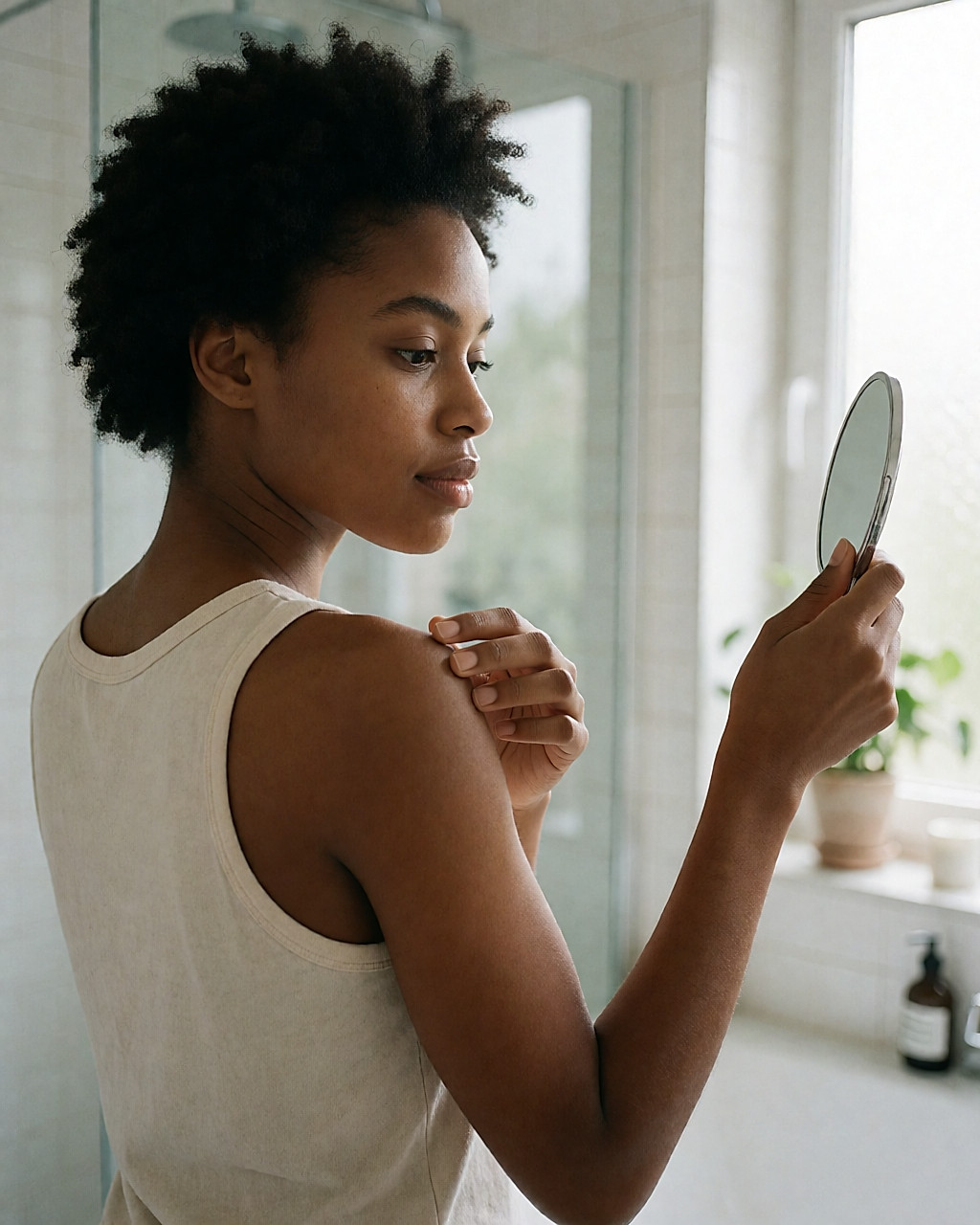
A useful clarification, because you read all sorts of things: some very alarming figures about mortality among young women circulate and deserve to be checked rather than repeated as they are. The main point lies elsewhere, and it is solid: artificial UV is an avoidable risk factor, recognised by health authorities.
What about vitamin D?
It's the argument most often served in salons, usually with a knowing smile. A session of artificial UV is not a reliable strategy for correcting a deficiency: synthesis depends on too many variables, and the benefit-risk balance is not favourable. If you're unsure about your vitamin D status, the right door is your GP or pharmacist. Not the sunbed.
Where the law stands
In the UK, sunbed use is banned for under-18s, and commercial premises must be supervised; the rules are devolved, so Scotland, Wales and Northern Ireland have their own variations. In France, since the 2009 law, supplemented by a 2013 decree, access is banned for minors and operators must meet conditions: declaration, staff training, public information. Anses recommended an outright ban as early as 2018. Several countries have already moved to full bans, including Brazil and Australia.
An artificial tan provides only very weak protection, insufficient and unreliable. If you use UV or self-tan, keep applying sun protection and avoid the most exposed hours. And keep up the checking habit: a mole that changes in size, colour or thickness should be shown to a dermatologist, not a search engine.
A sun-kissed look without UV
Good news: there are alternatives that add colour without exposing skin to ultraviolet. DHA-based self-tanners give surface colour, without UV. Note, though: they do not protect against the sun. They simply avoid the sunbed, which is already something. In-salon spray tan sits between £25 and £50 and usually lasts a few days to a week, depending on your skin.
On the shelves, look for a self-tan with a COSMOS ORGANIC or COSMOS NATURAL label. These standards cover formulation, ingredient origin and processing; the organic version also requires a minimum of organic ingredients. A glass bottle, a refill or a cardboard carton lightens the end-of-life packaging load. The compromise remains, though: DHA is not necessarily naturally derived — depending on the manufacturer, it may be synthetic or produced by fermentation — and an organic label alone does not guarantee its origin. Best to know that before believing in a completely natural happy ending.
A tinted moisturiser or BB cream also does the job day to day, with a composition that is often simpler to read — and a less dramatic result, that's the trade-off. It's the choice for a rushed morning, not for a summer evening out.
Budget
Ranges vary mainly by city, retailer and size. Here are ballpark figures, to adjust for your area.
- UV sunbed session in a salon: around £8 to £25, with discounted packages.
- Spray tan in a salon: from £25 to £50 depending on the formula and venue.
- Self-tanner in a pharmacy, supermarket or online: £8 to £25.
- Tinted moisturiser, foundation or BB cream: £8 to £30, from budget to premium counters.
- Dermatology consultation: via NHS GP referral, free at the point of use; private appointments typically £150 to £300.
In practice
What we know and what we don't yet know: the link between artificial UV and skin cancers is firmly established, while the promised benefit for the skin is not — and that's putting it mildly. Prevention here comes down to three simple steps: a self-tanner rather than a sunbed, SPF 50 outdoors, and an annual check of your moles. If you have any doubt about your skin or your exposure, talk to a healthcare professional: that's the only opinion that really counts. The rest is shop-window talk.
Sources
- ANSES — Opinion and expert report on sunbeds, 2018.
- IARC / WHO — Monographs on ultraviolet radiation, group 1 classification, World Health Organization.
- Santé publique France — Skin cancer prevention, data and recommendations.
- Institut national du cancer (INCa) — Skin cancer dossier, e-cancer.fr.
- Légifrance — Law no. 2009-879 of 21 July 2009 and Decree no. 2013-1261 of 27 December 2013, regulation of sunbeds.
Food supplements do not replace a varied, balanced diet and a healthy lifestyle.



Comments
Your opinion matters: rate the article, react and reply to comments.
Comments are moderated; AI-assisted comments are flagged. Text emoticons (8-), :-), <3…) are automatically shown as images.