
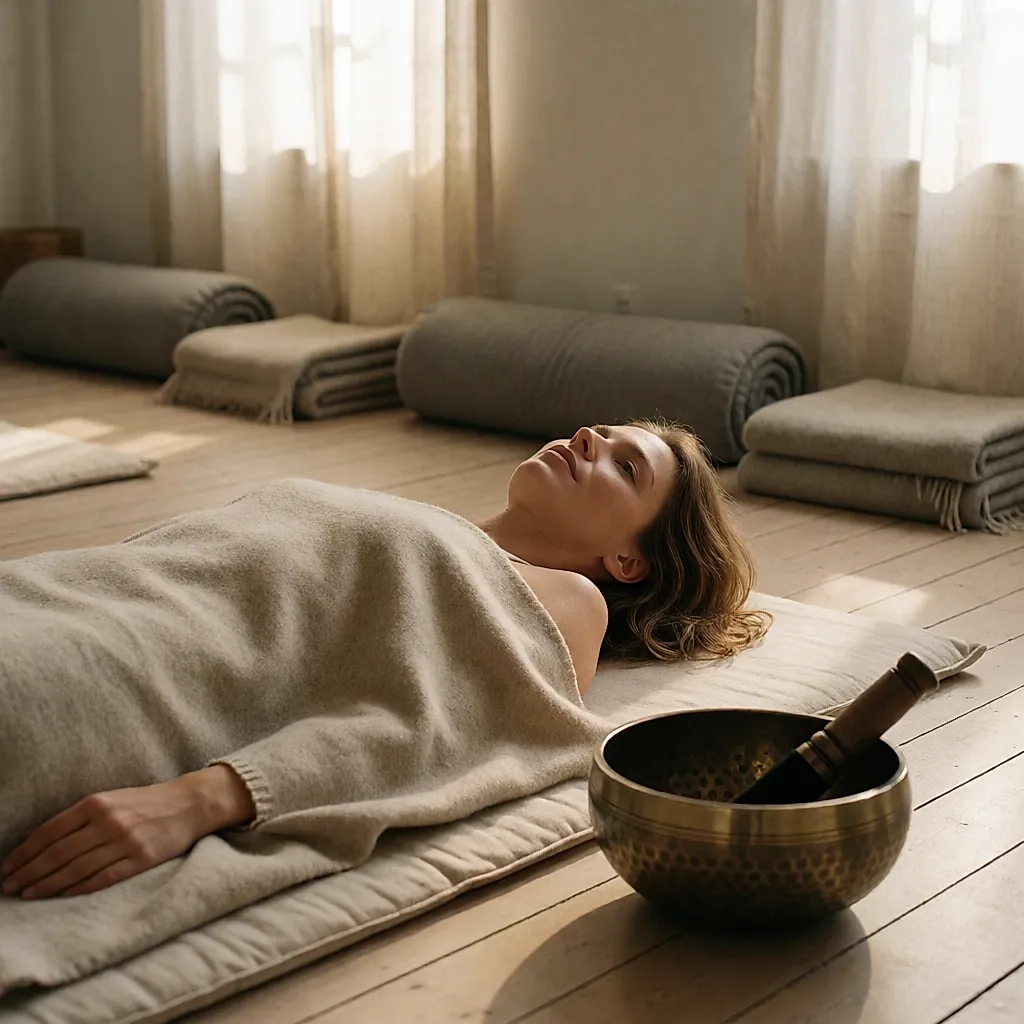
A metal bowl starts to hum, a gong fades, a chime lets its note hang in the air: in a sound bath, nothing else happens – and that is the whole point. You lie down, close your eyes, and the only thing you have to do is let the sound pass through you. Is that enough to relax you? The answer remains pleasantly unclear, and that is already a good reason to lie down for one.
Where this practice comes from
Metal bowls made in the Himalayan region were popularised in the 20th century by musicians, then by Western wellness practitioners; their precise ancient ritual use in Tibet is poorly documented. The sound bath format as you find it today is largely contemporary: it grew out of a meeting between these instruments, guided relaxation and yoga, first on retreats, then in urban studios.
The version offered near you is therefore not 2,000 years old. That is not a flaw, but it is worth knowing: the age of a practice tells you nothing about its effect, only about how it has been passed down.
What happens in a session
A sound bath can be summed up in one sentence: you settle, you listen, you do not join in. The practitioner sets several instruments vibrating – singing bowls, gong, tuning forks, chimes, sometimes a drum or voice – and lets each sound fade before starting another. The silences matter as much as the sounds, and that is often when the mind finally settles.
On the practical side, studios provide mats, cushions and blankets: above all, bring a pair of socks and a water bottle. They will show you where to put a cushion under your knees if your back is complaining. There is no class to follow, no posture to get right: the only serious instruction is to stay lying down and expect nothing spectacular.
What you can expect from it
In practice, you may come away with a sense of calm and a powerful urge to sleep – but that is a subjective feeling, not a proven therapeutic effect. The available evidence remains limited: it is not a treatment for anxiety, nor a cure for insomnia.
What is still unknown: whether the relaxation comes from the sound, from lying down, from the silence or simply from the hour you have given yourself. It is impossible to say. That may not matter if the experience suits you. But keep this in mind: a sound bath is not a treatment. If you have tinnitus, hyperacusis or epilepsy, are pregnant, or have persistent fatigue, speak to a healthcare professional first.
How to choose a session
First criterion, often overlooked: group size. Eight to fifteen people spaced well apart is not the same experience as a workshop of thirty where the person next to you is breathing in your ear. Ask before you book – it is a perfectly reasonable question.
Second, length: in practice, many sessions last about an hour, sometimes between 45 minutes and 1 hour 15 minutes. Many people find it takes time for the silence to settle. Third, the room: carpet and fabric-covered walls absorb sound, while wooden floors and stone walls make it reverberate; a busy street outside ruins everything. Watch out for a fridge humming behind the partition. Finally, look at the practitioner: their training, experience, and how carefully they warn you before the gong sounds loudly. That detail says a lot.
Tell the practitioner about any tinnitus, hyperacusis or auditory sensitivity before the session. If you have epilepsy, are pregnant, have a heart condition or are receiving care for a mental health condition, check with your GP or another healthcare professional. And if you are simply uncomfortable, get up: no one will hold it against you.
What it costs
As a rough guide for the UK, a group session in a yoga studio often costs around £15–£30, while shorter small-group sessions may be around £12–£20. Dedicated studios and spas tend to charge £40–£70, and one-to-one sessions more. Many venues offer a five- or ten-session pass that lowers the price per session, and some include sound baths in a monthly membership.
Book on the studio's website, at reception, or through yoga and wellness booking platforms that show live availability. Check the cancellation policy: Sunday evening slots can go quickly.
The right to do nothing
A sound bath does not answer the question of how to feel better; it asks a gentler one: what if an hour of doing nothing were already reasonable? You might go out of curiosity, leave indifferent, and go back two months later because Monday was long. Just plan nothing afterwards – waking up can feel fuzzy, and driving in that state is not a great idea. A blanket, socks, a phone on silent, and one certainty: you have the right to do nothing for an hour.


Comments
Your opinion matters: rate the article, react and reply to comments.
Comments are moderated; AI-assisted comments are flagged. Text emoticons (8-), :-), <3…) are automatically shown as images.