
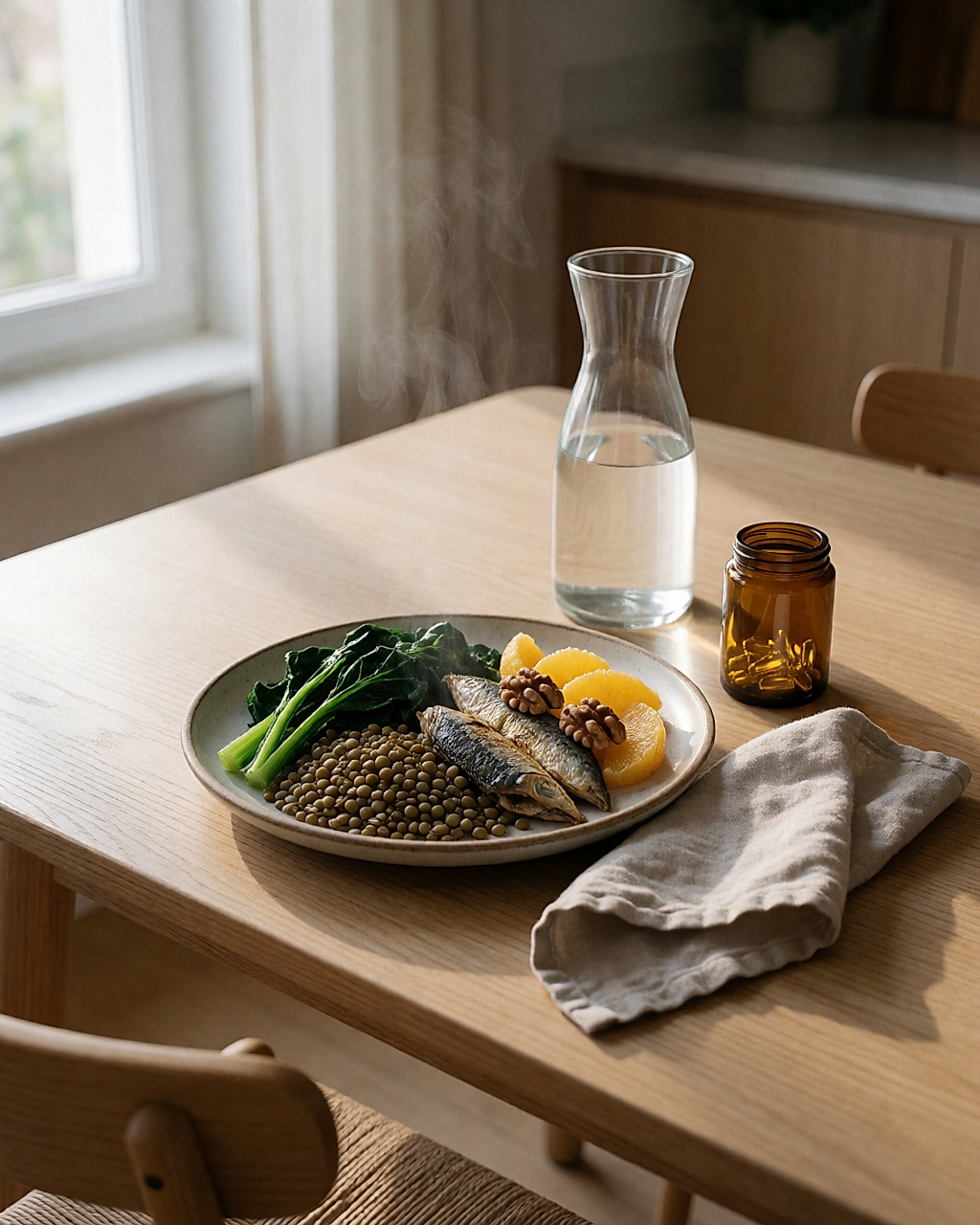
A saying often attributed to Hippocrates goes: 'Let food be your first medicine.' Micronutrition, by contrast, is a much more recent idea. This 'science' is taught at university and practised by doctors and pharmacists. There is also a European Institute of Dietetics and Micronutrition. In many people in France, intakes of certain nutrients — calcium, potassium, magnesium, iron, iodine and vitamins D and B — may be insufficient. These insufficient intakes can affect our health. Certain physical signs can alert you: difficulty digesting, dry skin, brittle nails, sleep problems, stress… For these everyday complaints, the first step is to review your diet and compensate for certain gaps with food supplements. This can include probiotics, whose effect on the gut microbiota is being studied in certain situations, omega-3 and omega-6, often associated with good mood, or algae extracts sometimes used as part of a wellbeing approach.
Here are two examples where micronutrition may play a role:
You feel tired even after good nights, and find it harder and harder to recover? Bouts of fatigue and repeated infections should also alert you: it is more than time to recharge your batteries! How? First, keep an eye on coffee, tea or cola: excessive or late consumption of caffeinated drinks can disrupt sleep and keep fatigue going. Also reduce your salt intake, which is responsible for the loss of certain minerals in urine. On the menu, favour fruit and vegetables, rich in vitamins and minerals. A seafood platter can also help you top up on vitamins and minerals. To regain your energy, do not forget protein, which you will find in meat or eggs, for example. In addition, a course of copper-gold-silver is sometimes mentioned, but it is better to speak to a healthcare professional before starting. And if these problems persist, head to your doctor, who will judge whether a blood test is useful.

You are overworked, anxious and irritable? These are the main signs of stress. The role of serotonin in mood is often mentioned, but it is complex and cannot be reduced to a deficit or a calming effect. First mistake to avoid: reaching for sugary foods — a sugary food may relieve very briefly but does not solve stress and may promote weight gain if consumed in excess! Instead, favour slow-release carbohydrates found in pasta, wholemeal bread or wholegrain cereals. Add animal proteins — meat, eggs or fish — to your menu, accompanied by raw vegetables dressed with rapeseed oil, naturally rich in omega-3 and omega-6. In addition, certain avenues are sometimes mentioned for anxiety, low mood and mood disorders, but it is better to talk to a healthcare professional before starting.

Self-medication is currently fashionable; however, if problems persist, do consult a doctor or a pharmacist trained in micronutrition. In practice, a food supplement is not a medicine and some can interact with medication you are taking. In certain situations — pregnancy, breastfeeding, infants, a strict vegan diet, older age — it is not a label that decides, but a doctor.

Further reading: Tous les bienfaits de la micronutrition by Didier Chos (Flammarion). And to find a doctor or pharmacist trained in micronutrition, the European Institute of Dietetics and Micronutrition lists practitioners on its website, mainly in France; check before you go.
A pretty cardboard box is a nice touch, but it says nothing about effectiveness; organic certification — such as Soil Association certification in the UK — guarantees that at least 95% of agricultural ingredients are organic, but it does not guarantee the final quality of the product.
Dietary deficiencies can affect our physical and mental state. Micronutrition is not considered a diet but a genuine healthy-eating method. It appeared in the 1990s and is now practised by many doctors in France. The principle? Tailor your diet to fill the various nutrient gaps by putting the right foods on your plate and using food supplements specific to your needs…


Budget
Budget-wise, expect to pay roughly £10 to £25 for a month’s supply of supplements: probiotics and omega-3 often fall into this range, while more targeted formulas, such as certain trace-element courses, can quickly climb above it. The price varies according to brand, dose per capsule and number of days in the course — a larger pack almost always works out cheaper per dose. They are available in pharmacies, health-food shops and specialist online stores, but it is always better to ask for advice before buying rather than relying on the packaging.
Sources
- European Institute of Dietetics and Micronutrition (IEDM) — institute information and practitioner listings, mainly in France; consulted in 2026.
- Vidal — French medicines and health information site; consulted in 2026.
Food supplements do not replace a varied, balanced diet and a healthy lifestyle.



Comments
Your opinion matters: rate the article, react and reply to comments.
Comments are moderated; AI-assisted comments are flagged. Text emoticons (8-), :-), <3…) are automatically shown as images.