
The kit does half the work
You've already seen those jars of colourful sauerkraut doing the rounds on social media, with a vague little promise about the microbiome. What current evidence suggests is a link between eating fermented foods and greater microbiome diversity. A link, not a guarantee. One thing is fairly certain, though: your first batch will succeed or fail mostly because of your kit and your technique. So here's what really matters, and what you can improvise without guilt.
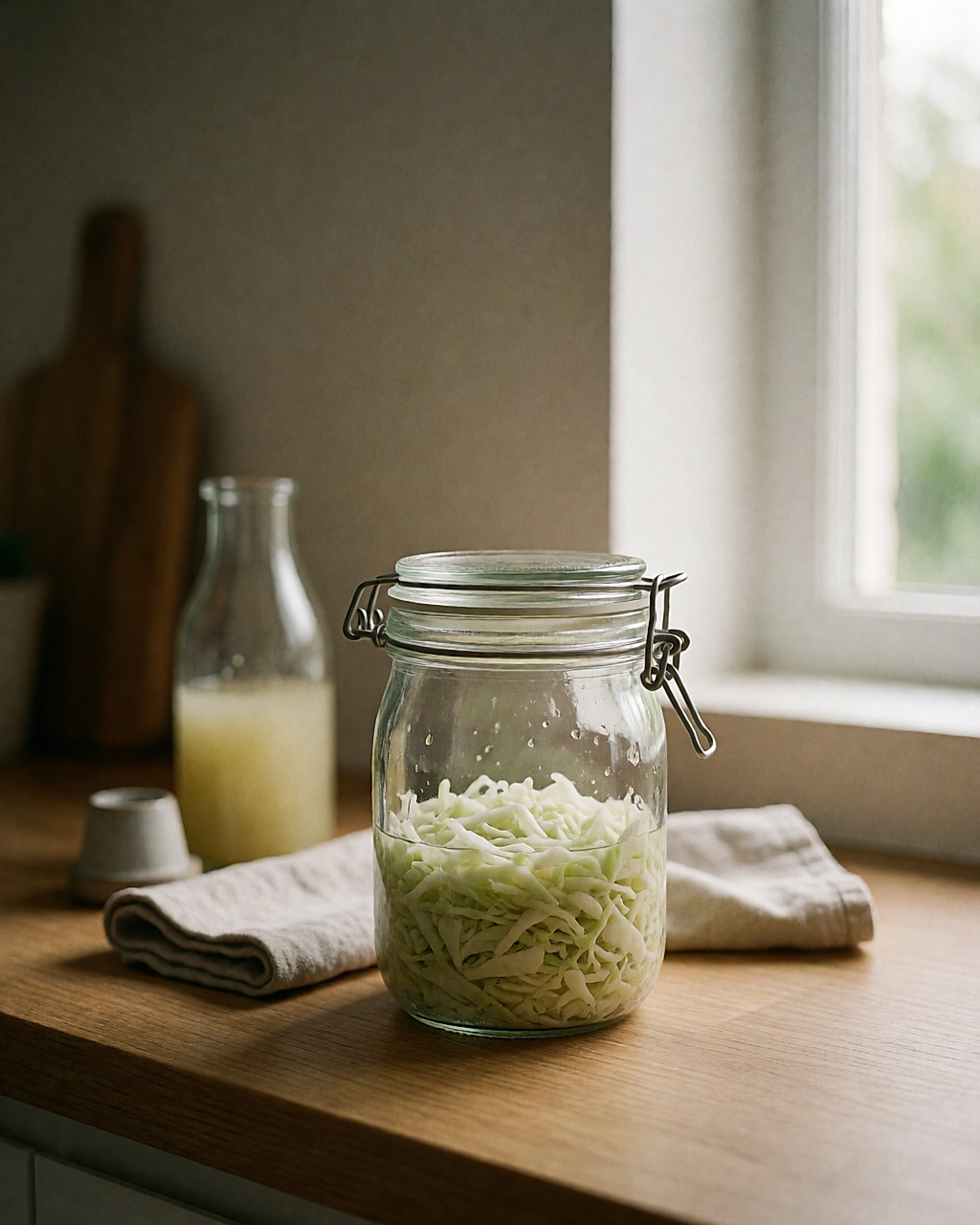
The jar: thick glass, supple seal, firm closure
A glass jar with a rubber seal and a clamp lid — the classic Kilner jar and its cousins — remains the best starting point. Before buying, check three things: the glass is thick and free from chips, the seal is supple and not cracked, and the lid sits flush without you having to force it. A hard or split seal no longer does its job, air gets in, and fermentation becomes unpredictable.

For sauerkraut and kimchi, a jar with an airlock does the same job in a more controlled way: gas escapes, air doesn't get in. It isn't essential, but it reduces mishaps. We like the idea of equipment that forgives: glass, after all, doesn't warp with age.
Useful size: 0.5 to 1 litre to start
For a first batch, 0.5 or 1 litre is plenty. There's little to lose if it goes wrong, and it fits in the fridge without taking over a whole shelf. Keep one simple rule: fill only three-quarters full. Cabbage and vegetables release water, the ferment produces gas, and an overfull jar will overflow onto your worktop or push liquid out past the lid.

Storage-wise, a half-litre jar slips into the fridge door without a fight for space. In other words, start small and scale up the number of jars later.
Weights: the bit everyone forgets
Vegetables need to stay submerged under their brine. A ceramic or glass fermentation weight, placed on a disc that lets the liquid through, solves the problem. If you don't have one, improvise: a small upside-down saucer, a ramekin filled with water, a freezer bag filled with brine. But no stone picked up from the garden — you can't control what it's carrying.

A vegetable that floats to the surface is a vegetable that oxidises and takes on dubious colours. So weighting isn't a perfectionist's accessory: it's what keeps the fermentation clean.
Salt, temperature, labels: the three things to keep track of
In practice, non-iodised salt with no additives is often recommended: iodine and some anti-caking agents could slow down the action of ferments. The most common ratio is 2% of the weight of the vegetables, or about 20 g of salt per 1 kg of cabbage. Weigh it rather than eyeballing it: a brine that's too weak is a risk factor for unwanted growth.
Temperature-wise, the comfort zone for lactic fermentation is around 18 to 22 °C. Above that, it races ahead and the flavour turns harsh; below 15 °C, it stalls. A simple room thermometer next to the jar gives you the information, and written notes beat an approximate memory. It may be the least glamorous step of the lot, but it's the one that will save you weeks of guesswork.
Add labels: date jarred, weight, salt, recipe. Without them, there's no way to know whether your jar is three days or three weeks old.
Pitfalls to know about
Surface mould that is fuzzy and coloured (green, black, blue, orange) means throwing out the whole jar: you don't just skim it off. A thin, smooth white film, however, can be a completely normal yeast. If in doubt, throw it out and start again — a jar costs less than food poisoning.
Direct light next: store your jars away from it, as it degrades colour and flavour. For utensils, forget aluminium, iron and untreated wood. Stainless steel, glass or food-grade plastic, nothing else.
Poorly controlled anaerobic fermentation, particularly with low-acid vegetables or home preserves, carries a rare but serious risk: botulism. Never taste a doubtful jar (bulging lid, rancid smell, slimy liquid). If you develop vision problems, difficulty swallowing or a dry mouth in the hours or days after eating it, call 999 or NHS 111 immediately and tell them what you ate. Diagnosis is made by a professional, never by reading a forum.
Timings and storage
Allow one to four weeks for sauerkraut, three to seven days at room temperature then in the fridge for kimchi, and two to four days for fruit kefir. Follow the recipe you've chosen rather than your memory.
Rinsing the jar and utensils with boiling water just before use reduces the starting microbial load: it doesn't replace canning sterilisation, but it's genuine prevention. Once the jar is opened, put it in the fridge and eat within the following weeks.
Budget
Good news: you can do very well without a marketing kit.
- Glass jar with a seal, 0.5–1 L: £4–10 each; £1–3 at a car boot sale if you check the seal.
- Airlock lid or valve jar: £13–26.
- Fermentation weight (ceramic or glass): £7–13, or £0 with a repurposed saucer.
- Non-iodised salt, 1 kg: £1–3.
- Room thermometer: £4–13.
- Funnel and labels: £4–9 for the set.
A complete starter kit therefore costs around £35–70 new, and £13–30 if you hunt down second-hand jars. Prices vary by city, capacity and glass quality.
Where to find them: hardware shops and household goods stores for jars and salt, health food shops and refill stores for non-iodised salt and cabbage, garden centres in the preserving section, charity shops and car boot sales for glass. Online, compare the price per litre and check whether replacement seals are sold individually: a jar whose seal can't be replaced is a single-use jar.
Sources
- Santé publique France — botulism surveillance and food hygiene
- ANSES — foodborne botulism and salt consumption guidelines
- Institut Pasteur, National Reference Centre for Anaerobic Bacteria and Botulism — botulism fact sheet
- EFSA — assessments on fermented foods and microbiological safety



Comments
Your opinion matters: rate the article, react and reply to comments.
Comments are moderated; AI-assisted comments are flagged. Text emoticons (8-), :-), <3…) are automatically shown as images.