
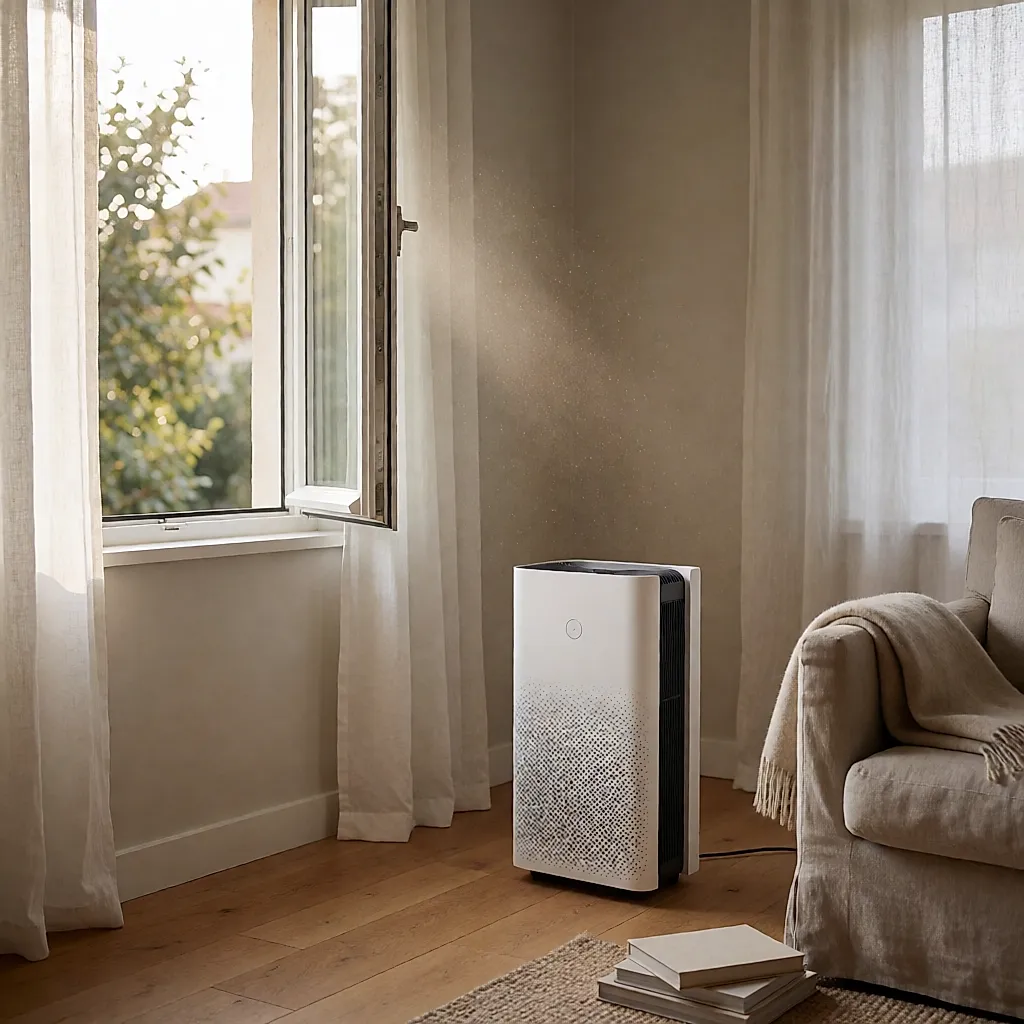
Gaseous pollutants — volatile organic compounds (VOCs) released by some furniture, paints or household products, plus moisture and carbon dioxide — are mainly cleared by air exchange; some activated carbon filters can adsorb some VOCs and odours, with variable effectiveness. CO2 and moisture, however, need ventilation.
In practice, remember this: open windows wide for at least 10 minutes a day, and more often if you can — no filter will do it for you. An air purifier is an extra, for days when you would rather keep windows closed — pollen peaks, background pollution, a noisy street. And if breathing discomfort sets in (a cough that lingers, waking at night, wheezing), that is something to discuss with a healthcare professional, not something to solve in a shop aisle.
The room first, the machine second
Simple question, useful answer: how many square metres is your living room? Everything starts there. Compact units, placed on a chest of drawers, are aimed at a bedroom or home office; taller, more powerful towers are designed for a living room. Too big, and the machine hums for nothing; too small, and it will not renew enough air for the room it has been given.
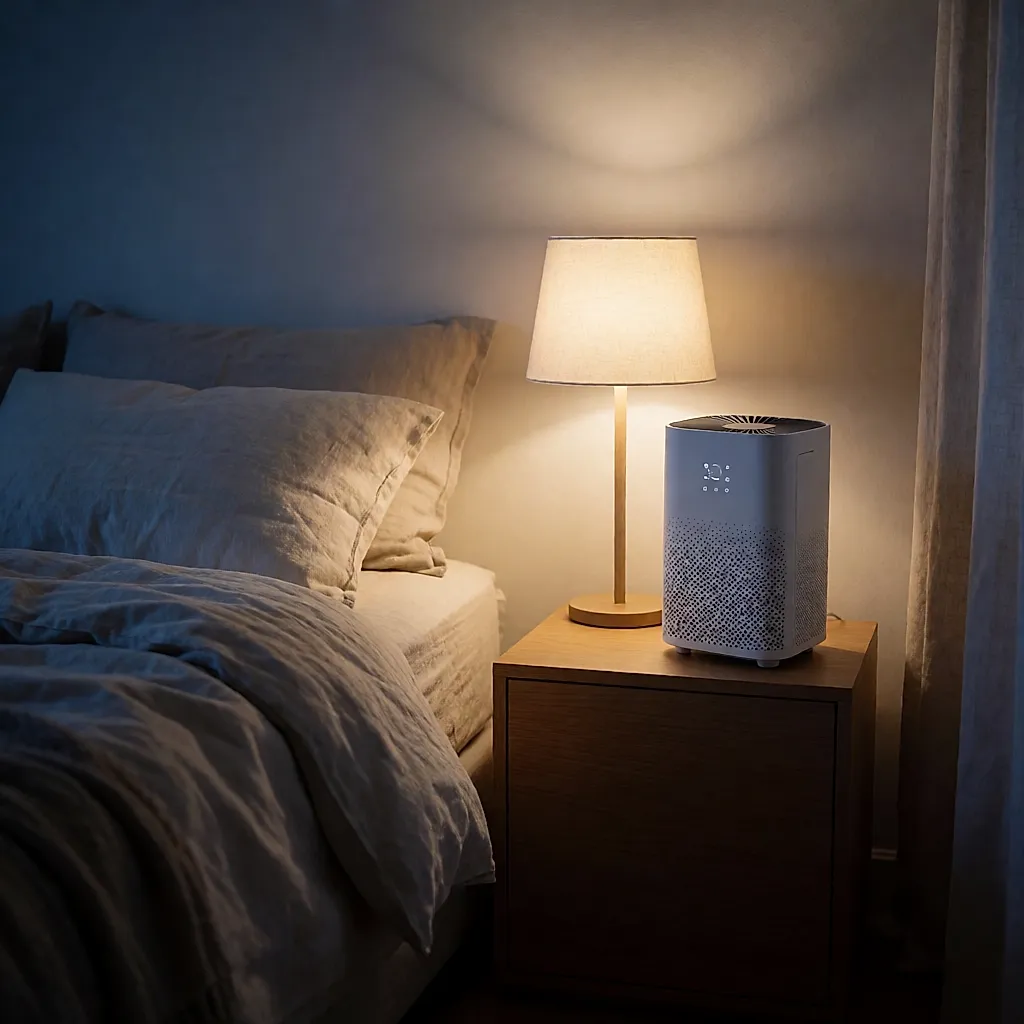
Two figures to check before you look at the colour of the casing. The airflow rate, often given in cubic metres per hour: in practice, you want a machine able to treat the room's volume several times an hour — a common-sense guide, not an official standard. Then noise, which really decides the machine's fate: a model that is too loud ends up switched off in a corner, and that is money sitting idle. For a bedroom, look at the quoted figure on low speed — around 30 decibels, and you might manage to sleep next to it — and check that it has a night mode. That is often the number that matters most.
Filters are where the real cost lies
This is where the real difference lies, far more than in the design. Most machines combine a pre-filter — which catches hair, dust and pet fur — with a HEPA filter, which traps the finest particles. A washable pre-filter changes the equation: rinse it under water, it goes back in, and it eases the load on the next filter. A HEPA filter cannot be washed: putting it under water damages its fibres, so it has to be replaced.
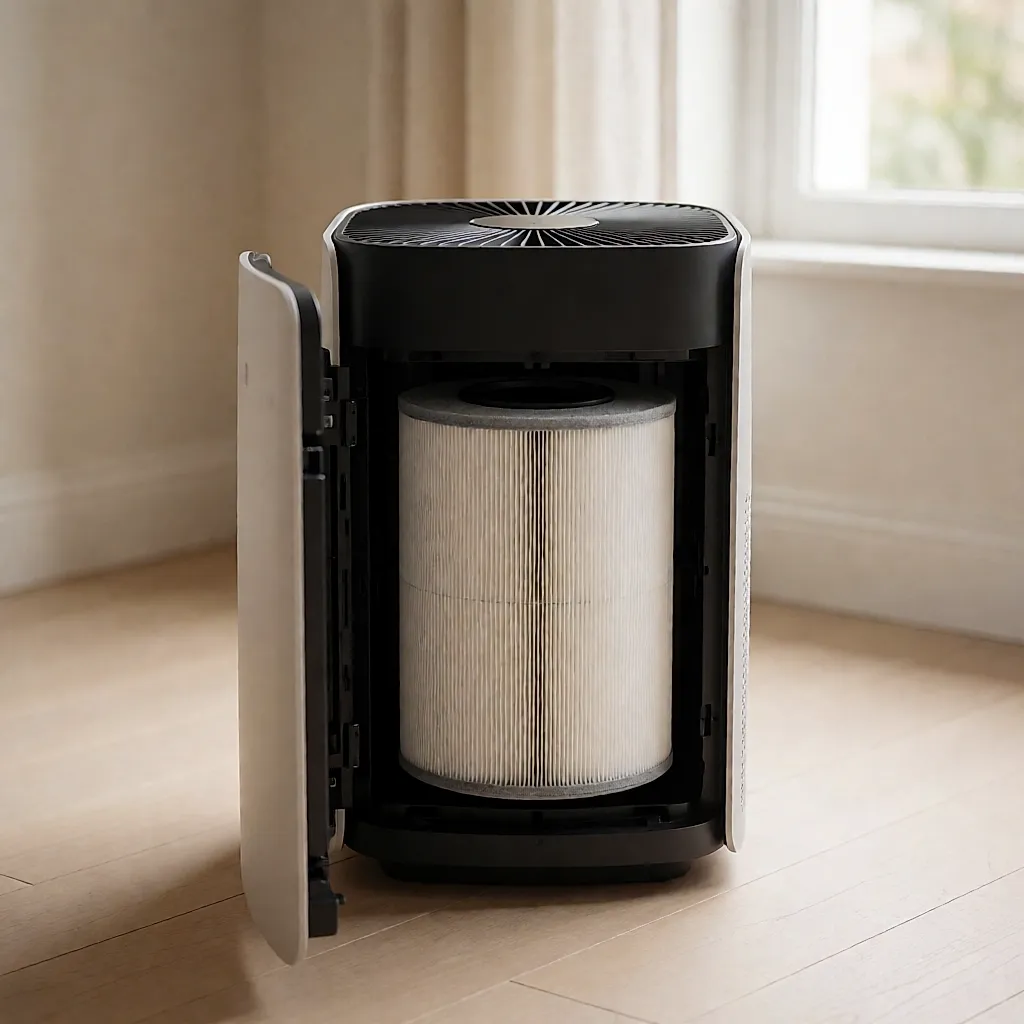
Replacement frequency is stated by the manufacturer; it depends on pollution, pets and smoking. Three questions to ask before paying: are the filters sold individually? At what price? Will spare parts still be available in three years? A machine whose filters disappear from the catalogue becomes a pretty box humming away for nothing — and that is where the budget goes off track. Be wary, too, of machines that emit something, ozone or fragrance: their benefit for respiratory health is not established.
Ventilate first, filter second. Open windows wide for at least 10 minutes a day, and more often if you can, even when it is cold — prioritise bedrooms, living rooms and kitchens. Never block vents or window trickle vents, and clean them regularly. An air purifier complements this, it does not replace it.
Budget
As a rough guide, expect to pay around £100 for a compact bedroom model, and £250 to £450 for a living-room tower. The ticket price is only part of the bill: replacement filters are bought separately, at the frequency stated by the manufacturer — often once a year — and cost tens of pounds depending on the model. A washable pre-filter, by contrast, costs nothing to use.
These machines are sold in DIY and electrical retailers, in pharmacies for compact models, and online. If buying second-hand, one habit: check before you buy that the brand still sells the matching filters, otherwise the deal is less good than it looked.
A well-chosen machine will not do the work for you: it supports something you are already doing. So, before comparing airflow rates and decibels, open a window. A few minutes, and the house breathes — the rest can wait until tomorrow.
Sources
- UK Health Security Agency — indoor air quality
- NICE — indoor air quality at home
Food supplements do not replace a varied, balanced diet and a healthy lifestyle.

Comments
Your opinion matters: rate the article, react and reply to comments.
Comments are moderated; AI-assisted comments are flagged. Text emoticons (8-), :-), <3…) are automatically shown as images.