
5 resolutions for a greener everyday life
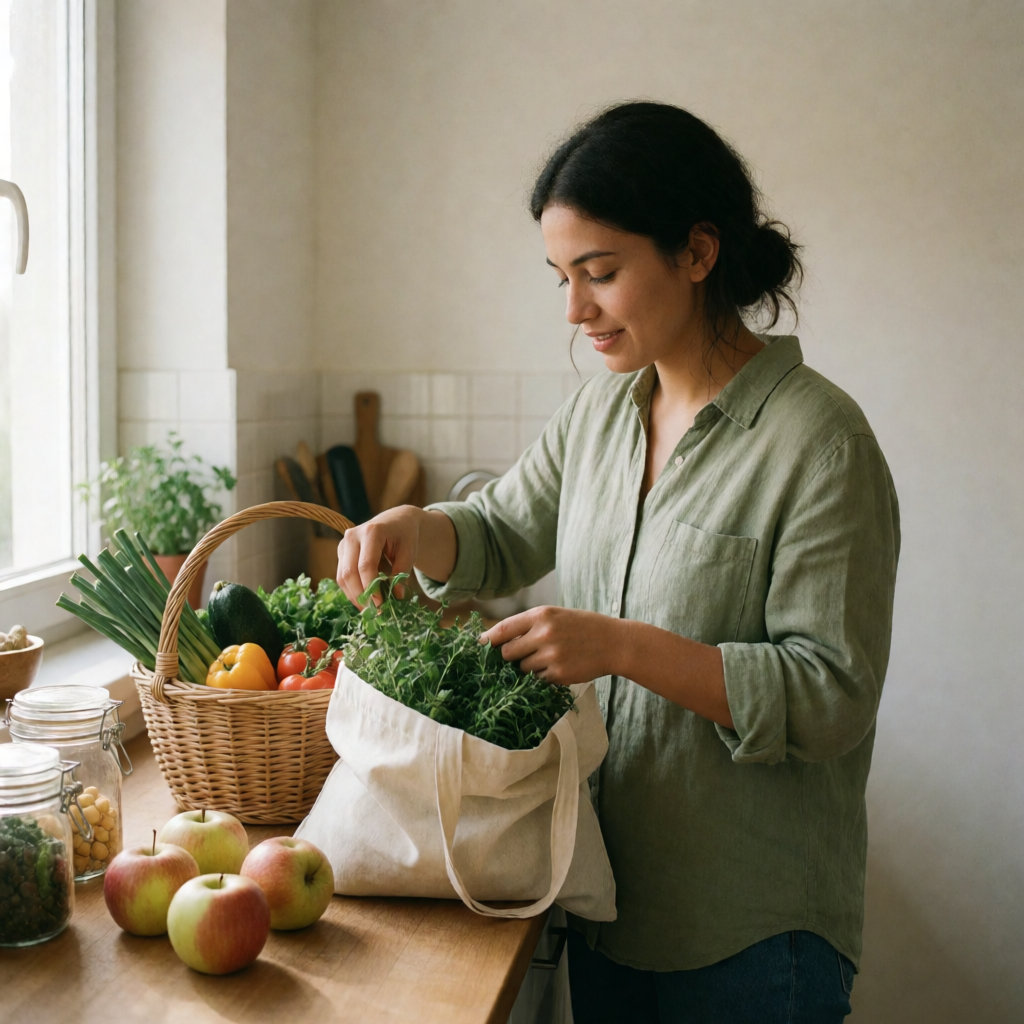
The shopping basket is on the worktop, and you hesitate. Is the organic apple at £2.50 a kilo really worth it when the one next to it costs half as much? We've all had that moment when we'd like to do something for the planet, without knowing where to start. The good news is that there's no big ecological reckoning to prepare, just habits to shift gently. Here are five, to pick according to your life, your desires and your budget.
Filling your basket differently
Eating organic doesn't make anyone invincible, and no plate protects you from everything, let's say that straight away. What current data suggest is something else: foods from organic farming contain significantly fewer residues of synthetic pesticides. The NutriNet-Santé cohort, run by Inserm, points in the same direction, with lower exposure among people who eat a lot of it. However, the effect of these exposures on long-term health is still being studied — no conclusions can be drawn, and no one can draw them for you.
So how do you do it without breaking the bank? Start with what you eat with the skin on — apples, tomatoes, salad, fresh herbs — that's where the difference is most direct. A veg box scheme or farmers' market basket also means less packaging, seasonal produce and often better taste. And don't forget the basics: cooking from scratch remains the simplest preventive habit there is. You know exactly what's in it.

Grow something, however small
No garden? It doesn't matter. A windowsill is enough for thyme, rosemary, mint or chives. These herbs flavour your cooking and their small flowers feed pollinators, whose decline is documented by INRAE and the French Office for Biodiversity. A few pots on a balcony, and you have a mini refuge for bees and butterflies!
For care, three habits are enough and they are fairly simple: mulch to reduce watering, collected rainwater, and hand-weeding rather than pesticides. There really is no space too small to have an effect. A mint planter on a corner balcony is already a step.

Cotton, bamboo and labels: making sense of it all
On the wardrobe front, it's easy to get lost. Certified organic cotton GOTS guarantees farming without GMOs or synthetic pesticides and sets standards for working conditions. Note that the OEKO-TEX Standard 100 label says something quite different: it covers undesirable substances in the finished textile. Two different benchmarks, often confused — next time you read 'organic cotton OEKO-TEX' on a label, you'll know how to tell them apart.
A word too about bamboo, often sold as the eco fibre par excellence. It frequently ends up as viscose, chemically processed, which rather weakens the argument. The most effective move lies elsewhere: wearing what you buy for a long time. Second-hand, repair, textile recycling banks — a garment kept for three more years has less impact than a 'green' piece forgotten at the back of a wardrobe. It's a little counter-intuitive, but that's where the real difference lies.

The bathroom: the job we overestimate
Making your own cosmetics is appealing, but it's not without risk. A preparation that contains water and no preservative quickly becomes a favourable environment for micro-organisms. As for essential oils, France's ANSES reminds us that they can be irritating, allergenic or photosensitising: they are not neutral ingredients, and mixing them blindly is not without risk.
The simplest route can be summed up in one sentence: fewer products, better chosen. Solid soap and shampoo, refills, glass containers, formulas certified Cosmos Organic or Ecocert — these markers help you sort without breaking the bank. Keep the essentials, lighten the rest, and if redness, tingling or a reaction that lasts appears, stop using the product and speak to a healthcare professional. Skin is not a testing ground.
And what about travel?
According to France's ADEME, on a trip, transport — and planes in particular — accounts for most of the carbon footprint. Before confirming a booking, one simple question: would the train do the job? Night trains have reopened several European routes, and going less far but for longer often changes the whole pleasure of travel. You come home less tired, you discover more, and the weekend gains depth.
Want to try making your own? Work on a clean surface, with well-washed utensils, in small quantities, and write the date on the jar. Avoid essential oils during pregnancy, breastfeeding and for young children, and always do a patch test on a small area of skin before applying.
Budget
A veg box or short-supply-chain vegetable basket often costs around £13 to £26 per week, depending on size and region; in supermarkets, organic remains a little more expensive than conventional. On the wardrobe side, second-hand starts at a few pounds, while a new certified piece is more like £26 to £78. For the bathroom, budget around £4 to £13 for a solid cosmetic and £9 to £30 for a certified cream. Train travel depends mostly on the date: booking early and comparing railcards really brings the cost down. Markets, veg box schemes, charity shops, health food shops, beauty retailers and official brand websites remain the most reliable places to buy.
Sources
- Inserm — NutriNet-Santé cohort: diet and pesticide exposure
- ANSES — Essential oils and cosmetic safety
- Santé publique France — Diet and physical activity recommendations
- ADEME — Environmental impact of transport and tourism
- INRAE — Pollinator decline
- Office français de la biodiversité — Pollinator monitoring
- GOTS — Organic textile certification standard
- OEKO-TEX — Standard 100: undesirable substances in finished textiles
- Refashion — French textile repair and recycling scheme



Comments
Your opinion matters: rate the article, react and reply to comments.
Comments are moderated; AI-assisted comments are flagged. Text emoticons (8-), :-), <3…) are automatically shown as images.