

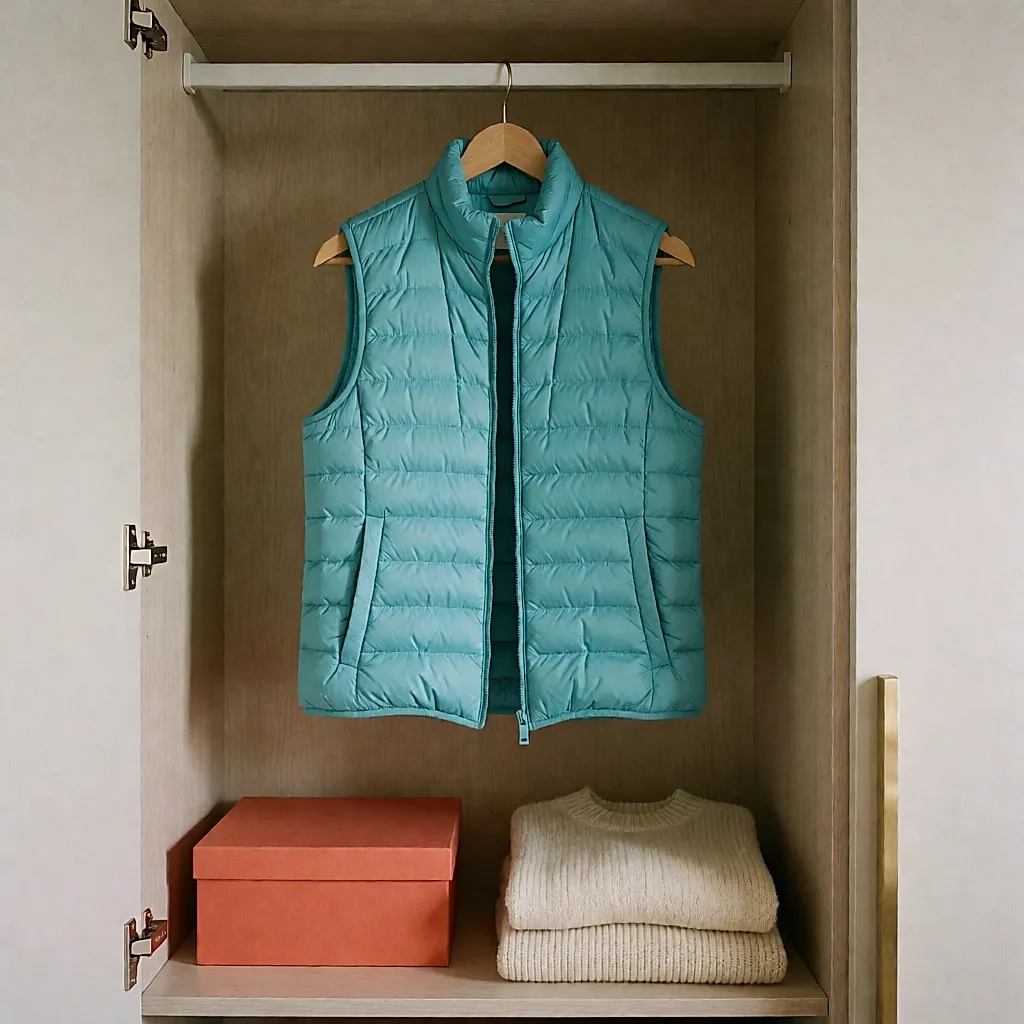
A thin down gilet under a coat isn't a chunky jumper in a lighter version: it's a layer that has to leave room for your arms. What matters is the order you put things on, how much space the armhole gives you and how much you spend on it. Warmth itself isn't up for debate — but warmth alone won't help you choose.
The order of the layers under your coat
Layering order does more than fabric. Under a close-fitting coat, start with a fine base layer — a tee, a blouse, a fine knit — add the down gilet, then do the coat up. In that order the space goes to your arms rather than to bulk: a thick jumper eats into the width of the sleeves, stops you crossing your arms and turns fastening your belt into a flexibility test. A thin gilet leaves you room to move without feeling as though you've left the house in a shirt in midwinter.

It's also one of the most versatile pieces in a winter wardrobe: worn open over a blouse in October, zipped up under a coat in January, folded into a bag for a weekend when you've no idea what the weather will do. And that's where it earns its keep — folded, it takes up about as much room as a scarf. One caveat: it isn't a coat, it's a mid-layer. Below zero, a thin down gilet under a light trench won't work wonders.
The armhole test
This is where everything is decided, and it's the detail we all forget to check in the changing room. A coat armhole that's too narrow doesn't look tight on the hanger; you feel it when you lift your arm to grab the handrail on the bus.

The three-step test, in the shop, with the coat on. Put on the gilet, then the coat, and fasten it all the way. Raise your arms straight up: if the shoulder pulls or the collar rides up into your neck, it's a no. Then cross your arms in front of you: if you feel pressure across the upper back, this layer is too much for this coat. Finally, slide your hand flat into the armhole under your armpit: your fingers should go in without a fight.
Three more things are worth a look. Length first: a gilet that pokes out below the coat breaks the line, and one that's too short rides up the moment you sit down. Sleeves next — a sleeveless gilet slips under anything, while a fine-sleeved version needs to stop short of the coat cuff, otherwise everything bunches up and rustles. And a last, thoroughly mundane point: some very smooth outer fabrics let the gilet slide around inside the coat, and there you are, putting the layer back in place every ten minutes.
What lightness actually costs
Expect to pay somewhere in the region of £30 to £60 for a thin gilet from a supermarket clothing line or a high-street fashion label: the filling is nearly always synthetic, the cut is decent, the lifespan varies. From around £80 to £150 you're into outdoor brands, where down starts to appear — you notice the difference in the loft and, often, in how fine the outer fabric is. Above £200 you're paying for traceable down, well-finished seams and a smarter cut that works as well in town as on a trail.
Where to look? Outdoor ranges for technical specs, fashion retailers for colour and close-fitting shapes, second-hand for premium down at half price — it's the kind of piece people sell on barely worn, so there are real finds to be had. One tip: read the label before you choose a style. Plenty of gilets sold as 'down' are filled with synthetic fibres; if that matters to you, check the actual down content and where it comes from.
What flattens, creases and washes badly
In fairness, this piece has its flaws. The filling packs down with repeated compression — a gilet stored bundled up all summer may bounce back after a few hours, but filling that's been squashed for years can lose its loft, and with it its warmth. Store it flat or on a hanger with room to spare, never crushed under a pile of jumpers.
Washing is the other tricky part: a gentle detergent, a delicate cycle, a long and often baffling dry. Follow the label to the letter; it's more reliable than any tutorial you find at midnight. And on the style front, fine outer fabric creases at the elbows, keeps the mark of your coat belt and comes out of an over-tight bag crumpled. This isn't the piece in your wardrobe that forgives everything.
So, does it replace the chunky jumper? For a fitted coat, an overheated office and a life spent on public transport, the thin gilet earns its place — and your reflection in a shop window will thank you. If your coat has a roomy armhole and you're facing real cold, keep the chunky jumper for Sundays at home and buy the gilet as an extra, without trying to cut corners on the layer that keeps you warm outdoors. The right call isn't one or the other, it's the order of the layers: a fine base, the gilet, the coat — and the chunky jumper when the armhole allows.



Comments
Your opinion matters: rate the article, react and reply to comments.
Comments are moderated; AI-assisted comments are flagged. Text emoticons (8-), :-), <3…) are automatically shown as images.