
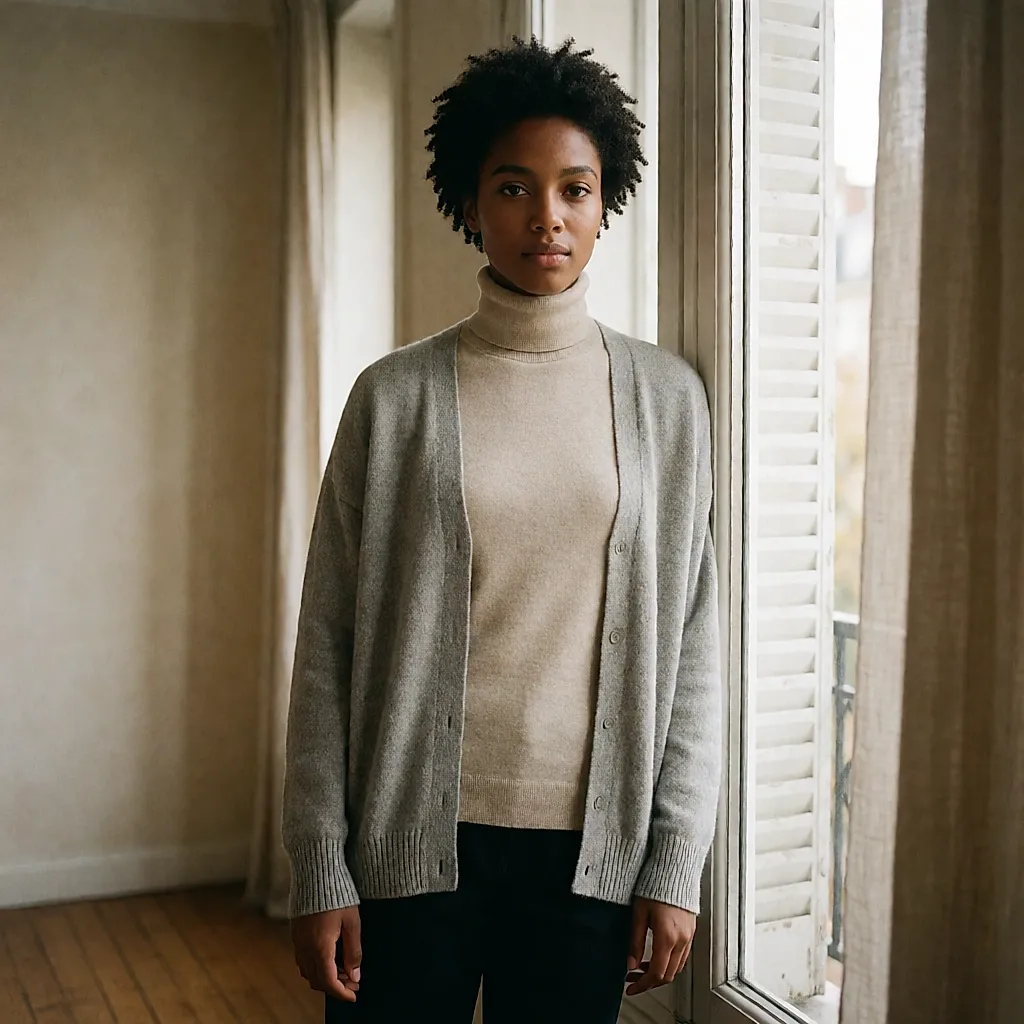
8am, 9°C, and you pull on the chunky cable-knit jumper that makes you look like you've stepped out of a Swiss chalet. 1pm, 19°C, the sun is blazing through the office windows, and that same jumper ends up rolled into a ball on your lap. You can't negotiate with the thermostat on an October day. What you can negotiate is how you dress for it.
The chunky knit trap
Let's give it its due: chunky knitwear has a lot going for it. The generous drape, the cables, the way it turns any old outfit into a Sunday-best look. We fall for it in September, wear it all winter, and then realise in October that it only really does one thing: keep you warm. Very warm.
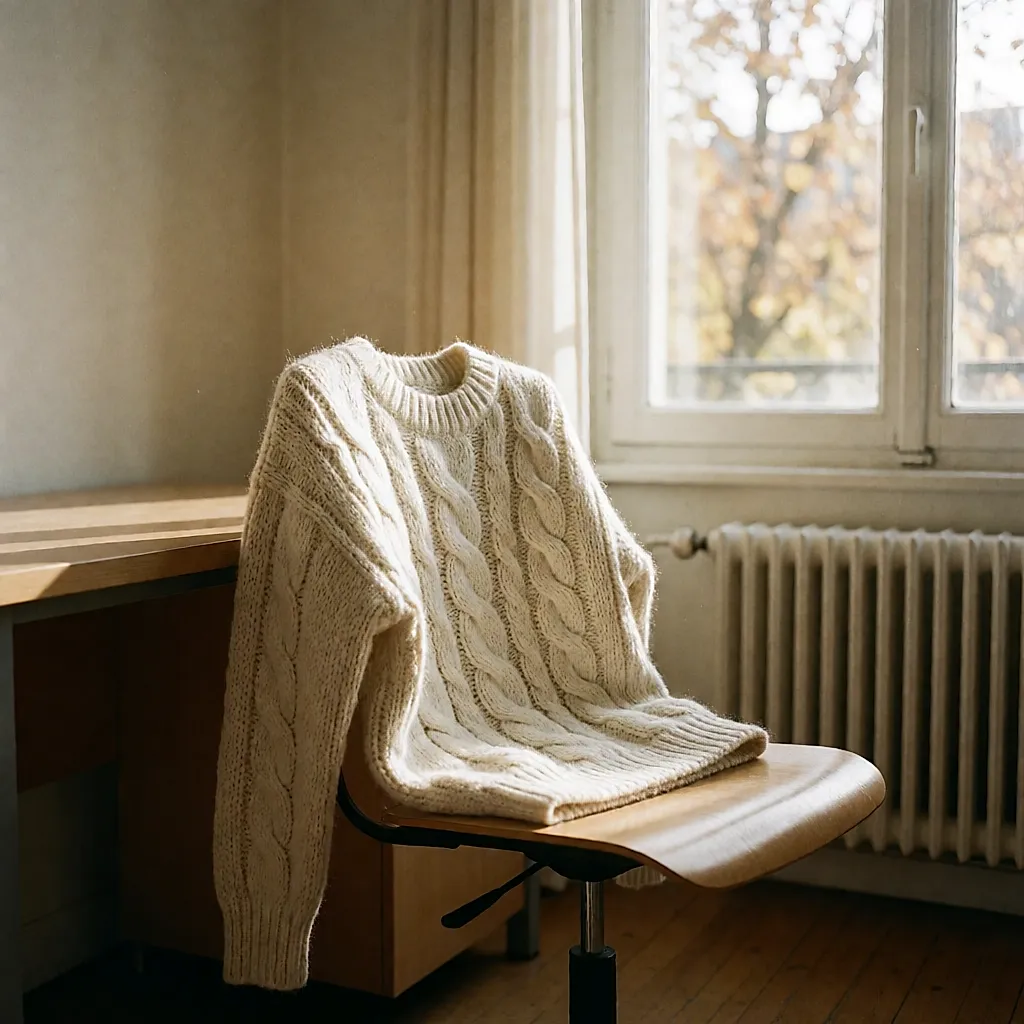
In a heated flat, a packed Tube carriage, an open-plan office where the radiator is going full blast, a single layer has no way to adapt. It has no half-speed. Too hot by early afternoon, never warm enough by late evening: the chunky jumper is a great companion in January, but a poor negotiator of mid-season. And if you end up carrying it around for part of the day, it becomes as bulky as a coat.
It's the air that insulates, not the thickness
One principle is worth more than a long explanation: what keeps you warm isn't the wool itself, but the still air trapped between the stitches. Layering two fine knits multiplies those air pockets, and gives you an adjustable system that chunky knitwear can't offer. You add the second layer when you leave the Tube, take it off at midday, put it back on at 7pm. The word to remember is layering, and there's nothing mysterious about it: a fine base layer, a mid layer, a light outer layer.
In practice? A merino wool base, thin enough not to add bulk under a jumper. Over that, a fine round-neck jumper, a soft shirt or a light wool cardigan. Outdoors, a windproof jacket, even a thin one, is often enough in October and November as long as the rain is light. Three pieces, only one layer on your shoulders at a time, and a silhouette that follows the day instead of fighting it.
Two layers, not two sizes up
Layering has one enemy: volume in the wrong place. The rule that saves your silhouette comes down to one sentence — the first layer should sit close to the body without being tight, the second should breathe. A fine turtleneck under an open shirt, a wool camisole under a slightly oversize jumper, and the eye reads a considered silhouette rather than a pile of clothes.

The rest is about drape. A fine knit that hangs well makes more of an impression than a thick knit that bunches: straight cuts, clean shoulders, and lengths staggered by a few centimetres when the top layer is shorter than the one underneath.
Two honest caveats, because there's no universal recipe. If you feel the cold deeply, two fine knits won't replace a proper chunky jumper outside in January: they're made for mid-season, heated interiors and days with two different climates. And if layering makes you feel bulky or restricted, one well-chosen fine layer is better than a forced pile of layers.
Budget
On the price front, a decent-quality fine knit in merino wool usually costs somewhere between £40 and £120 on the high street. For cashmere, expect to pay from around £100 for the simplest styles, and considerably more from specialist brands. Recycled wool and small knitwear labels often sit in the same range as merino.
Second-hand, you can find a fine knit for between £10 and £40 in charity shops, and more on resale platforms if it's a sought-after brand. So where to look: mid-range high-street stores, specialist knitwear brands, charity shops, resale sites — and end-of-season sales, with January and February being prime time for bargains. Before you pay, read the composition label and check the proportion of synthetic fibres — some of them, or certain blends, can encourage pilling and wear. Labels such as RWS (animal welfare and pasture management) or GOTS for organic cotton give you some pointers, provided you look carefully at what they actually cover.
The keepers
The real mid-season bargain isn't a purchase: it's making what you already have in your wardrobe work harder. The summer shirt under a fine jumper, the cotton dress under a light knit, the organic cotton T-shirt promoted to base layer — half the solution is already there, folded on the shelf.
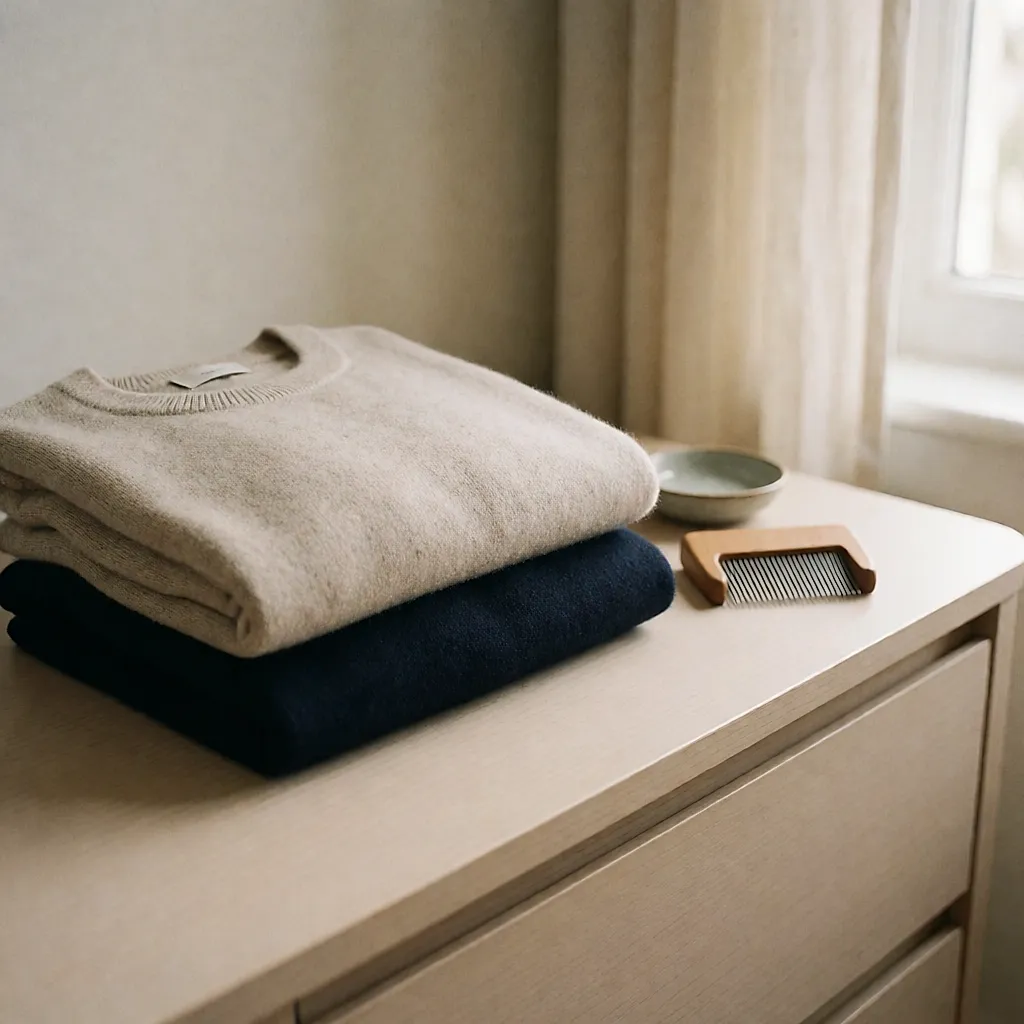
To make these layers last, a few habits are enough. Wash less, air often, fold instead of hanging (a hanger distorts the shoulders of a knit), and keep a de-pilling comb in the drawer. A small hole can be darned in ten minutes, and a mended knit is a knit that stays.
The three-layer rule, mid-season version: a fine base layer close to the body, a light mid layer, a windproof outer layer. In the morning, wear all three; at midday, remove the middle one. So plan a bag that can hold it — that's the truly essential accessory for layering.
So, that chunky jumper? Keep it. It has its season, its Sundays, its trips back from the market. But for those October days that start at 9°C and end at 19°C, try two fine knits: you'll quickly get into the habit of adding and removing a layer. And in the evening, when the temperature drops, you'll be glad you didn't put all your eggs in one basket.


Comments
Your opinion matters: rate the article, react and reply to comments.
Comments are moderated; AI-assisted comments are flagged. Text emoticons (8-), :-), <3…) are automatically shown as images.