
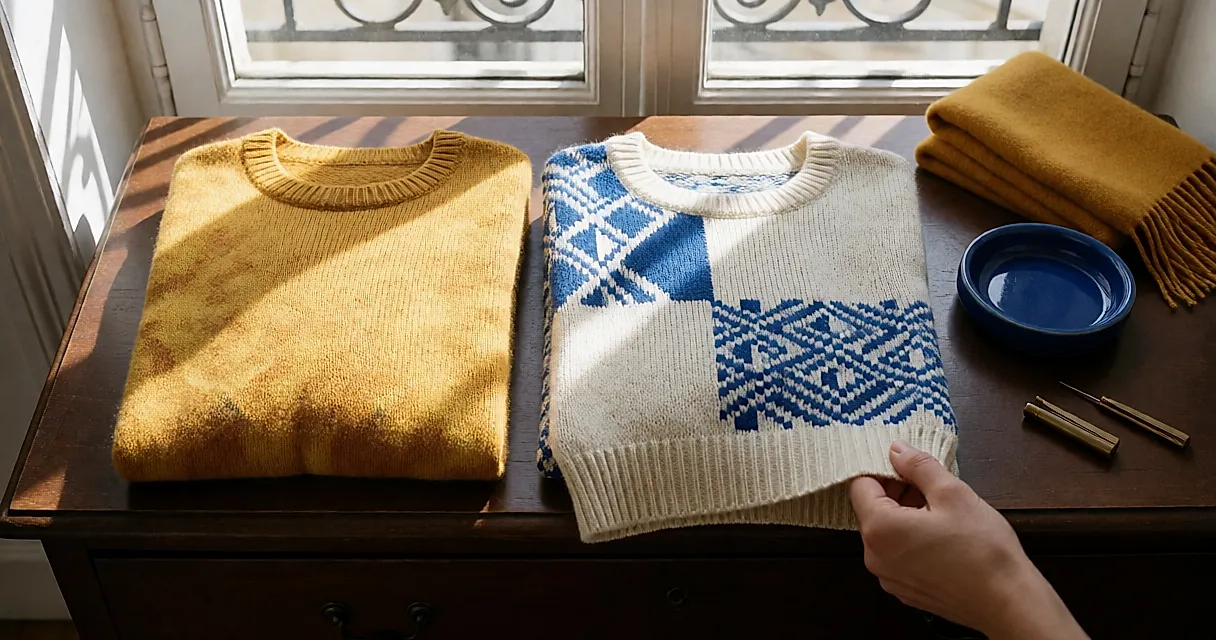
Turn the jumper inside out: on the reverse, a printed pattern leaves an almost smooth surface, sometimes with a faint plasticky film, whereas a knitted jacquard shows threads travelling from one colour to the next. You won't see the reverse while you're wearing it, yet it is what determines how the piece behaves in the wash, how it ages and how it hangs. So it is worth looking at a jumper the way you would inspect a seam: up close.
What the reverse tells you
A printed pattern sits on top of the knit: it lives on the surface. To the touch, the ink can make the printed area feel slightly stiff; on the reverse, you will often find the base colour, with no trace of the design. The print can be crisp and the colours bright, but it remains a film on the knit, not the knit itself. Does that matter? For a pattern you plan to wear for one season, no; for a jumper you want to keep, it is more debatable.
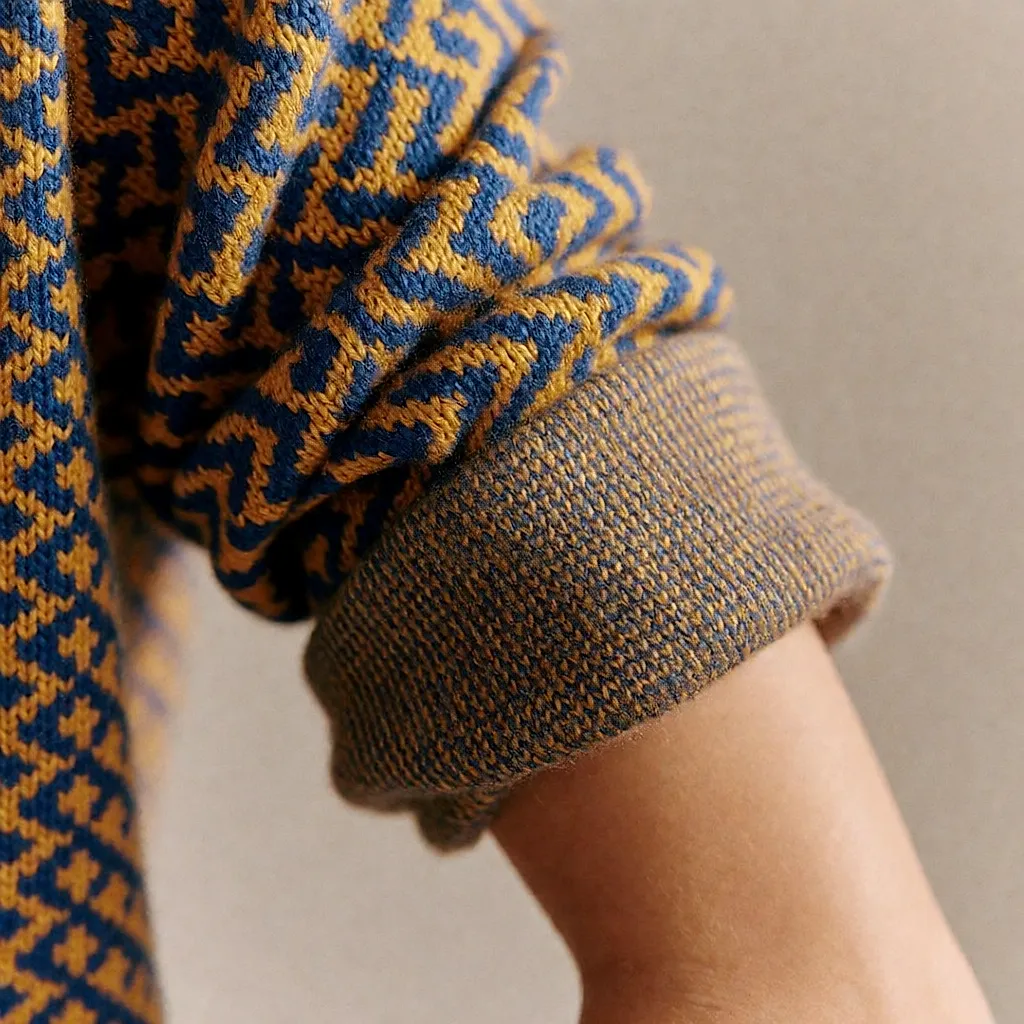
A knitted jacquard, by contrast, is built during knitting: yarns in several colours are knitted together to form the design. On the reverse, you see floats — the strands that carry the yarn across the back between colour blocks. They may be long or cut, depending on the technique. This network of threads is part of the pattern's charm and strength: the design will not flake away because it is part of the structure. The trade-off is that the reverse can catch if the floats are very long, and the knit is often less supple than a plain single-colour knit. A well-made jacquard has a neat reverse, with no loose loops or over-tight strands.
In the wash, two different lives
A printed pattern often survives the first few washes, then may start to show wear: fine cracks, colours that fade, a slightly drier feel. The ink remains an added layer, even if print quality changes the outcome. Should you avoid it altogether? No, but wash the piece inside out, on a cold cycle, and skip the tumble dryer. It is not a guarantee that it will last forever, just a way not to speed up wear.
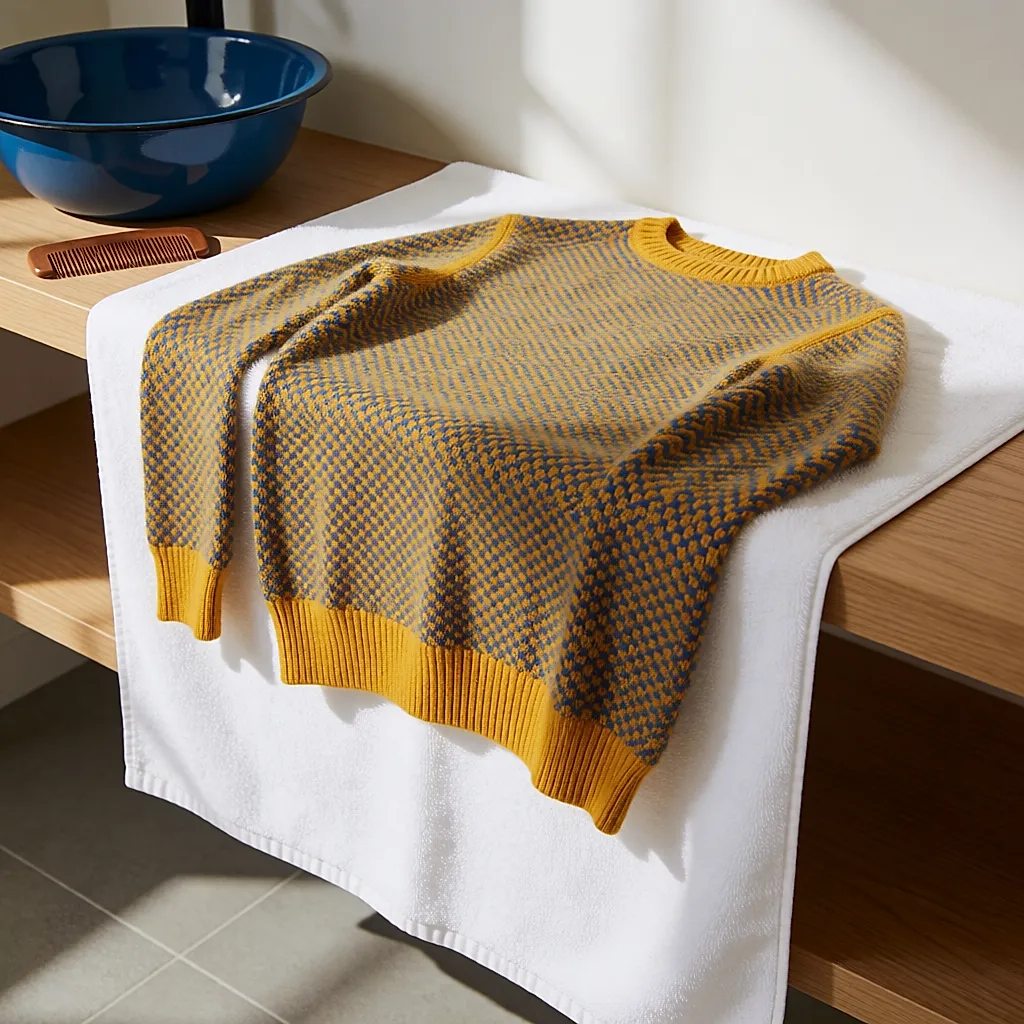
A knitted jacquard does not have the problem of a pattern that cracks. It does, however, dislike hot water and agitation: wool washed too vigorously can felt, and a thick jacquard can lose its softness or distort at the shoulders. So how do you wash it without felting it? Cold wash or wool cycle, gentle spin, dry flat, away from a radiator. If the jumper is merino or recycled wool, airing it between wears is often enough to space out washes. The piece then ages in the right way: it develops a patina, and its pattern does not peel away.
With a thick knit, check the shoulder drop
The thicker the jacquard, the less give the knit has. A sleeve set very close to the shoulder, with a neat armhole, can pull as soon as you raise your arms; the pattern distorts, the seam is put under strain and the jumper soon feels restrictive. Why does a dropped shoulder change that? Because a seam that sits lower on the upper arm gives a rigid piece some ease. The pattern stays straighter, you can fit a T-shirt underneath, and the silhouette keeps that cosy feel without being stifling.

Does a dropped shoulder suit every silhouette? No: it visually widens the line. If you want a close-fitting jumper or a very tailored look, it is not your best friend. With a thick jacquard, try it on with your arms raised, then sit down; check whether the shoulder rides up, whether the pattern blurs and whether the armhole gapes. And read the label: a high proportion of wool, organic cotton or knitted linen will feel more pleasant than a blend that itches. A small proportion of synthetic fibre can help the knit hold its shape, but keep it discreet.
In the fitting room, check that the floats are supple and not under tension: no strands pulled tight like rope. Then raise your arms and bend forward. If the pattern distorts or the shoulder pulls, going up a size will not always solve it — the cut is wrong.
What it costs
As a rough guide on the UK high street, expect to pay around £60 to £110 for a merino or recycled-wool jacquard. Prices vary with the fineness of the wool, the complexity of the pattern and where it is made; they fall at the end of the season and on the second-hand market. A thick pure-wool or extra-fine merino jumper can sit around £130 to £260.
If you are looking for a bargain, charity shops and vintage shops remain the best place to learn: £15 to £50 for a vintage jacquard, provided you check the reverse, the shoulders and any repairs. Online, read the composition before you look at the photo, and be wary of very crisp patterns on a very fine knit: sometimes that is a sign of a print. You can also look at knitwear brands that list where their fibres come from and offer repairs. A knitted jumper can be kept, mended and passed on — that is part of the better sum.
In the end, the real test is in your hands: a printed pattern is most obvious on the outside, while a knitted pattern owes its colours to the yarn itself. If the construction is neat and the shoulder falls in the right place, you have a piece that will see you through winters without missing a beat. And if you like the pattern as much as the knit itself, that is already a very good sign.


Comments
Your opinion matters: rate the article, react and reply to comments.
Comments are moderated; AI-assisted comments are flagged. Text emoticons (8-), :-), <3…) are automatically shown as images.