

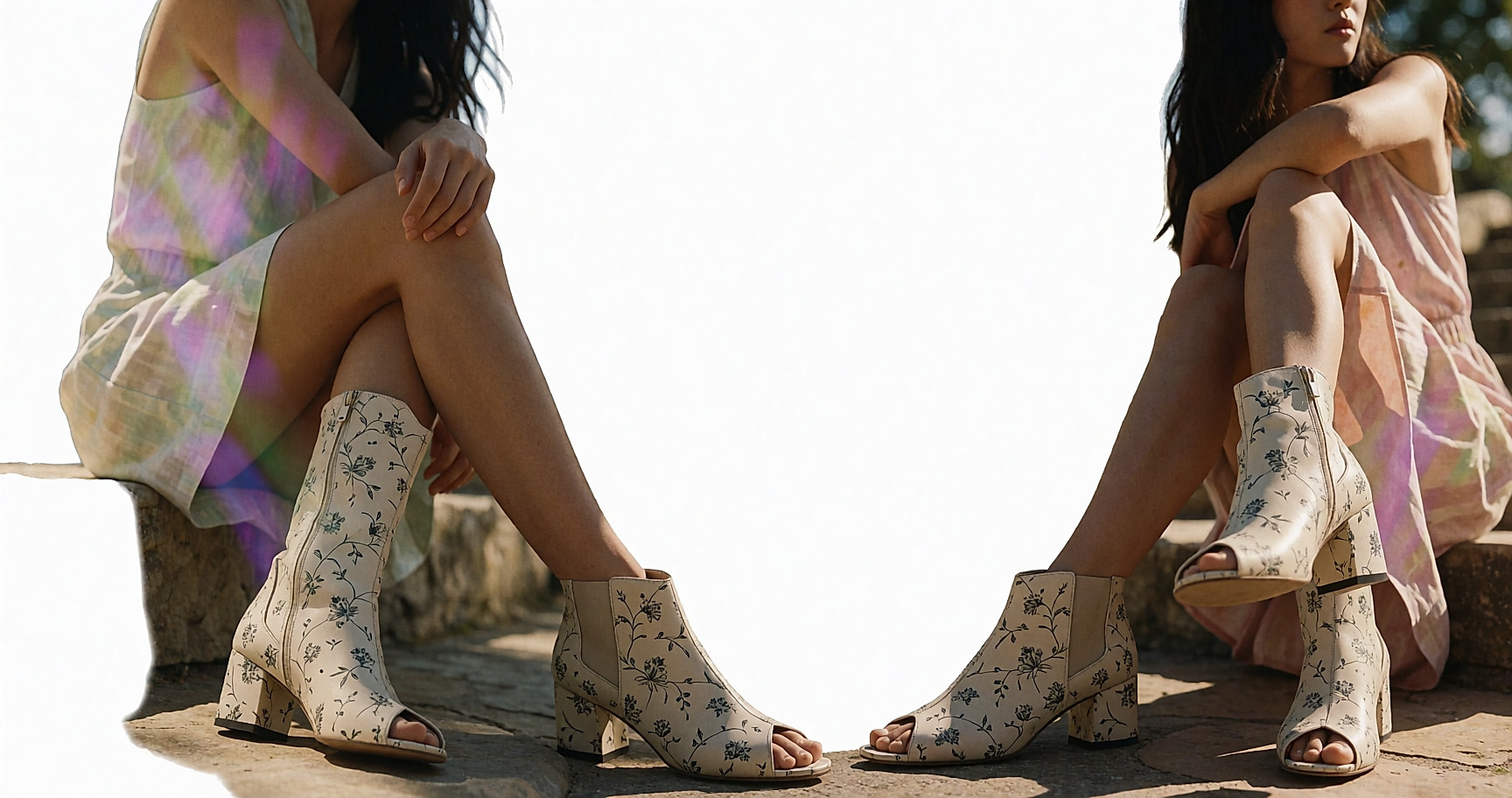
You'll have spotted them everywhere this summer: ankle boots that stop just above the ankle yet let a couple of toes breathe at the tip. The peep toe — literally "open at the toes" — is back in our wardrobes, and not only on those who live in sandals from May to September. Why the resurgence? Because the cut covers the ankle, frees the toe and reshapes the whole silhouette. And you don't need to wait for the sales to see the point.

Why peep-toe boots are back this summer
Born in the 1940s and 50s, made famous by pin-ups and later adopted on the catwalks, they've gone through several waves before returning today. Designers are bringing them back with lower heels, softer materials and graphic finishes. In truth, it's an easy-to-wear statement piece: it accessorises a head-to-toe look without the need for a single piece of jewellery. One open detail at the toe, and the whole look shifts.
How to choose: material, cut, fit
The open toe needs to sit right. Too tight, and it squeezes the toes; too loose, and the foot floats and your walk turns hesitant. On the material front, full-grain leather ages beautifully, suede marks more quickly, and vegan options are improving — though not all are equal, some remaining synthetic derivatives.

Look at the sole too: stitched, it can be repaired at the cobbler's; glued, it often ends up in the bin. The game-changer: choose a pair whose product page mentions vegetable tanning or Leather Working Group (LWG) certification for the tannery, European manufacturing and a stitched sole. If no credible equivalent exists within your budget, a conventional leather pair remains an acceptable compromise: it lasts longer than a cheap synthetic, but its impact depends on the tanning and the shipping.
What to wear them with
A mini dress works, but it's far from the only option. Wide-leg trousers with a clean hem, turned-up raw denim or a printed midi skirt create an interesting contrast with the open toe. Play with layering according to the weather: fine tights if it turns cooler, no-show socks, or nothing at all.
For a head-to-toe look, stay within one colour family and vary the textures: grained leather, knit, satin. And avoid piling on statement pieces — the boot already is one, it doesn't need competition.

Comfort: the real test
Walking in peep toes takes a bit of attention. The open toe rubs when the opening sits badly, and a pair that's too tight makes itself felt within the hour. Go half a size up if you have wide feet, and break the pair in gradually, over short distances. For evenings, pack a spare pair of flats: your look will thank you far more than plasters will.
Three tips before you buy
- Check that the open toe doesn't cut into your toes as you walk.
- Look at the heel height: 5 to 7 cm is enough to lengthen the leg without exhausting you.
- Choose a repairable sole or a brand that offers a cobbler service.

Budget
In the UK, expect around £35 to £70 for a pair in synthetic or reconstituted leather from a mainstream brand, £85 to £170 for full-grain leather or European manufacturing, and £170 to £300 and up for a designer label or a specific tanning. The price varies with the material, where it's made, the sole (glued or stitched) and the level of finish.
Where to find them: high street stores and online shops for smaller budgets, independent shoe shops and online brands for mid-range, second-hand (Vinted, Vestiaire Collective) and charity shops for pre-loved — a barely worn pair there often costs a fraction of the new price. Always check the returns policy and whether the pair can be repaired before you hit "buy".



Comments
Your opinion matters: rate the article, react and reply to comments.
Comments are moderated; AI-assisted comments are flagged. Text emoticons (8-), :-), <3…) are automatically shown as images.