

The dressmaker's tape measure that lives in the button tin, tangled up with odd buttons, is the best-value accessory for your next boot purchase. A calf measurement scribbled in the corner of a notebook can save you three trips to the changing room in unforgiving light, and a return to sort out before the deadline. A tall boot isn't chosen like a pair of trainers: it has to flatter the calf without squeezing it, and you – not the sales assistant, not the product page – know what you'll wear underneath. The sole can tell you whether a boot can be repaired, the colour whether you like it; the calf measurement tells you whether you'll actually wear it.
Three numbers to take standing up
The first measurement is the one we always forget: the calf circumference at its widest point. Stand with your feet flat and legs relaxed, wrap the tape around your calf, and read the number without pulling it tight. No tensed leg and no tape biting into the skin: you want the measurement of your leg at rest, the one that will be inside the boot on a Tuesday morning when you're running for the bus.

The second is quieter, and often the one that decides everything: the circumference just below the knee, exactly where the shaft will stop. A boot that clears the calf but compresses just below the knee leaves a mark – and it's the mark people see, not the elegant drape. Add the height from heel to the hollow of the knee: whether the boot stops below the knee, at mid-calf or lower changes the whole look, and the skirt you wear with it.
Your trousers are part of the measurement
A tall boot never lives alone: it shares space with jeans, chinos, leggings, thick tights. So take the measurement with what will go inside, or allow room for it – add 1–2cm for fairly rigid cotton jeans, less for leggings. It's the difference between a shaft you slide into and one you only get into by pulling on the zip while balanced on one foot.

And the try-on itself? Do it with those trousers, not the sales assistant's leggings. Pull the boot on, squat, climb three steps, sit down. Those movements reveal whether the shaft holds firm or gapes, far better than the shop mirror and its flattering lighting.
When the shaft holds, and when it leaves a mark
The whole judgment call is here: a slightly generous shaft often holds better than one that is exactly your measurement. It lets trousers through, settles on the calf and doesn't create the bulge above the knee you discover with horror in end-of-night photos. A shaft that's too tight forgives nothing. You often read that leather gives with wear; gaining several centimetres is another matter entirely.
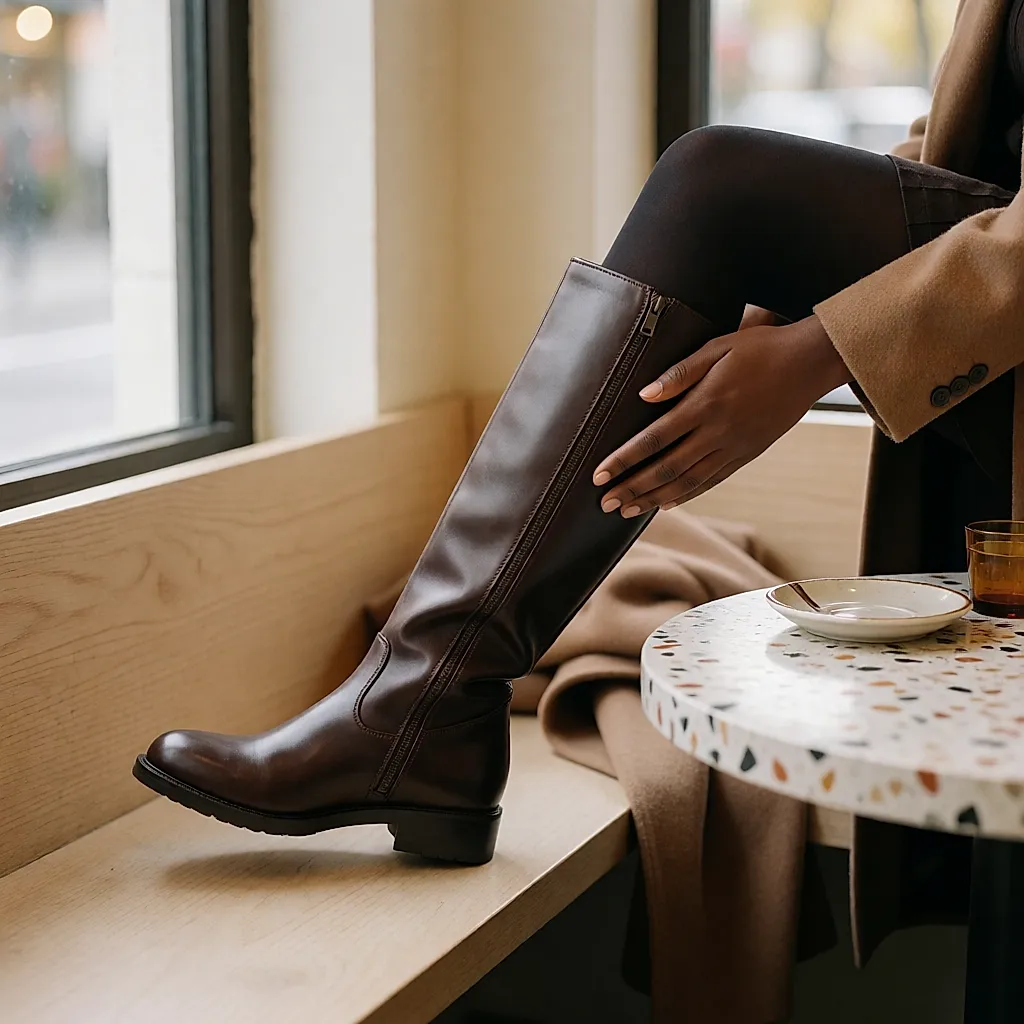
Look next at the details that change comfort: a zip running the full height rather than a half-zip, an elastic panel at the back, a shaped top that leaves the back of the knee free, a sole with good grip. And know who they won't suit: with a very full or very slim calf, standard styles can either float or squeeze – it's better to look for laced or elastic-panelled shapes, which are more forgiving, than to force a rigid shaft because the colour was perfect.
What to budget
Expect to pay around £80 to £180 for a leather pair from high-street chains or online, and around £220 to £400 at a specialist shoe shop or for vegetable-tanned leather where the brand documents its supply chain. Suede often falls between the two, with upkeep – a brush, a waterproofing spray – adding to the bill. And check the proportion of synthetic materials on the label: it can give a clue to how well the boots will wear and how easy they are to care for, but it isn't enough on its own – leather quality, construction and finishing matter just as much.
On alterations: roughly £25 to £55 to have a slightly wide shaft taken in by a cobbler, depending on where you live and the work involved. That's often less than a second pair, and far simpler than stretching – the reverse, widening a shaft that's too narrow, is delicate and sometimes impossible. One more reason to reach for the tape measure before you reach for your card.
The three-step check. Stand with your feet flat: calf circumference at its widest point, circumference just below the knee, height from heel to the hollow of the knee. Note the three numbers on your phone, along with the trousers you plan to try the boots with. In the changing room, ask for the shaft width the brand states and compare: it's a useful benchmark across different pairs.
A successful boot isn't the most photogenic one on the shelf; it's the one you pull on without thinking and keep for years. Take your measurements tonight, put the piece of paper in your bag, and the next changing room will feel like a formality. Your calf will thank you – and so will your credit limit.



Comments
Your opinion matters: rate the article, react and reply to comments.
Comments are moderated; AI-assisted comments are flagged. Text emoticons (8-), :-), <3…) are automatically shown as images.