
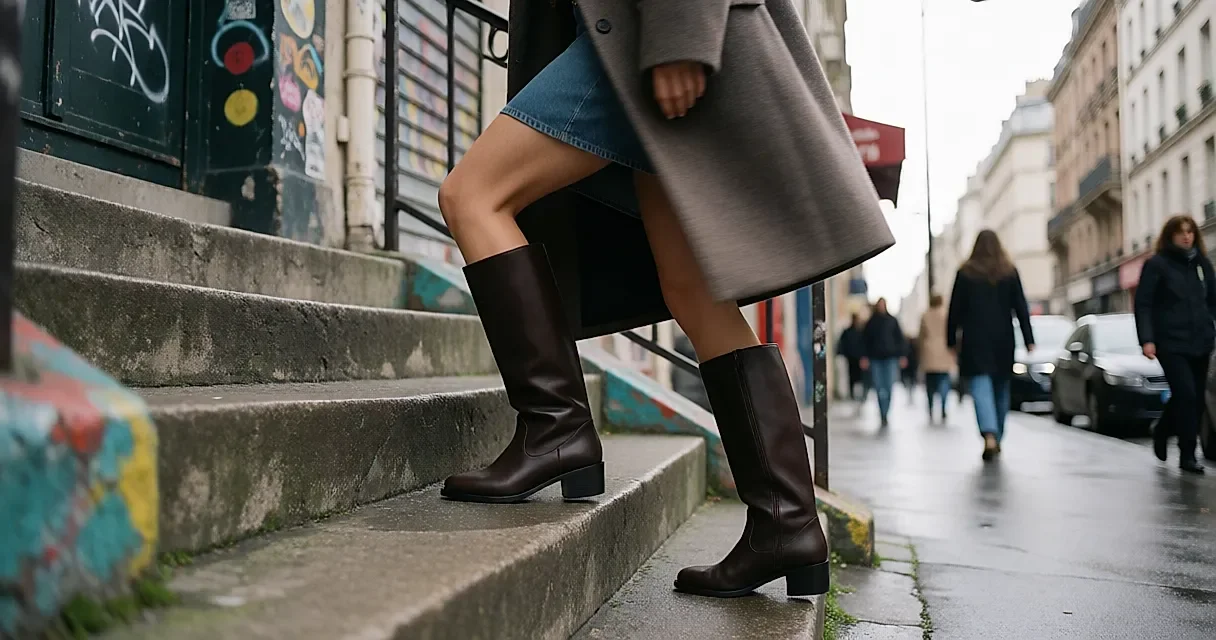
Two pairs of knee-high boots, same size, same calf measurement, same intention of keeping them for ten winters: one stays with you until the last Tube home, the other gives up on the first flight of steps. What separates them isn't printed on any label. It comes down to a spot nobody measures in the fitting room: the crease at the back of the knee, and how much room you leave it.
It all comes down to where the shaft stops
In the fitting room your eye travels down — ankle, instep, calf — and skips the one checkpoint that matters, just behind the leg, in the hollow. A shaft that ends right in the crease has no millimetre left to move with you: it pulls when you bend, gapes at the ankle or squeezes the calf. A shaft that stops too low breaks the line and rides up at the first step, which is no better.
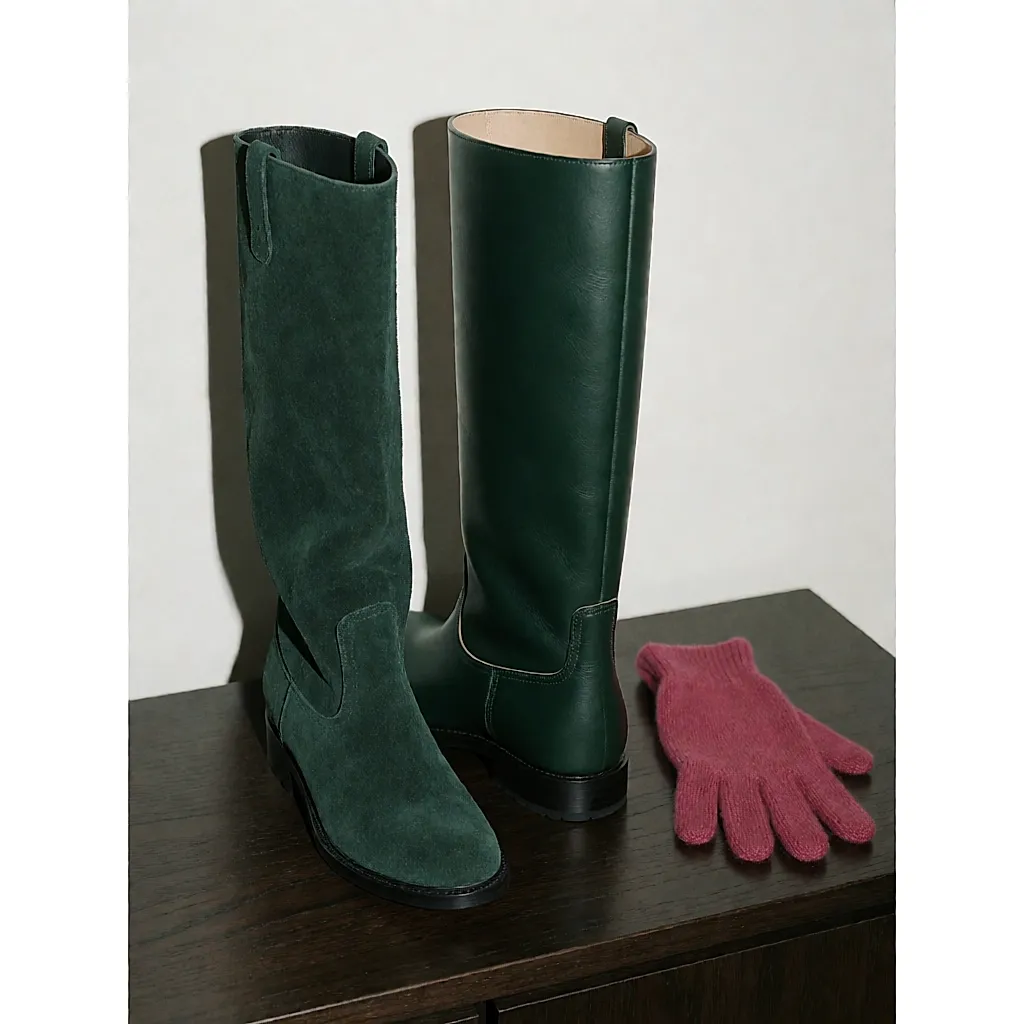
The practical marker we use — a starting point, not a rule — is two to three centimetres below the crease. You should be able to bend your knee, slowly, without the leather answering back. It really is that simple, and almost nobody does it in the shop.
Second decision: how the shaft holds itself up. Soft suede or lambskin moves with the crease, even if it relaxes a little with wear. Thicker, vegetable-tanned, lined leather keeps the line of the leg and doesn't budge — but it forgives nothing in the fitting room. And if the shaft is too wide at the calf, it won't be your knee that complains: the boot slides down, creases across the instep, and you spend the day hitching it back up by the heel.
Walk, climb a stair, sit down: the test that actually works
The fitting room lies. Standing still on a flat floor, almost every boot in the world is perfect. So get out of it, walk ten metres along the aisle without looking in the mirror, and listen to your feet rather than your eyes.

Then go up a stair — one is enough. Foot flat on the step, knee bent, shaft under tension: that's where you feel whether the leather bites behind the knee or the boot sags. Finally, sit down properly, legs crossed, the way you would on the Tube or at a lunch that runs long. How many times have you said yes to a boot without ever sitting down in it?
Three warning signs, in the order they tend to show up. A heel that lifts with every step: the boot isn't your size. A shaft that presses hard below the crease the moment you bend: it won't soften enough to become comfortable. A foot that slides forward as if on a slope: the shaft is too wide or the sole too smooth.
The ninety-second try-on. Thin socks first, then thick ones — the boot has to live with both. Ten steps along the aisle, one stair up and back down, one seated position with your legs crossed. If a single test catches, put the boot back on the shelf without negotiating with yourself.
Different calves, different boots
A fuller calf and a narrow knee aren't looking for the same thing. For a rounder calf, go for a straight shaft rather than a tapered one, a zip running the full height — a cobbler can take it in — and a softer panel at the back. On a very slim leg, by contrast, the shaft floats: without a slightly firm counter and a lining, the boot rotates around the calf and you feel as though you're wearing someone else's pair.
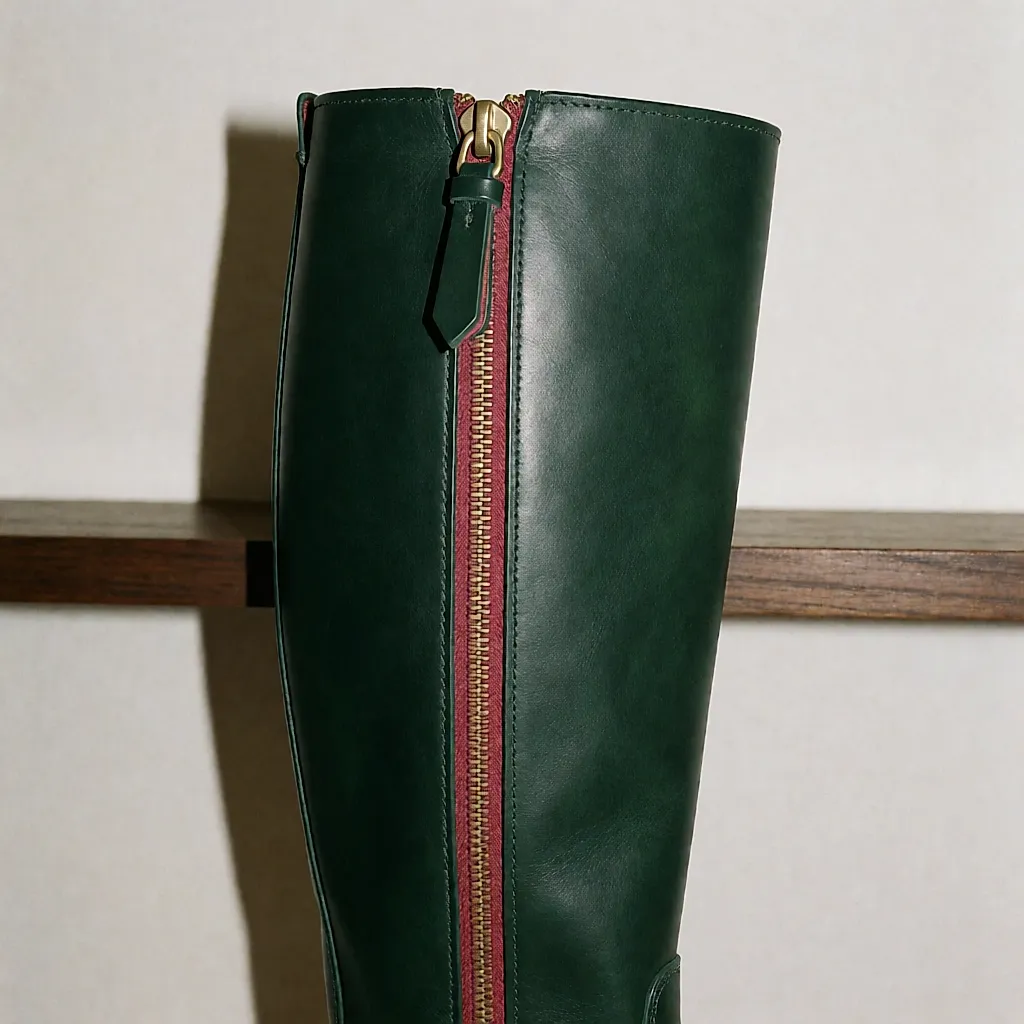
There's also how you'll actually wear them, which gets forgotten even faster than shape. Eight hours at a desk, a bike ride each way, stairs, carrying a child: a boot that bites into the crease is unbearable in all four cases, even if it looked perfect standing in front of the mirror.
Budget: where the money really goes
As a rough guide — prices swing between retailers and seasons — expect around £90 to £160 at a high-street shoe chain for a leather knee-high boot, £220 to £400 at a bootmaker or leather goods shop for full-grain leather lined in leather with a stitched sole, and £40 to £110 second-hand, sometimes with a sole that needs replacing. What pushes the price up: the thickness of the leather, vegetable tanning, the lining, the quality of the zip, and whether the pair has already been looked after.
And the cost doesn't stop at the till. Wooden shoe trees (£15 to £25) keep the shaft straight between wears, a polish suited to the material extends the life of the leather, and resoling at a cobbler is often £35 to £65 — less than a new pair. It's a quieter reflex than a third purchase: wear, care, repair. One warning while you're at it: check the synthetic fibre content on the label. It often explains a tempting price and a shaft that doesn't soften the way you expect.
The right boot, in the end, is the one you can climb a stair in, sit down in and walk away in without thinking about it. For a first pair, a soft shaft that stops two centimetres below the crease, at around £140, will do the job very well. If you're after the pair that will see you through five winters, put the money into thick leather and a solid sole — even if that means hunting down a second-hand pair and taking it to the cobbler. Your knees will thank you, and so will your ankles.

Comments
Your opinion matters: rate the article, react and reply to comments.
Comments are moderated; AI-assisted comments are flagged. Text emoticons (8-), :-), <3…) are automatically shown as images.