
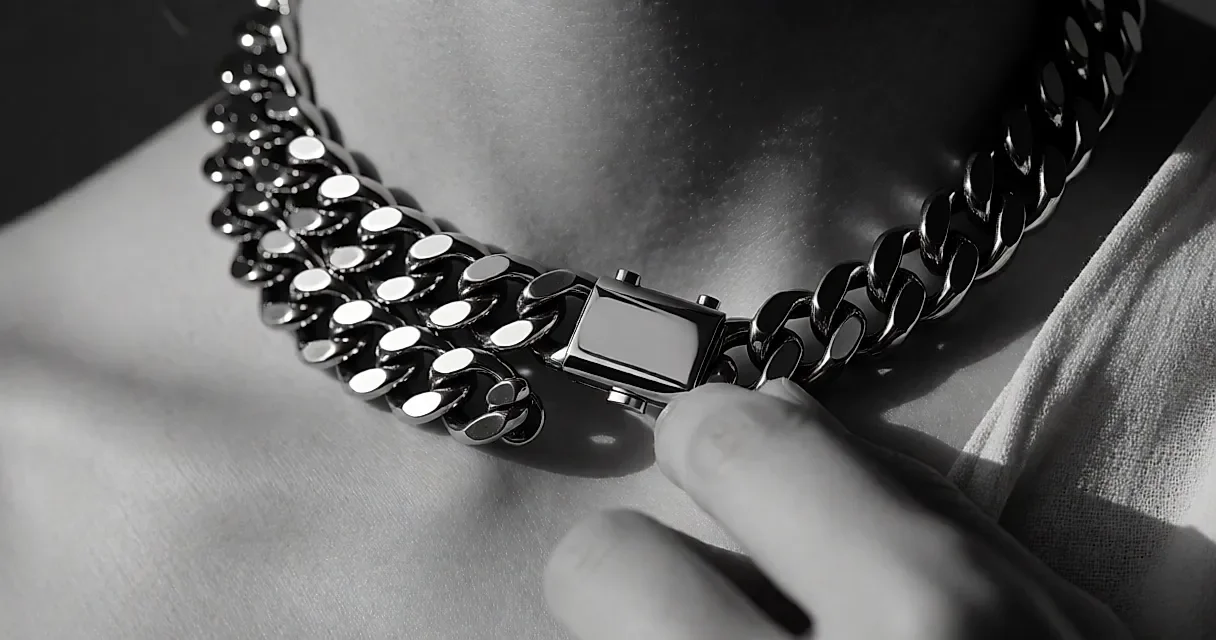
A chunky chain necklace is bought for the look: the weight on the collarbone, the shine of the metal, the links stacked like a ship's chain. Yet everything can hinge on two centimetres you hadn't even noticed. The clasp. It decides whether the piece stays with you for three winters or ends up in the back of a drawer with a twisted link as its parting shot.
Three clasps, three lives
The lobster clasp first: the little lever you press to open it. It's the most straightforward of the three, the one you can work one-handed, with your back to the mirror, without thinking. On a heavy chain, it inspires confidence — as long as the lever springs back cleanly and it doesn't look puny next to the links. A tiny lobster clasp on a thick chain is like a seatbelt on a fairground ride: reassuring, but not much use when it matters.
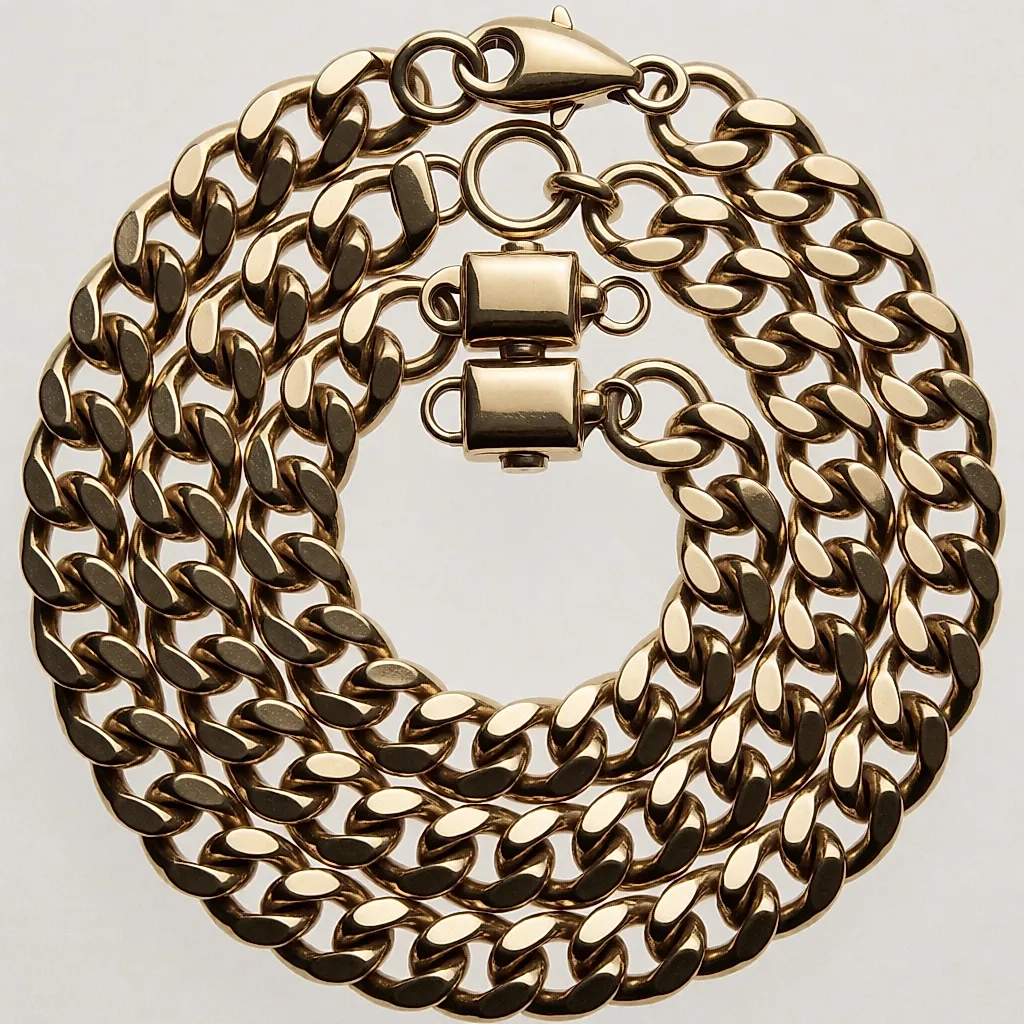
The spring-ring clasp next: a split ring with a tiny sliding pin. You mostly see it on fine chains, where its spring is minuscule. On a heavy necklace, compare its diameter with that of the links. If it is narrower than the link just before it, be wary. As for the box clasp — the one that clicks shut — you find it in proper jewellers on pieces with real weight. Ask whether it has a safety catch: on a heavy necklace, that's the belt-and-braces detail. So: lobster, spring ring or box?
The gap you can feel with a fingernail
Run your fingernail around the links, between your fingernail and thumb. A soldered link is closed, smooth and snag-free. A link that has simply been bent shut keeps a tiny gap — and that's where trouble starts: the wool of a coat catches on it, a thread from a jumper pulls, and with wear the gap opens. On a fine chain the detail is almost invisible; on a chunky chain it makes all the difference, because the weight is doing the work.
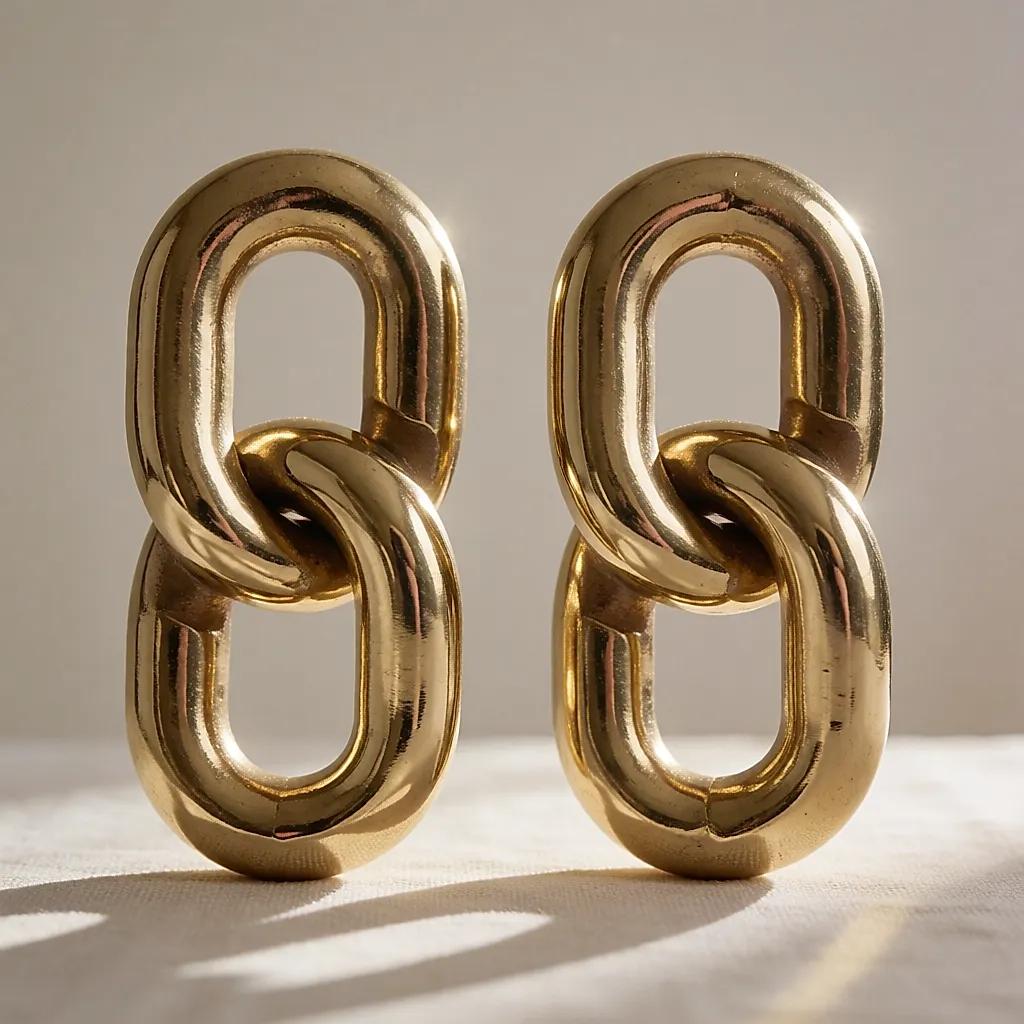
In the shop, ask the question: 'Are the links soldered?' A salesperson who hesitates has already answered. Online, look for a close-up photo of the chain lying flat, and see whether the links have a clean cut or close neatly. No decent zoom? Move on to the next necklace; there are plenty more.
How a heavy chain sits is decided at the nape
A heavy necklace doesn't so much drape as settle. Depending on the model and your morphology, a shorter length can sit in the hollow of your throat; then two things happen: the clasp migrates to the front as soon as you turn your head, and the piece becomes restrictive over a polo neck. A mid-length chain tends to sit on the collarbone — often where chunky chains have the most impact, with the clasp staying neatly at the back. A much longer chain is another story: the weight pulls down, and the necklace works better layered with a finer chain.

How can you tell before you buy? Wear it for a few moments, ideally over the top you're wearing that day — long enough to turn your head, sit down and pull a jumper on over it. If the clasp creeps up towards your throat or the links twist, you have your answer. A chain that keeps turning over usually means something is throwing it off balance — a clasp that is too light, a link that catches.
Budget
On the UK high street, at roughly £20–£45 you're in fashion jewellery: gold-tone brass, a small spring-ring clasp, links that are often left open. It does the job for a summer, a night out, a full gold-tone look that may last a season. For daily wear, this is where the trouble starts.
At around £50–£100, stainless steel and gold plating come in. This is the hinge zone: the clasp stops being a detail. Links are sometimes soldered, and the hardware starts to carry the weight of the chain. Check the plating thickness where it is stated: that, far more than the phrase 'gold finish', decides how long the colour lasts.
Above £100 and up to £250, from local jewellers or specialist brands, you move into solid silver with a box clasp and safety catch, and clean soldering. Higher than that, it's generally gold. And if the budget won't stretch, vintage jewellery shops and antiques fairs are still a good training ground: a 1980s silver necklace with its original box clasp often turns up for £40–£90 — provided you have checked the links one by one.
Before you pay, three quick checks: run your fingernail over three or four links to feel for gaps; pull gently along the length to see whether the chain opens up; and ask for the exact length, clasp included — then judge how it sits on you, depending on the model and your morphology.
At heart, the clasp is the necklace's handshake: the thing that holds when everything else shines. You can absolutely fall for a low-cost chunky chain and wear it as holiday jewellery, knowing it may not make it through the winter. But if you're looking for the piece that can go with Monday's blazer, Sunday's jeans and January's polo neck, put your budget into the clasp and the soldering. Shine shows from across the room; strength doesn't — and that's exactly why you check it before you buy.



Comments
Your opinion matters: rate the article, react and reply to comments.
Comments are moderated; AI-assisted comments are flagged. Text emoticons (8-), :-), <3…) are automatically shown as images.