

A trail jacket and a commuting jacket can carry the same technical label and still answer opposite needs. The first is designed to keep you dry at all costs, even if you arrive soaked from the inside. The second has to cope with twenty minutes on the street, then stay bearable for three hours once you're sitting at your desk. That is the real balancing act, and it isn't solved by adding zeros to the price tag.
How the membrane lets vapour escape
A membrane is a thin film bonded to the inside of the fabric: it keeps raindrops out and lets the water vapour your body produces escape. Its resistance to water is measured by hydrostatic head. In practice, a simple rule of thumb is enough: for an urban commute, there's no need to chase the specifications built for mountains and long, heavy downpours. For the walk to your open-plan desk, mountain-grade numbers are no substitute for breathability.
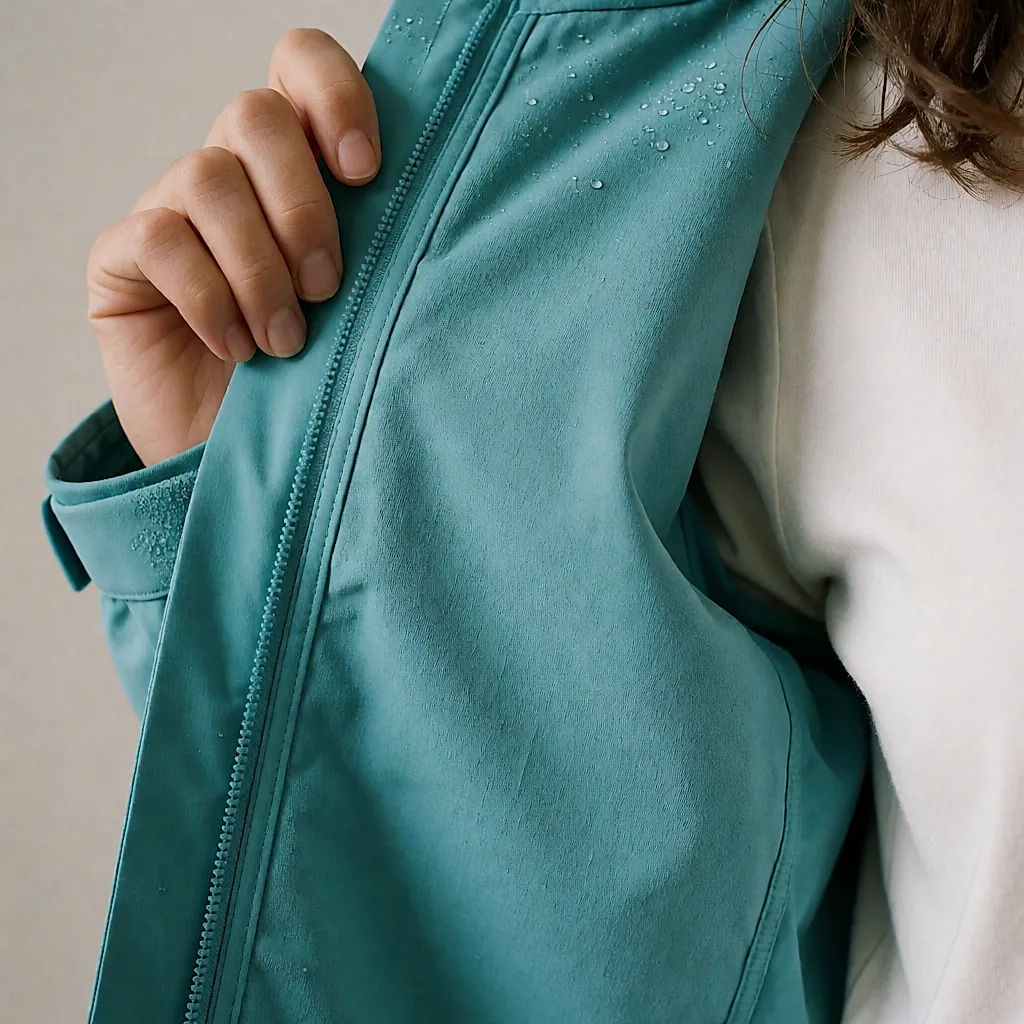
Breathable doesn't mean dry, though. A membrane jacket is still a closed garment: if you walk fast, with a thick jumper on and a packed train, vapour escapes less efficiently than the marketing suggests. Cheaper coated styles are waterproof too, but they let even less sweat out, so they're less comfortable over a full day.
The seams that decide everything
A waterproof jacket with untreated seams will let water in through the stitch holes: that's where you get wet, not through the membrane. Look for taped seams — a tape bonded to the inside — and a storm flap over the zip. The simplest test? Turn the jacket inside out in the fitting room and check the inside: the tape should be neat and straight, with no bubbles.
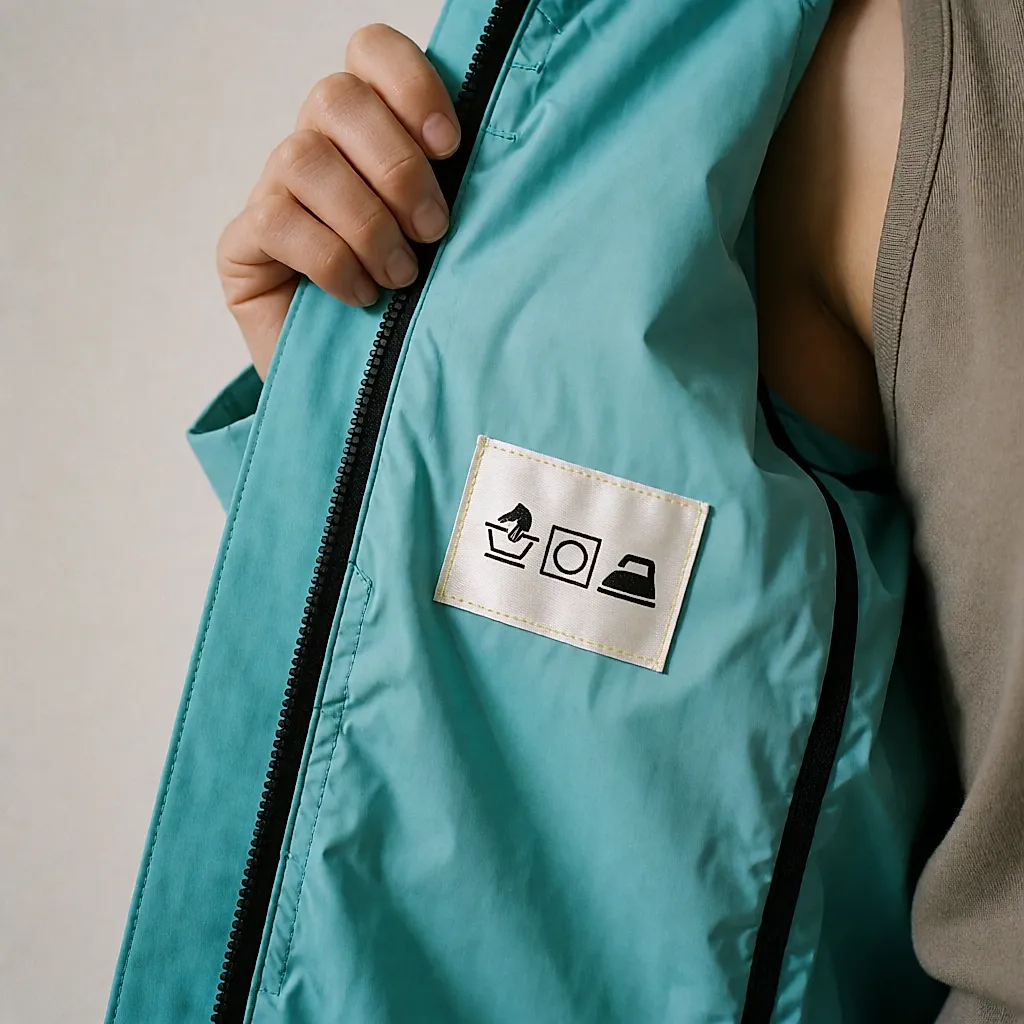
Then look at the areas that get wet first: the shoulders under a bag strap, the top of the pockets, the back of the collar. And the hood: if it won't stay on your head without you holding it with one hand, you'll never wear it — so what's the point?
Room for a jumper, and for you
The real question in the fitting room isn't 'does this fit me?' but 'does this fit over the jumper I'll actually wear on Tuesday?'. Put on underneath what you really wear in November: a fine roll-neck, a blazer on meeting days. If the armholes pull or the sleeves ride up to your elbows when you raise your arms, the jacket will end up on the coat rack.
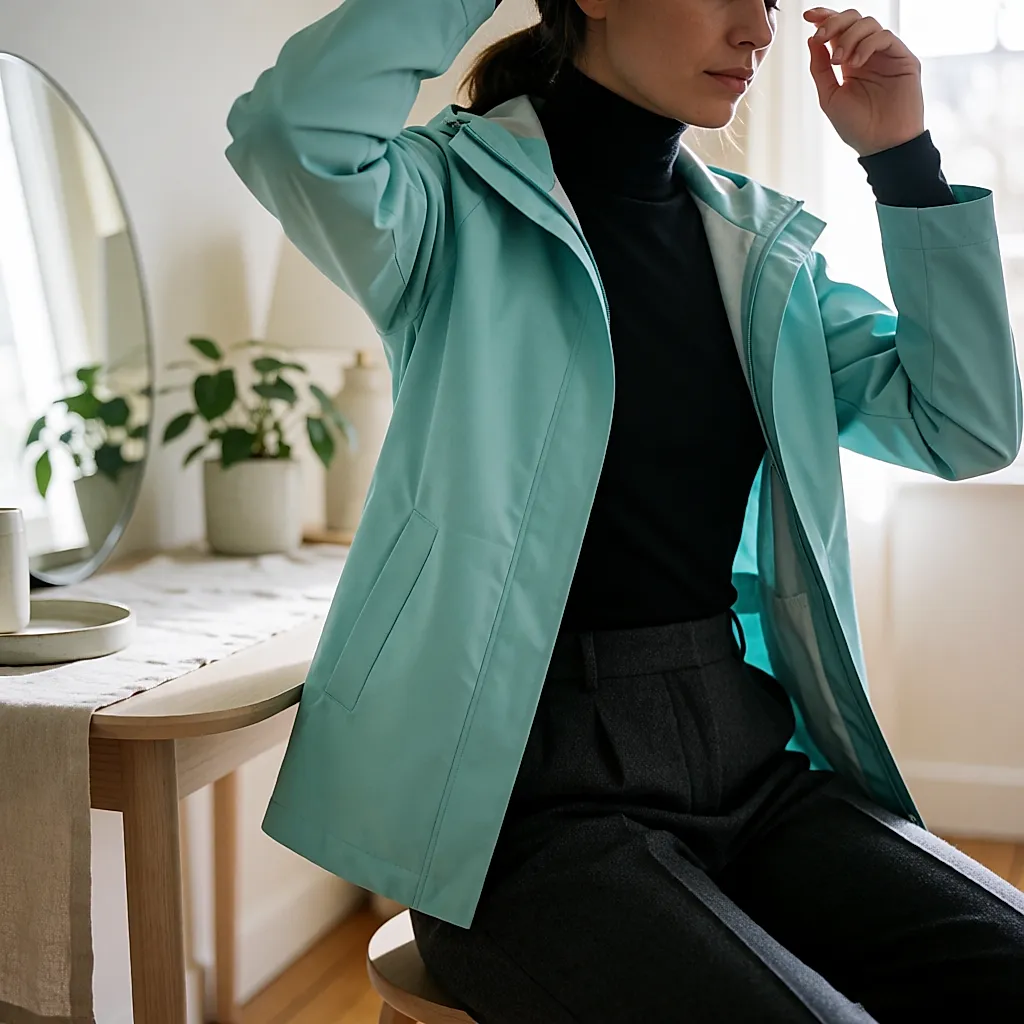
A well-chosen mid-layer makes a real difference: a fine merino wool knit keeps you warm without adding bulk and dries faster than a thick cotton jumper. The jacket itself can stay soft and light, even if it's a little less warm. You get a better drape, and you can take it off at the office without finding yourself in a crumpled shirt.
What you give up, and why that can be a good deal
A perfectly waterproof jacket has a hidden cost: it keeps you warm. You walk, you sweat, you open it, you get cold — and you finish the morning with a damp T-shirt under an office blanket. For a twenty-minute commute, a lighter, slightly less protective but genuinely breathable jacket is often the better trade-off.
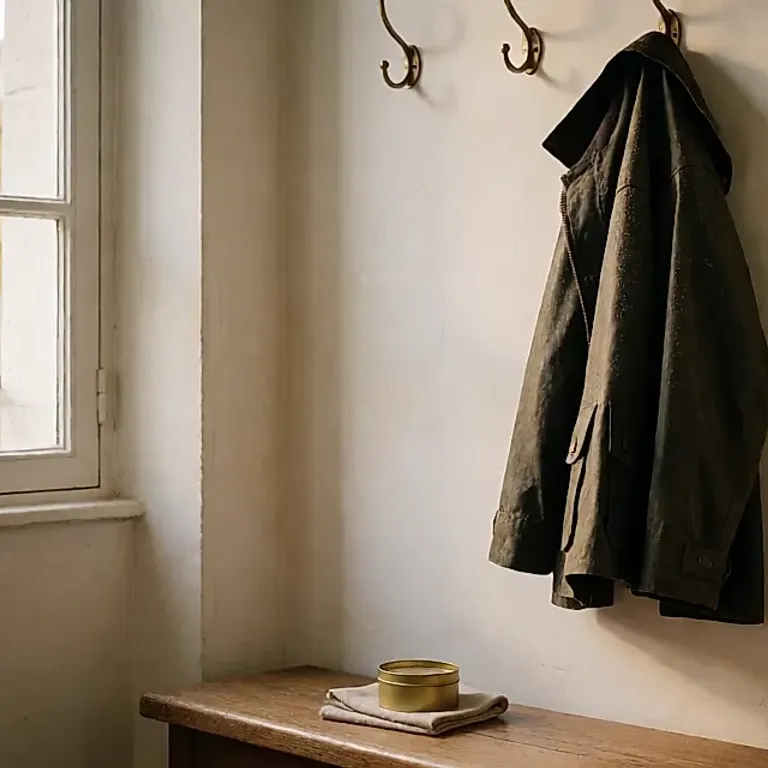
A word on materials, because it can't be avoided: technical membranes are now almost all made from synthetic fibres, and there's no point pretending otherwise. Check the proportion of synthetic material on the label and favour styles that can be repaired, reproofed and kept. A well-maintained, repairable jacket is often a better buy than repeated replacements. Care is simple: a gentle wash, no fabric softener, and a reproofing treatment when water stops beading on the sleeve.
In the fitting room, do four things: turn the jacket inside out to inspect the seams, raise your arms, put a bag strap over your shoulder, then pull up the hood and check that you can still see your feet.
Budget
As a rough guide, expect to pay £50–£100 for a simple rain jacket from a sports superstore or online: enough if you don't walk much and accept that it may need replacing sooner. At £120–£250, you're into outdoor and urban ranges that pay attention to seams, hood and cut — often the best balance of protection and breathability. Above £300, you're paying for lightness, a finer membrane and the name on the label.
Prices shift with location (a town-centre shop doesn't charge the same as an outlet), range, size and season. Does it have to be new? Second-hand, expect £25–£70 for a used technical jacket: inspect the seams inside and put a drop of water on the sleeve; it should bead.
The right urban rain jacket isn't the one that protects you most: it's the one you put on without thinking, that fits over your knitwear and that you forget once you're sitting down. Decide according to your commute — and if you're torn, take the lighter of the two. Your back will thank you by the end of the day.
Comments
Your opinion matters: rate the article, react and reply to comments.
Comments are moderated; AI-assisted comments are flagged. Text emoticons (8-), :-), <3…) are automatically shown as images.