

After three winters, the collar of your favourite coat has started to look like a civil servant counting down to retirement. A short band of feathers at the collar and a narrow strip at the cuffs, and the coat almost gets its old verve back. Such is the odd arithmetic of winter: it isn't clothes you're short of, it's finishing touches.
The short band, and the art of the invisible alteration
Give a boa an inch and it will swallow you; a short band frames you instead. The difference is all in the depth. On a collar, look for two to four centimetres of feather, rarely more; at a cuff, one and a half to three centimetres, just enough to peek beyond the sleeve when you lift your hand to reach for your coffee. Think piping, not fancy dress: the feather should underline an existing line, not cover it up.

What actually works? A wool coat with a slightly tired tailored collar, a boiled-wool cardigan whose neckline gapes, a black blazer whose cuffs have gone pale and shiny. A short trim frames the face, warms the gesture and gives an everyday piece a drape all of its own.
What doesn't work? Highly structured collars — officer collars, sharp notched tailoring, visible lining — where the feather breaks the edge. And silhouettes that already have volume at the shoulders: that is adding snow to snow. If you are already wearing a thick scarf and a beanie, choose the cuffs rather than the collar: this is the area that forgives everything.
Why the length of the barbs matters
The barbs are the filaments that grow from the quill. Short and dense, as in goose or duck, they give an almost matte, well-behaved trim that stands up to cuff friction without ruffling at the first gesture. Long and supple, as in pheasant or ostrich, they bring movement — and fragility: they have a life of their own, catch on things and need smoothing back into place.
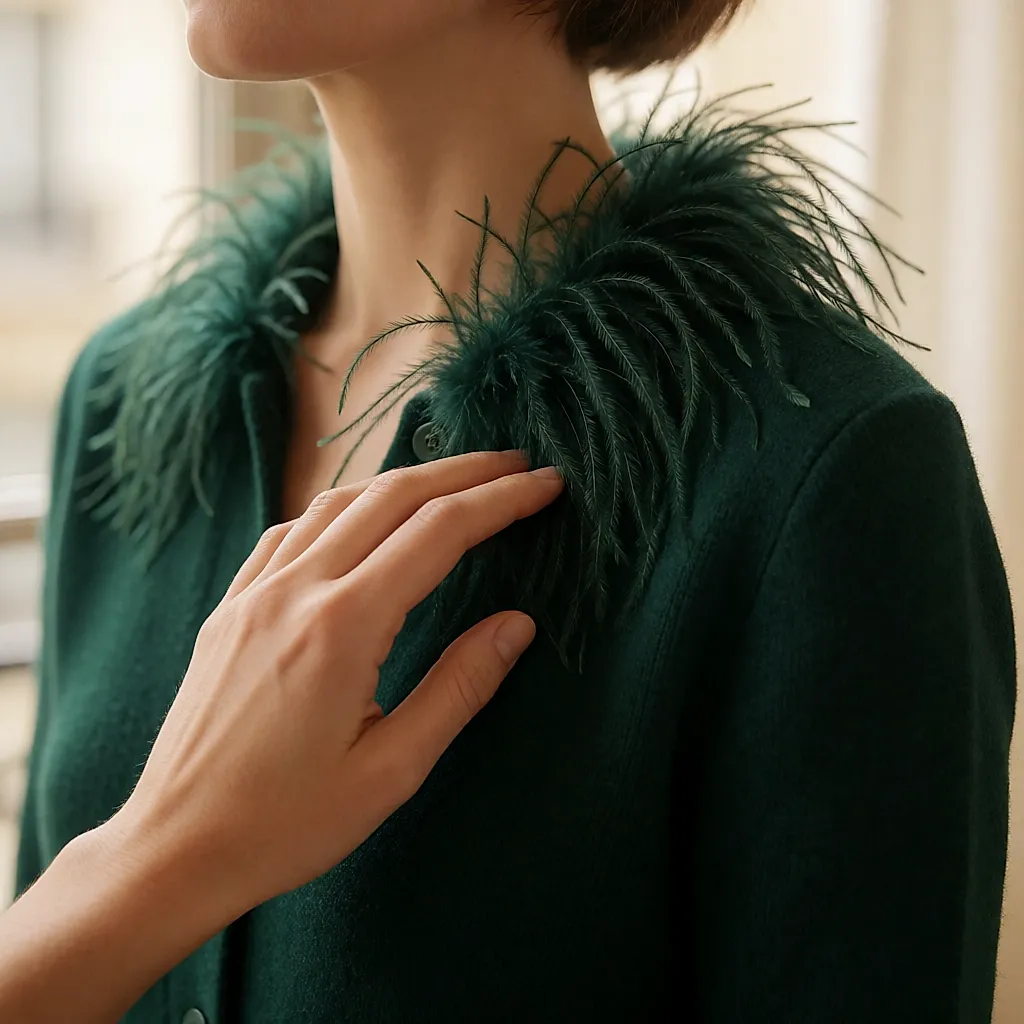
In practice, a long-barb band on the cuff of a coat worn every day will not wear as well as a short, tight band. On the collar of a cardigan worn three times each winter, however, a little flourish is allowed. The hand test? Stroke the palm against the nap: if the feathers lie down and spring back, the density is right. If they stay flattened, the trim has had it.
When it comes to care, be modest: shake it, brush it in the direction of the barbs and avoid heavy rain — wet feathers stick up and take a while to settle back into shape. And ask where they come from. Feather is often a by-product of another industry, but not all sources are equal; a trim sold with no clear origin at a suspiciously low price is not a good buy.
Ribbon, stitching or press studs
Three options. A band already mounted on ribbon or twill tape is the simplest: hand-sew it to the collar edge, or fix it with press studs so it can be removed. The advantage of ribbon is that it stiffens the whole thing slightly and stops the feather from bunching; the downside is the extra bulk at the neckline seam, which can pucker if the tape is too rigid.
Stitching directly to the garment gives the neatest finish — provided you can open the lining to hide the stitches. It is permanent, though: once sewn, the collar is married to its trim.
Then there is the detachable collar, mounted on ribbon and fastened with press studs or small magnets. It is the most flexible option: the same collar can move from one coat to another depending on Monday's mood. The catch? On a very fine collar, press studs leave marks. Best kept for thick wool.
The measurement that saves a wasted order. Before ordering trim by the metre, measure the circumference of your collar, add two centimetres at each end for turnings, and allow a safety margin: feathers compress during mounting. A classic coat collar often needs 60 to 70 cm of trim; two cuffs take about 40 cm between them.
Budget
A feather band mounted on ribbon costs roughly £7 to £22 per metre from online haberdashery or a fabric fair, depending on density and fineness of barb. For fitting by a seamstress or tailor, allow around £25 to £65 for a collar, £15 to £35 for a pair of cuffs — prices rise if the lining has to be opened and resewn, and if you are in a city centre rather than out of town.
A new ready-to-wear detachable collar: £35 to £110. Second-hand and vintage, often under £35, with barbs that may be a little tired but can be brushed back into shape. As for a fully feather-trimmed coat in store, expect £180 to £550, and considerably more at houses that make it a signature.
The comparison is easy: an applied trim costs a fraction of a new piece, and it rescues a garment you already love. This winter, it offers a lot of pleasure for the outlay.
All that remains is to choose your side. A small cuff trim, discreet, barely peeking beyond the sleeve: the safest way in, the one you can wear to the office without the meeting stopping. A detachable collar on a thick wool coat: the most playful version, to be removed according to the weather and how bold you feel in the morning. And if you are still unsure, start with the cuffs — that is where the feather is least visible and most noticed.

Comments
Your opinion matters: rate the article, react and reply to comments.
Comments are moderated; AI-assisted comments are flagged. Text emoticons (8-), :-), <3…) are automatically shown as images.