

It's 9.47pm, your basket contains a coat you have never touched, and the person hosting the livestream has just announced there are twelve left. You know how this ends: either the parcel goes out tonight, or it comes back as a return next week. Except the price of that coat began to be decided much earlier, and much further away — on a ship, at the entrance to a US port.
From the ship's deck to the price tag
At US ports, discussions about fees targeting certain ships linked to China — built there or operated by Chinese shipping companies — have added uncertainty. The principle is simple enough: when port costs move, shipping companies have to adapt. They have not sat on their hands — they shift port calls, switch ships, consolidate cargo. The result is that schedules become elastic, and a brand that was counting on a delivery on 10 November finds itself hoping for 25 November.
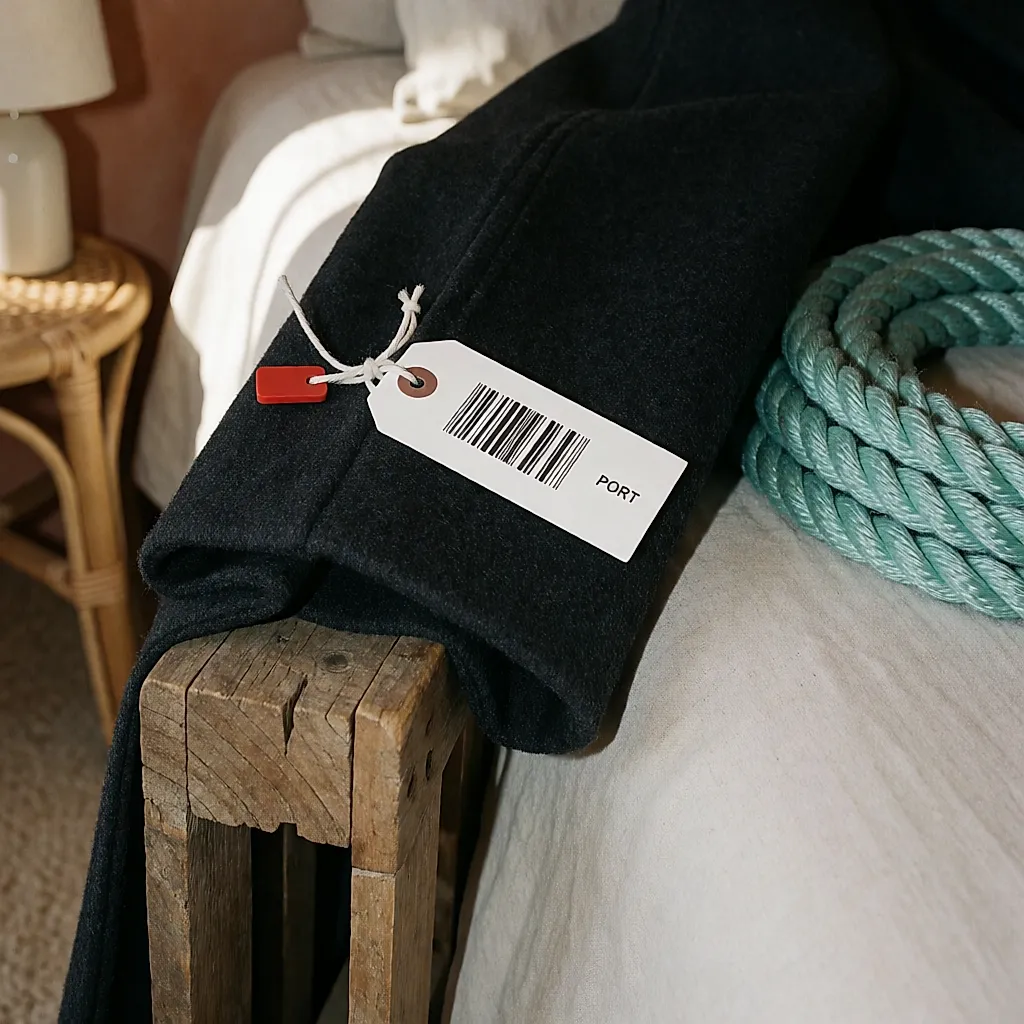
Winter clothing cannot afford a traffic jam: coats and knitwear are ordered months ahead, to arrive just before the cold weather and just before Black Friday. When a ship is held up, it is not just one container that is late: a whole retail calendar shifts.
Does that mean your wool coat has gone up by 15%? No, and nobody can tell you that quite so simply. Transport's share of a coat's price remains smaller than the cost of the material and the workmanship. What uncertainty does change is room for manoeuvre: less visibility, fewer ad-hoc discounts, more prices being held firm. The real cost of the ship is the flexibility it takes away.
At 9pm, the new fitting room
Which is why the second pressure comes through a screen. Before Black Friday, brands push live selling: often short sessions of varying length, one piece shown on someone who moves, a code that exists only for the duration of the stream. Sometimes it is very well done — you see how a sleeve falls, a fabric catching the light, a colour that is not the one in the catalogue. You gain a communal fitting in place of a real one.
But the staging is a lever too. The timer, the countdown, the magic line about twelve pieces remaining: none of it tells you anything about your wardrobe. Twelve pieces remaining is information about stock, not about your needs. And here is the uncomfortable question: how many pieces bought in a livestream are you still wearing in February?
The livestream is a good buy in one specific case only: when you already know the brand, the size and the fabric. Then the discount can be real and you're buying certainty. In the opposite case, you're buying a surprise with a returns window. It's not the same thing, even if the basket looks similar.
What is worth keeping in your wardrobe
Since so much of the price is decided upstream, it is worth looking at what you are really paying for. A coat, first: the composition on the label, read before the picture. A good dense wool that falls straight and holds its shape on the shoulders does not behave like a light blend that goes shiny at the elbow by December. For knitwear, merino wool and recycled wool remain reliable choices for winter; for shirts and T-shirts, organic cotton and linen wear in rather than wear out. A simple habit: check the share of synthetic fibres before you check out, because it often explains the price gap between two pieces that look alike.
Then the cut. A silhouette that fits properly is worth more than a statement piece bought on impulse and never styled. Layering forgives a lot, except a shoulder that is too narrow. And if a seam gapes, a hem drags, a waist hangs loose, the real smart move is not the return: it's a good local alterations tailor.
Then there is the most sober and most cost-effective move: wearing what you already own, brushing, mending, having things altered, looking at second-hand before ordering. A well-cared-for coat from last year costs £0 and will never sell out.
Budget
As a rough guide on the UK high street, expect about £90–£220 for a wool coat, £260–£520 when the wool is denser and the cut more considered; second-hand, £35–£130 depending on condition. For a merino wool jumper, a reasonable range is £45–£130. For care and adjustments: £12–£25 for a hem, £20–£50 for taking in a waist depending on the piece and the city — often the best investment of the lot.
Before you confirm a livestream purchase, check four things: the exact fibre composition (not the pretty description, the percentage); the size guide with flat measurements; the length and conditions of the returns window; the stated delivery date. If any of the four is missing, check whether the offer still stands after the livestream; some promotions are limited to its duration.
And if doubt remains, remember the Sunday-night rule: in practice, if you are genuinely torn, a piece often ends up staying in the wardrobe, unworn. The ship and the livestream do their work; you have the final say.

Comments
Your opinion matters: rate the article, react and reply to comments.
Comments are moderated; AI-assisted comments are flagged. Text emoticons (8-), :-), <3…) are automatically shown as images.