
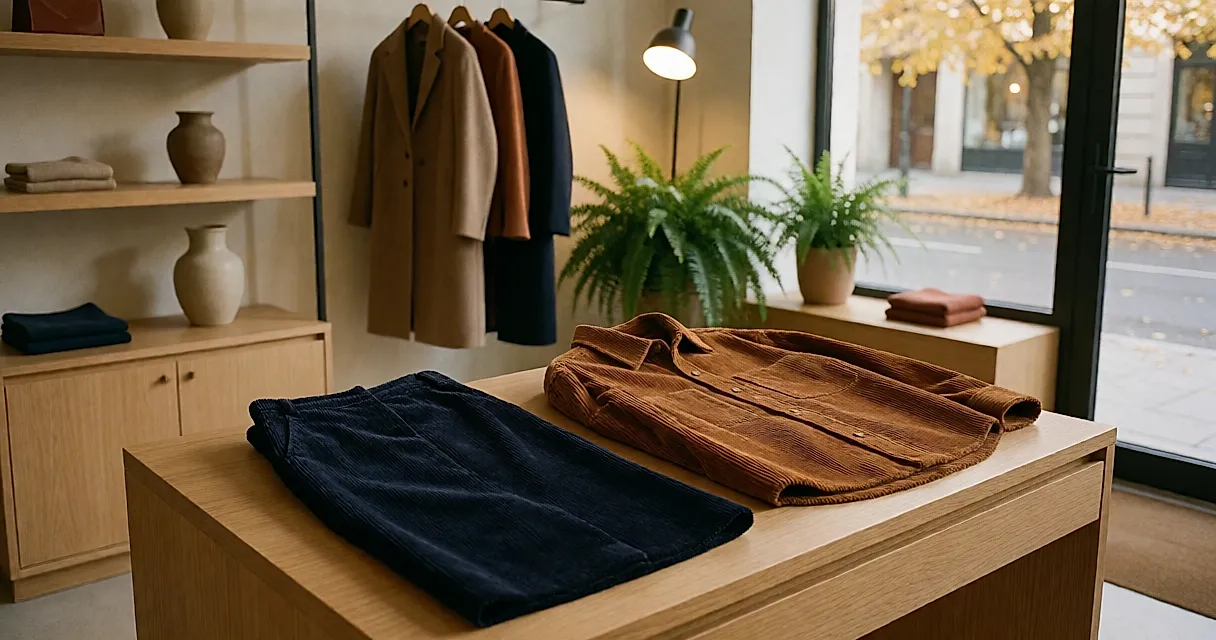
Pinch the corduroy on a skirt between your thumb and forefinger: the gap between two ribs already tells you whether it will survive three winters or end up as something to wear on the sofa. On the rail, all corduroy looks much the same; in real life, it behaves very differently. And the first thing to look at is not the colour or the label, but the width of those ribs.
The measurement no label gives you
Corduroy is a fabric whose pile is cut into vertical strips: the ribs, or wales. Their width varies from one weave to another, and it governs almost everything: how the piece holds its shape, how it hangs and how it ages. Two skirts described as the same fabric, in the same cotton, can behave like complete strangers.

The trade counts the ribs across a given width, a bit like counting the threads in bed linen: the more there are, the tighter the weave. At one end, fine wales — an almost smooth, dense grain that gives structure. At the other, wide wales — a bolder, airier, cosier relief. So which should you choose? It depends on the life you intend to lead in it.
Fine wales for the office
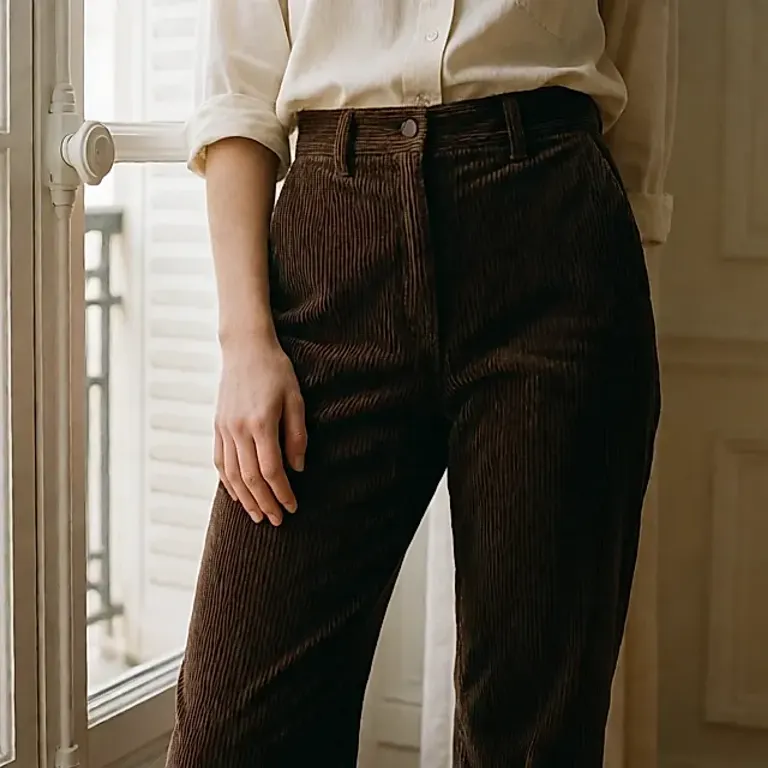
This is the corduroy of straight skirts, pleated trousers and slightly formal blazers. Tighter-woven, it keeps its shape and hangs cleanly: the silhouette stays crisp, and the fabric does the job of a fine wool without the austerity. With a merino jumper and ankle boots, you get an office look that doesn't feel like a uniform. A genuinely good find.
Its limits? Friction. On the seat of a chair, at the knees and thighs, the pile flattens and catches a lighter sheen. This is called marking, and it is the usual lot of thinner, tighter wales. Before you buy, turn the piece inside out: if the reverse looks soft and stretched, the face will shine quickly. And if you are after oversized cosiness, look elsewhere: fine wales look chic, but they are not cuddly.
Wide wales and the comfort of creases
Here we change camps. The relief is visible from three metres away, the fabric is suppler and thicker, and the piece softens with wear. This is the corduroy of overshirts, work jackets and loose trousers you pull on of a Sunday to fetch bread and come home with three unnecessary treats.
The downside comes down to one word: creases. Inside the elbow, behind the knee, where a bag strap rubs, the rib crushes and keeps the trace of the movement. On a jacket, those marks tell a story and look charming. On trousers worn in an office from morning to night, they show more. One last detail: wide wales add volume. If your aim is a leaner line, keep them for the upper body or a very straight cut.
Steam inside out, and put the iron away
This is the step that decides how long your piece will last, and it takes ten seconds to learn. Steam from the inside: turn the garment inside out, steam the reverse, and the pile lifts without being flattened. A flat iron, by contrast, presses the ribs down and leaves shiny bands that never really fade.
Wash it inside out too, choose a delicate cycle, and forget the tumble dryer — that is what breaks the pile. Leave it to dry flat, and that is enough. As for a quick press 'to look smart' just before you go out, that is the habit to unlearn: a piece of corduroy that has been properly steamed does not need a military crease. You will see the difference straight away.
The fitting-room test, in three steps. Pinch the rib between two fingers: if it flattens instantly and does not spring back, the piece will mark quickly. Sit down for thirty seconds, then stand up and look at the seat in the mirror. Finally, turn the garment inside out: a clean, tight reverse suggests the face will wear better.
What to spend, from £30 to £250, and why a steamer counts
Expect roughly £30 to £90 for a skirt or cardigan in decent cotton from mainstream high-street labels, £50 to £130 for well-cut trousers, and £150 to £250 from brands working with denser corduroys and neat finishes. In second-hand shops, good pieces turn up at £10 to £40. Corduroy is a fabric that ages well, and older pieces are often thicker.
Add a steamer if you do not already have one: £25 to £80 depending on capacity and brand, from electrical retailers or online. Given what it saves in ironing and ruined pieces, it is a sensible buy. The free alternative? Hang the piece in the bathroom after a hot shower — less effective, but it will do at a pinch.
House summary: fine wales for a skirt or a pair of trousers that has to survive a day of meetings, wide wales for weekends and layering, and a steamer in both cases. At £40 for a second-hand skirt and £30 for an entry-level steamer, you can do very well — and keep the piece for much longer. That is a wardrobe that only improves with age.


Comments
Your opinion matters: rate the article, react and reply to comments.
Comments are moderated; AI-assisted comments are flagged. Text emoticons (8-), :-), <3…) are automatically shown as images.