
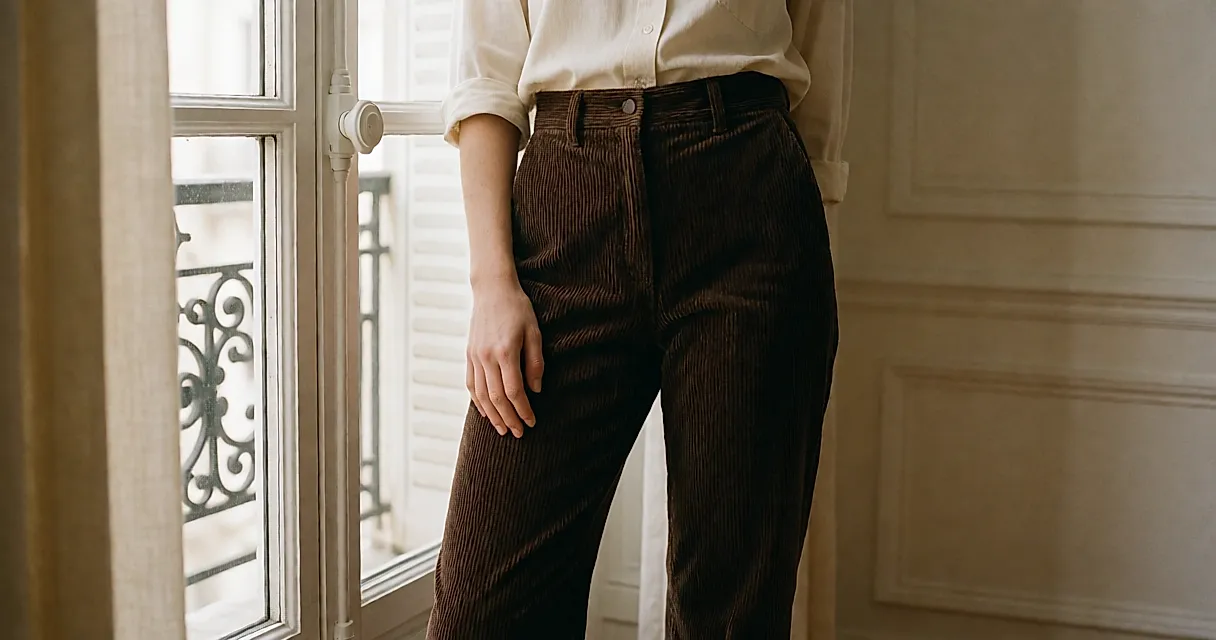
Have you ever spent ten minutes in a fitting room deciding that a pair of corduroy trousers makes you look squashed, before giving up? Often the culprit isn't the size, the colour or your reflection that day: it's the width of the wale, the raised rib. That little ridge you stroke absent-mindedly in the shop plays a decisive role in the drape, even though composition, weight, cut and finish count too, and it often makes the difference between trousers that fall like tailored trousers and a pair for lazy Sundays. And labels rarely tell you this.
The rib you stroke without really seeing
Corduroy is a fabric whose surface is covered in small raised ridges. They can be so close together that you barely see them, or so wide that they almost read as a pattern. That density changes everything: the finer the wale, the suppler the cloth and the more the trousers behave like a smooth fabric; the wider the wale, the more body the weave has, the more the garment holds its shape and the stiffer it feels.

So where does the fitting-room confusion come from? You try a wide-wale corduroy cut like smart trousers and wonder why the look doesn't follow. It isn't corduroy's fault; it's a mismatch. A fabric that wants volume in a cut that wants fluidity will gape at the hips and break at the knees.
Fine wale, your Monday-morning ally
This is the corduroy that fools almost everyone. Up close you see the ribs; from a metre away you'd swear they were plain. The drape is supple, almost fluid, and that is exactly what makes it office-ready: a straight fine-wale pair with a shirt and Derby shoes, and you're dressed without looking as if you've put on a blanket.
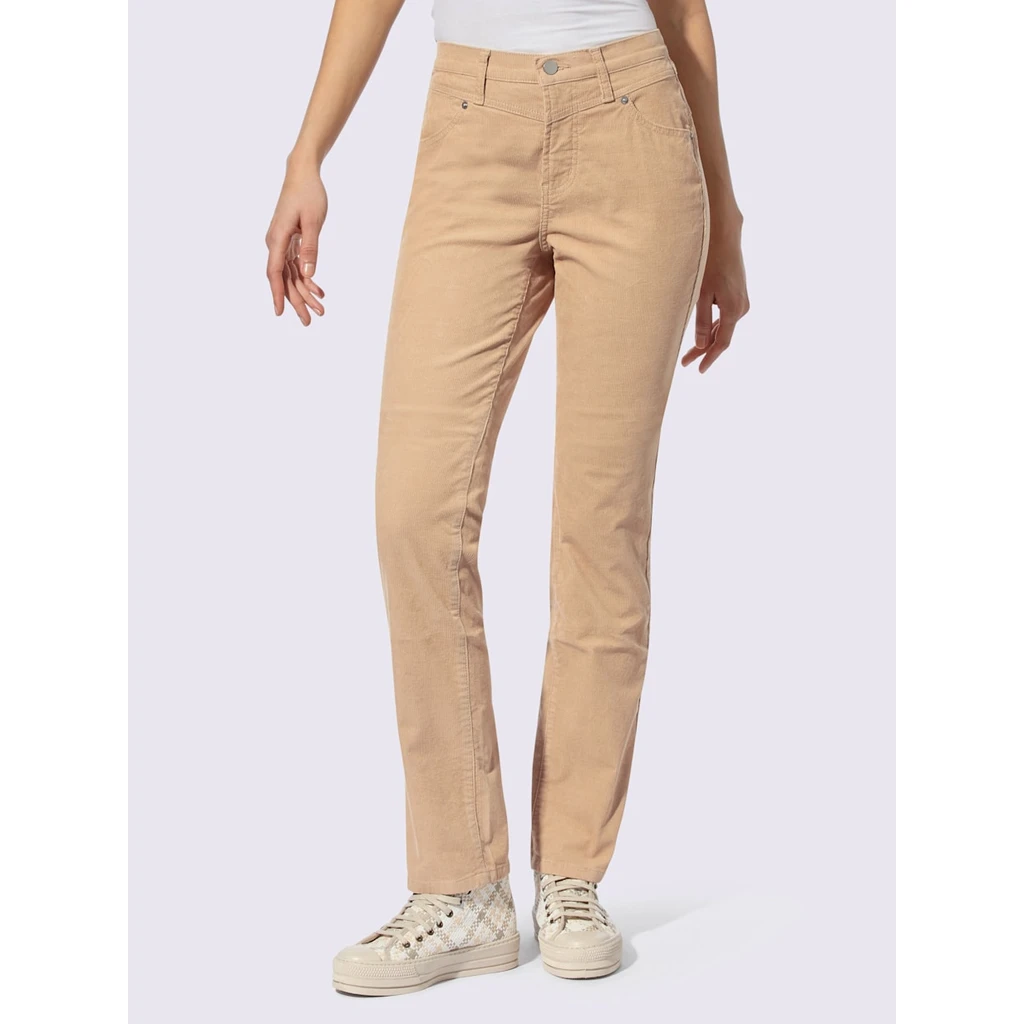
You still need the right cut. Wide and fluid, fine-wale corduroy can quickly resemble a wrap skirt that has gone wrong; choose straight, slightly tapered, or pleated trousers instead. And check the composition: pieces that are mostly cotton or wool hold up better over the day than a blend that shines under fluorescent lights. A little elastane for comfort is fine; a lot, and we'd pass.
Wide wale, the texture that owns Sunday
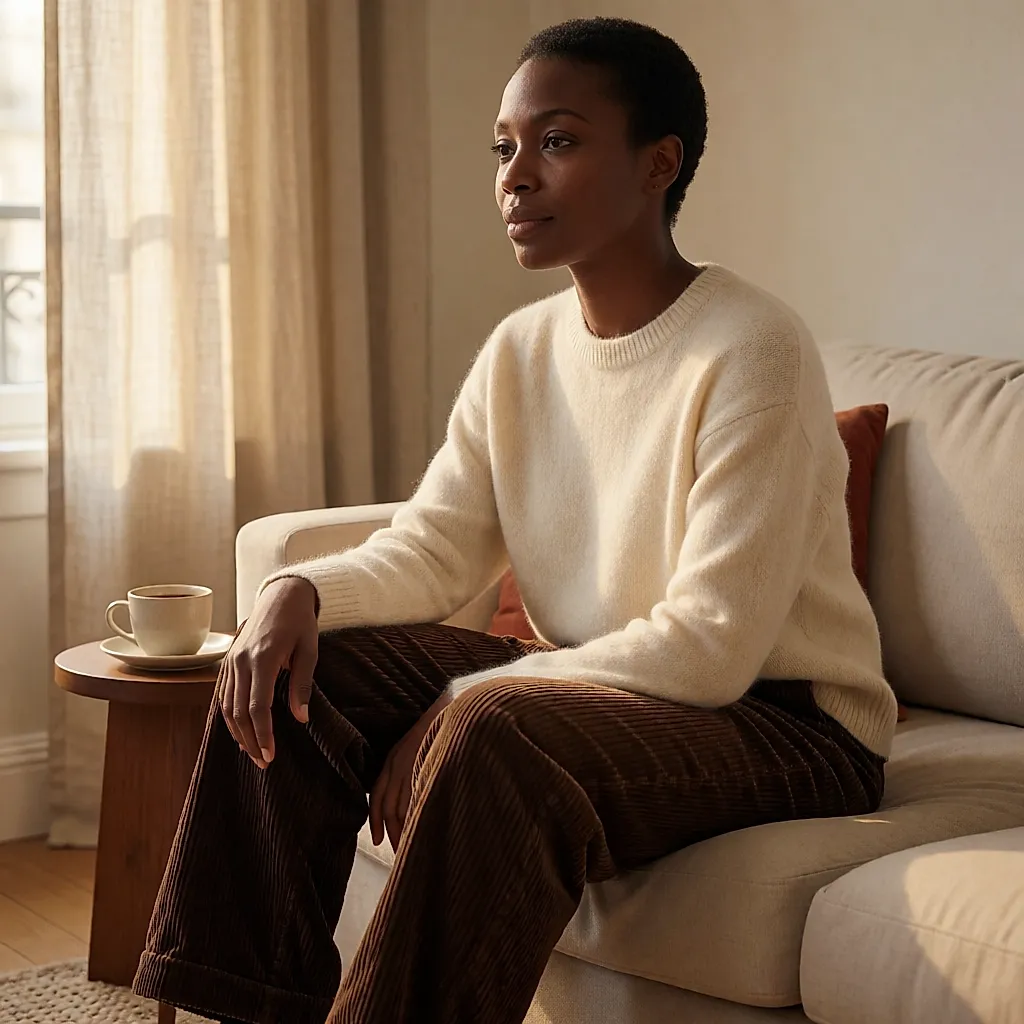
There's no pretending here: the rib is visible, the fabric has a life of its own, and the trousers don't ask anyone's permission. This is the corduroy for November Sundays, markets and afternoons when you do nothing. They take boots, chunky knits and spilled coffee with the same philosophy.
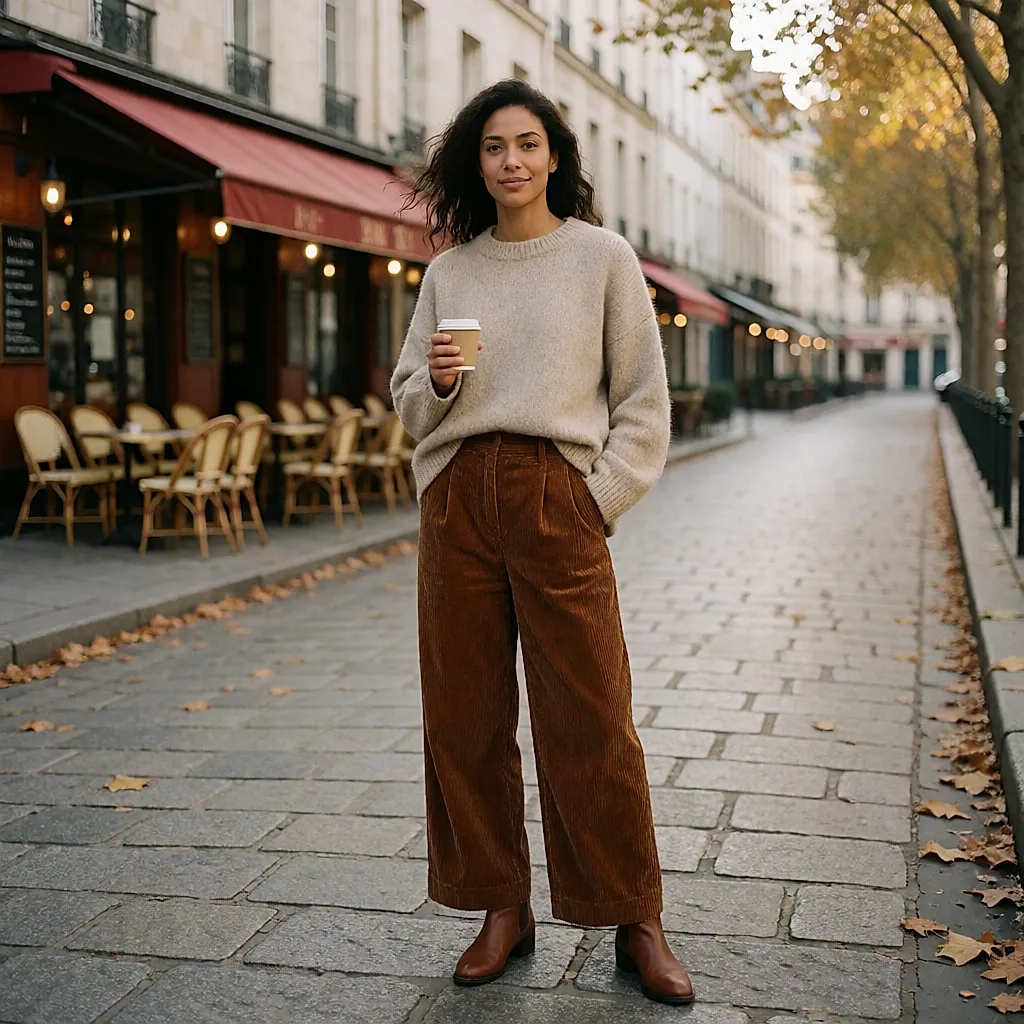
But watch the pitfalls. A wide wale on a thin fabric quickly marks at the knees and keeps the creases from the sofa. And if the cut is too tight, the stiffness of the weave creates strange bunching at the crotch. For this kind of corduroy, look for controlled volume: a high waist, wide or straight leg, and a thick fabric that holds its shape. It's the most casual version and, admittedly, the easiest to wear with trainers.
Three seconds in the fitting room to decide
Spotting it takes no special training. Turn the garment inside out: on the reverse, the wale is much easier to read, and you'll see immediately whether the rib is woven in or merely printed, because yes, some 'corduroy' is just a smooth pile with a pattern, and there is no ridge to feel under your fingers.
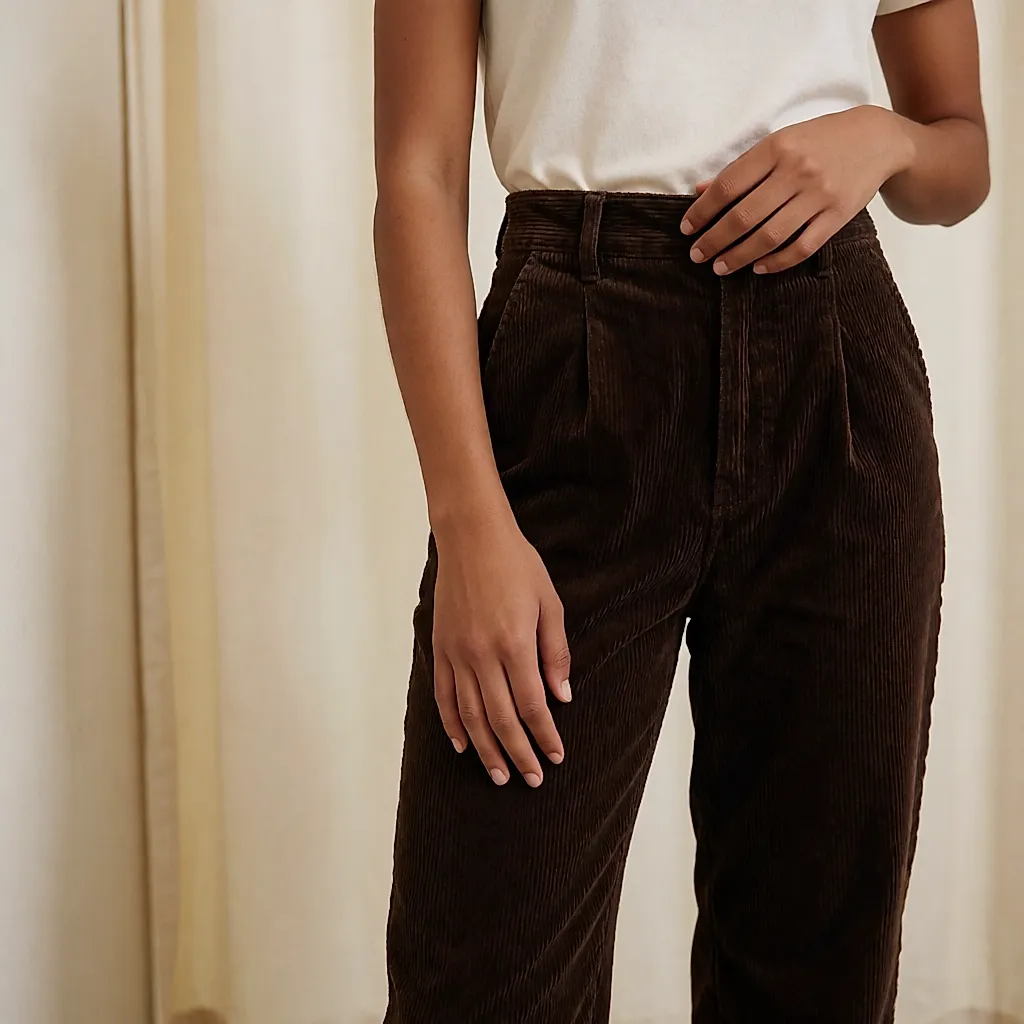
Next, run your hand flat over the thigh and slide the fabric. If it concertinas into folds, the wale is too wide for the fineness of the cloth. Finally, fold the trousers over your arm: a fine wale breaks gracefully, while a wide wale folds like an invitation card. And look at the shop lighting: sheen can sometimes be a clue, but it isn't enough to tell you the composition.
The reverse-side test, in three steps
- Turn the waistband inside out: the reverse of the wale gives the true density.
- Pinch the fabric between two fingers: supple usually points to a fine wale, cardboardy to a wide one.
- Sit down for thirty seconds: if the knee goes pale and marked, the trousers are likely to age badly.
Colour, the false debate
We spend ages wavering between chocolate, navy and that green that goes with nothing. Yet colour changes the mood of the trousers, not their drape. A camel wide wale will stay casual; a black fine wale will stay smart, whatever the catalogues say. The real question is: which wale width for which life?
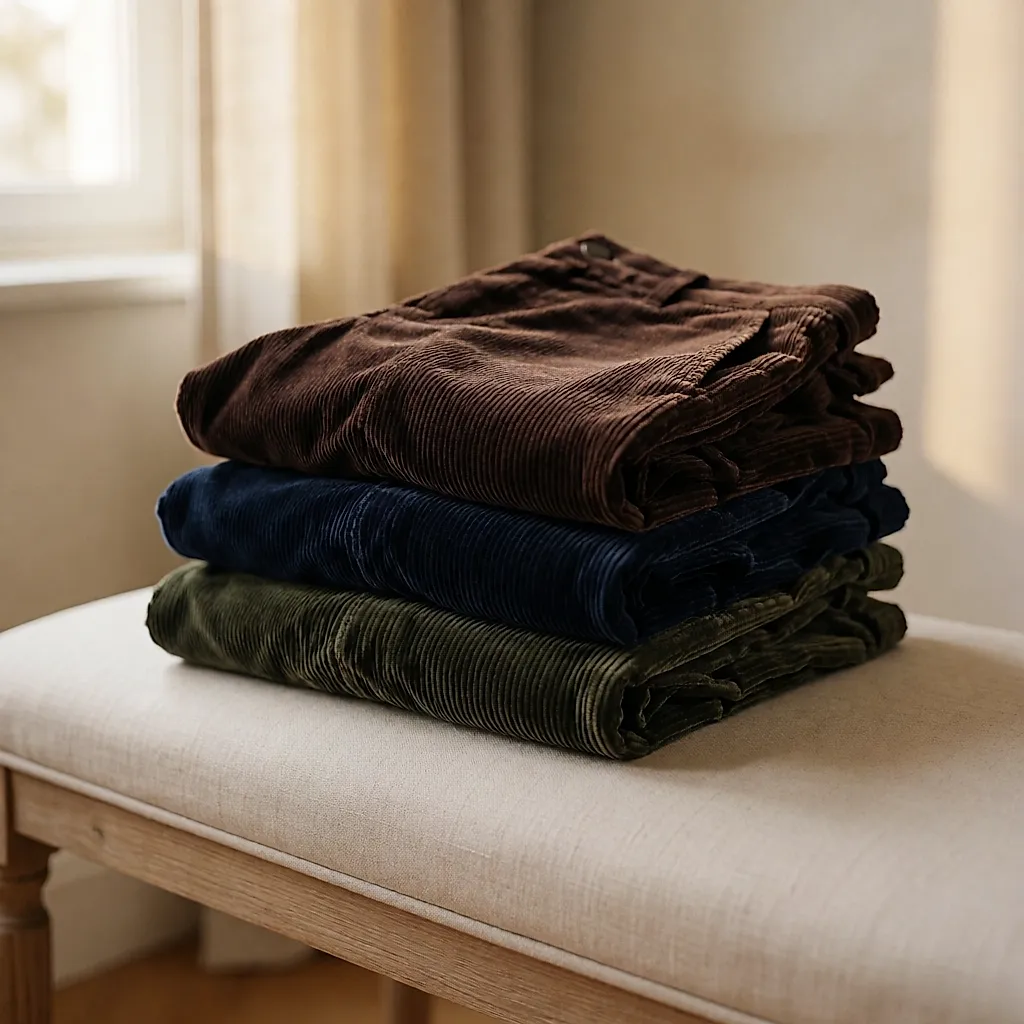
If you only have one pair of corduroy trousers, choose a fine wale in a neutral shade; it will take you from office to dinner without a change. If you already own a pair, have fun: wide wale, a bold colour, and own the texture.

What to spend
As a rough guide, fine-wale corduroy can be found for around £35–£60 on the high street, where the fabric is often mostly cotton with a little elastane. Expect to pay around £70–£130 for better-cut corduroy in heavy cotton or a wool blend from mid-range brands. Above £170, you are paying for fabric and finish: at that price, insist on an impeccable cut and neat seams, or disappointment becomes expensive.
Second-hand and charity shops are a good source: for around £10–£25 you can find fine-wale corduroy whose weave is still perfectly sound. Check wear between the thighs and the condition of the hems, then take them to an alterations service to adjust the waist, often £15–£20, and the trousers can go on for years.
The trousers you won't regret
A successful pair of corduroy trousers is one you wear until the wale flattens under the thighs, and it does happen; it's a sign they've lived. So next time, before blaming the mirror, turn the garment inside out and trace the ribs with your fingertip. It's a small detail, but it often tips the balance between a polished look and posh pyjamas.

Comments
Your opinion matters: rate the article, react and reply to comments.
Comments are moderated; AI-assisted comments are flagged. Text emoticons (8-), :-), <3…) are automatically shown as images.