
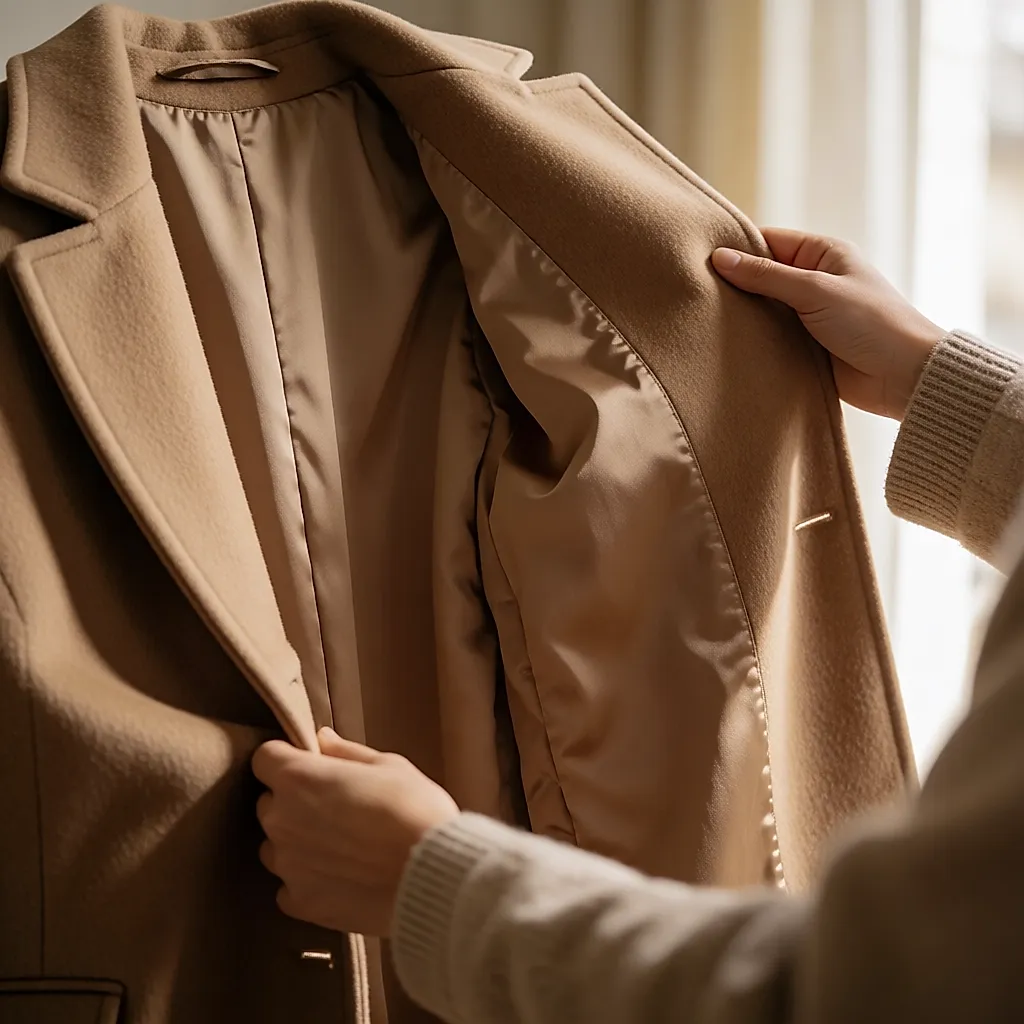
Nobody warns you that the lining plays a key role in how warm a coat feels — and it's the one part you never think to look at. You loved it the moment you tried it on. The drape, the colour, the shoulder that sat exactly right — this was the coat, no question. Then January arrived, and so did the reality check: wool jumper, thick scarf layered on top, and you were still cold.
What a lining actually does
Reach inside a new coat while you're still in the fitting room, before you've even put an arm in. If the fabric rustles under your fingers, if it catches slightly and gives off static the moment you move, it's almost certainly a synthetic lining. It costs less to make, but it usually lets air circulate less freely, which can leave you feeling clammy and uncomfortable.
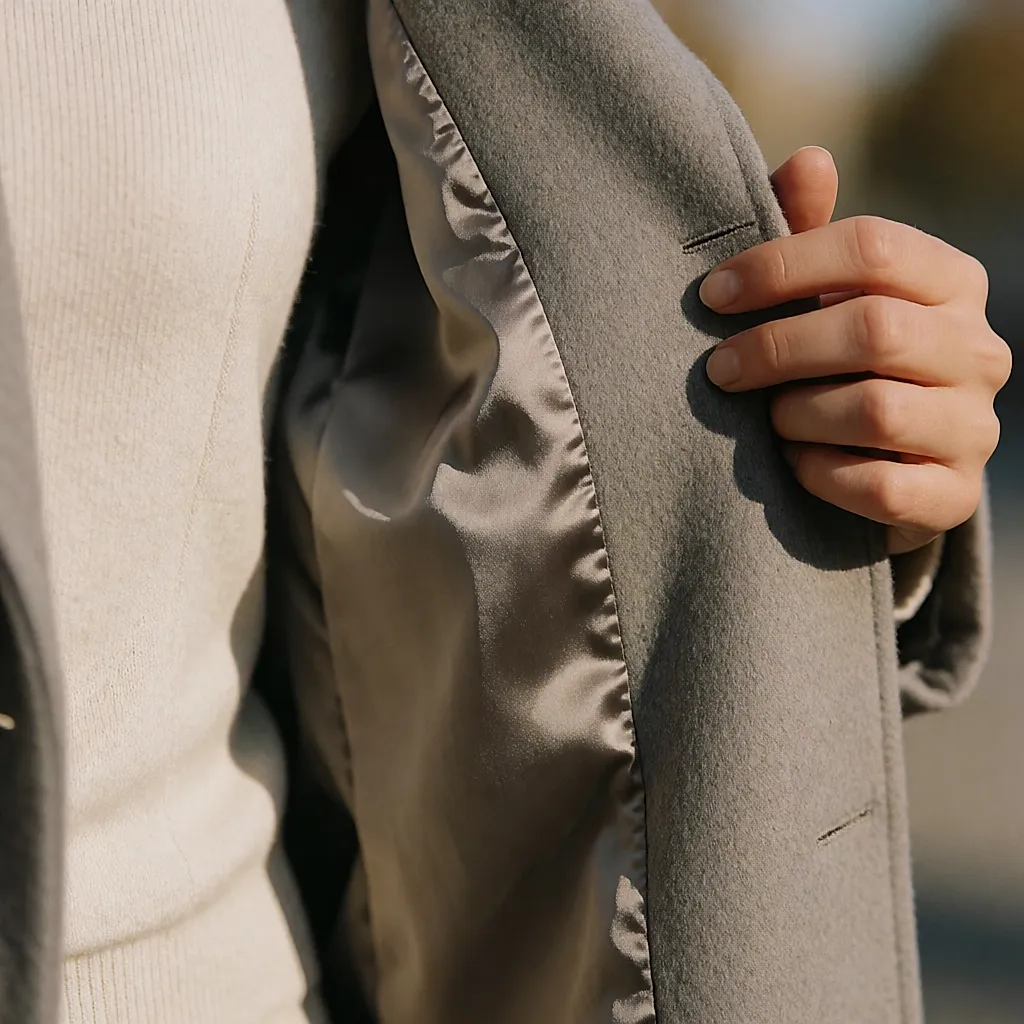
What you're after is a fabric that glides without creasing, lets air through and doesn't stick to your skin. Cupro, dense viscose and silk are the classic partners for a warm wardrobe. Cupro — sometimes sold as "vegetable silk" — has a soft, slightly satin feel and is a genuine pleasure to wear for a modest extra outlay. Viscose, far more common, does the job perfectly well when it's thick enough and cut properly. Real silk, meanwhile, remains a benchmark — as long as you look after it.
The fitting-room habit worth building
Start with your fingers. Run your hand along the inside shoulder seam: the lining should be attached without pulling or gathering. A lining that billows — that is, floats in suspicious waves — will wear out and eventually tear. Then check the thickness. A very thin lining is almost translucent. In a thick wool winter coat, that's not a good sign.

Check how it moves, too. Put the coat on over the jumper you'll actually wear in December, raise your arms, cross them, bend forward. A good lining follows the movement, doesn't suddenly tighten and doesn't ride up your back. If you feel it tugging between your shoulder blades, or the sleeves pull downwards, that usually points to an armhole that's too tight or a lining that's been badly cut. The coat may still look lovely in the mirror, but you won't wear it for three hours straight.
Get the lining right and the whole coat works
The part you can't see doesn't just "line" the fabric: it shapes how the coat hangs. A floating lining — stitched loosely, sometimes with a small ease pleat at the back — lets the coat move freely. A rigidly fixed lining, by contrast, shows at the armholes, pulls when you fasten it and lifts the hem at the slightest movement. You can spot the difference in the fitting room, in the way the back panel falls.

Get into the habit of checking the hem, too: the lining should be finished neatly, often with a small hand-turned edge or a discreet stitch. That's where you can tell whether the maker cut a corner — or didn't.
A few minutes in the fitting room are enough: hand inside (fabric, fixings), eye on the shoulder seam and the hem, then move your arms and torso. If you're unsure, ask for the lining composition.
What to budget
When it comes to price, it's easy to fall for the cut and forget to look inside — yet the lining is part of what you're paying for. Expect to pay around £100 to £220 for a wool coat with a properly finished lining, from a high-street or accessible brand; £220 to £550 for pure wool or a wool blend with a cupro or silk lining. Beyond that, you're into mohair or cashmere territory, where the lining is rarely the weak point. The gaps are real: the same cut can cost twice as much depending on the weight of the wool and the quality of the lining.
If you have a coat whose cut you love but whose lining lets you down, alterations are perfectly possible. A tailor or alterations service will take care of it, for a price that depends on the length and the fabric you choose — an order of magnitude, not a fixed rate. Far less than buying new, and often a much better way to keep a piece you love.
Before you leave the fitting room, close your eyes and picture it. A packed Tube carriage, November rain, a jumper that scratches a little — and you, comfortable. That's what a good lining buys you: quiet comfort, an everyday ease nobody sees. So next time you're shopping, turn the coat inside out — literally. You'll never buy a piece again without checking what's inside. It's an invisible detail that will never let you down.


Comments
Your opinion matters: rate the article, react and reply to comments.
Comments are moderated; AI-assisted comments are flagged. Text emoticons (8-), :-), <3…) are automatically shown as images.