
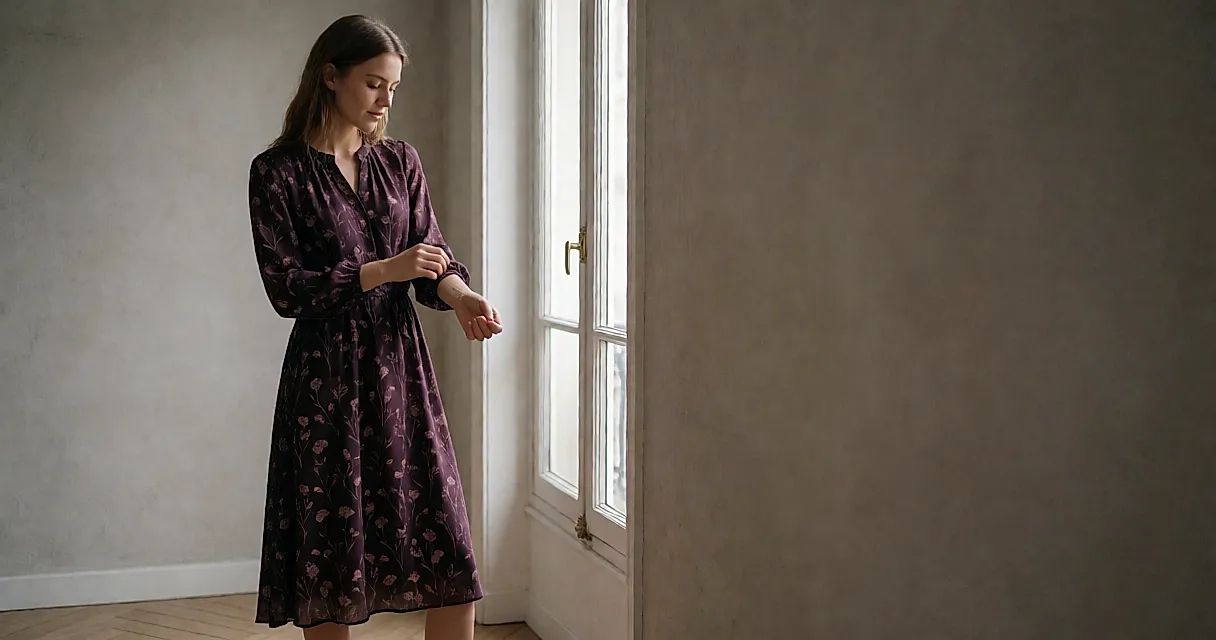
A dress is hanging on the bedroom door, and it isn't the dress you notice first — it's the stems. Dark, tightly packed flowers, with leaves that look as though they've spent the summer pressed between the pages of a dictionary. It could be a herbarium someone left on a hanger, and yet this is the flower of the season, telling a very different story from the bouquets of July.
The wallpaper has changed sides
For a long time on the catwalks, flowers were the scenery. They climbed the wallpaper, they were printed into the carpet, they upholstered the reconstructed garden under the spotlights. You looked at the silhouette, then went home with a picture of a wall: pretty, often gorgeous, but it stayed at the back of the room.
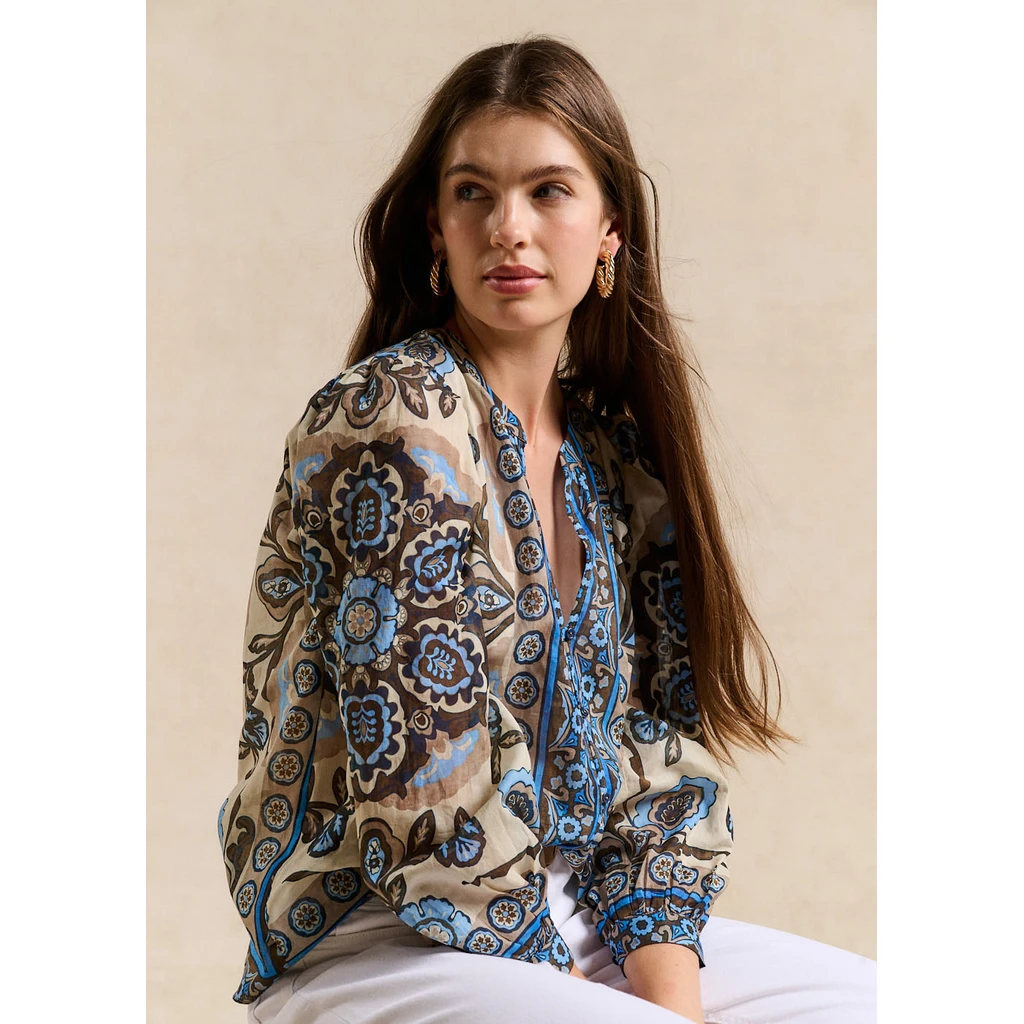
What's changed is that the print has travelled the other way. It has left the background to land on the clothes. The dress becomes the wallpaper, the shirt becomes the curtain, and you're the one carrying the scenery into the room. Which explains the odd feeling when the parcel arrives: you didn't order a flower, you ordered a place.
Except wearing wallpaper isn't the same as hanging it. A pattern designed for a wall is drawn at a distance, in repeat, in flat colour. On fabric it has to live with folds, light and movement — and that's where a floral either lands properly or turns into village-hall curtain.
A herbarium, not a bouquet
Three details you can spot in three seconds. First the drawing: the print reads like a herbarium, stems visible, leaves traced one by one, some flowers still closed. Then the ground: a dark background — brown, aubergine, lichen green — which settles the piece firmly into the season. And finally the density: tight, almost meticulous, like a botanist's plate. Think of the small, fine flowers Liberty has printed since the 19th century, on deep grounds, never slipping into sweet-shop colour.
Does that mean giving up on bouquets? No — they simply change job. A big open flower on a pale ground is still a piece for a terrace and full sun. The herbarium version goes with a wool coat, boots and the grey light of November.
And there's a very practical advantage: this kind of print is forgiving. A fine, repeated flower hides the creases of a day spent sitting down, the splashes at the hem of a skirt. You can get through a wet Monday without looking like you slept in it. Which is no small thing.
How to wear it without turning into wallpaper
The rule we forget fastest in the changing room: one floral piece at a time. Around it, matte, plain, no detail — a plain knit, raw denim, a sand trench, leather boots. If the print is dense, the plain pieces mustn't tell a second story: no ruffles, no lace, no buckled belt. Two chatterboxes in one outfit and nobody gets heard.
Then the drape. A tight print on a fluid fabric — light cotton, silk, a linen blend — reads as a drawing; the same print on a stiff cloth reads as cut-out paper. The test is a single movement: raise an arm and watch the piece fall back.
Let's be honest: a very full-on print won't suit every mood. If you'd rather people didn't look at your top before they look at you, start with a scarf or a shirt worn open over a plain tee. Thirty centimetres from your face is enough to tell the story, and the rest of the wardrobe can stay completely silent.
Three checks in the changing room: is the stem actually drawn, or merely suggested? Is the ground dark enough that it won't drift into springtime pink? And above all, does the print match up at the seams? A pattern that jumps out of line at the side is exactly what separates a well-made piece from something you'll only wear at home.
What to pay
Expect to pay roughly £40 to £90 for a dress or shirt on the high street or in a department store, usually in a cotton blend — keep an eye on the label, the synthetic share climbs quickly. Between £120 and £250 the cuts are more considered, the cottons heavier, the pattern matching better aligned; you'll find those in the mid-market and on multi-brand sites.
To try the idea without spending the price of dinner, charity shops are still unbeatable: a printed silk scarf often turns up for £10 to £30. It's the most forgiving format, the one you buy without thinking twice — and which ends up tied to a bag handle once you've tired of the print.
In the end, autumn floral doesn't ask for much: a dark ground, a properly drawn stem, everything else plain. If you're still torn between two, take the one that looks least like a bouquet and most like a botanist's plate — that's the one you'll still be wearing in December, when the flowers have gone from the shop windows.
Comments
Your opinion matters: rate the article, react and reply to comments.
Comments are moderated; AI-assisted comments are flagged. Text emoticons (8-), :-), <3…) are automatically shown as images.