

Fitting rooms are cruel because they make up their minds fast. The sleeves fall just right, the collar holds its shape, the shoulders don't swallow you — and yet something's off, though you can't quite say what. More often than not, that something isn't the cut or the colour: it's the leather, and the way it's been finished. So how do you spot it? Thirty seconds, bare-handed, before you reach the till.
The collar pinch, or how leather gives itself away
Pinch the collar between thumb and forefinger, as you would to judge a fabric. Then the shoulder, where the leather is thickest. Lambskin creases almost like tissue paper, marks under a fingernail and falls back immediately into soft folds. Cowhide resists, holds the crease for a few seconds, then springs back into place with a certain authority. Neither is better: they don't tell the same story. A fine leather follows the body and moves with you, but it ages faster — bag straps, car seats. A firmer leather holds the shoulder line and gives structure to the drape.
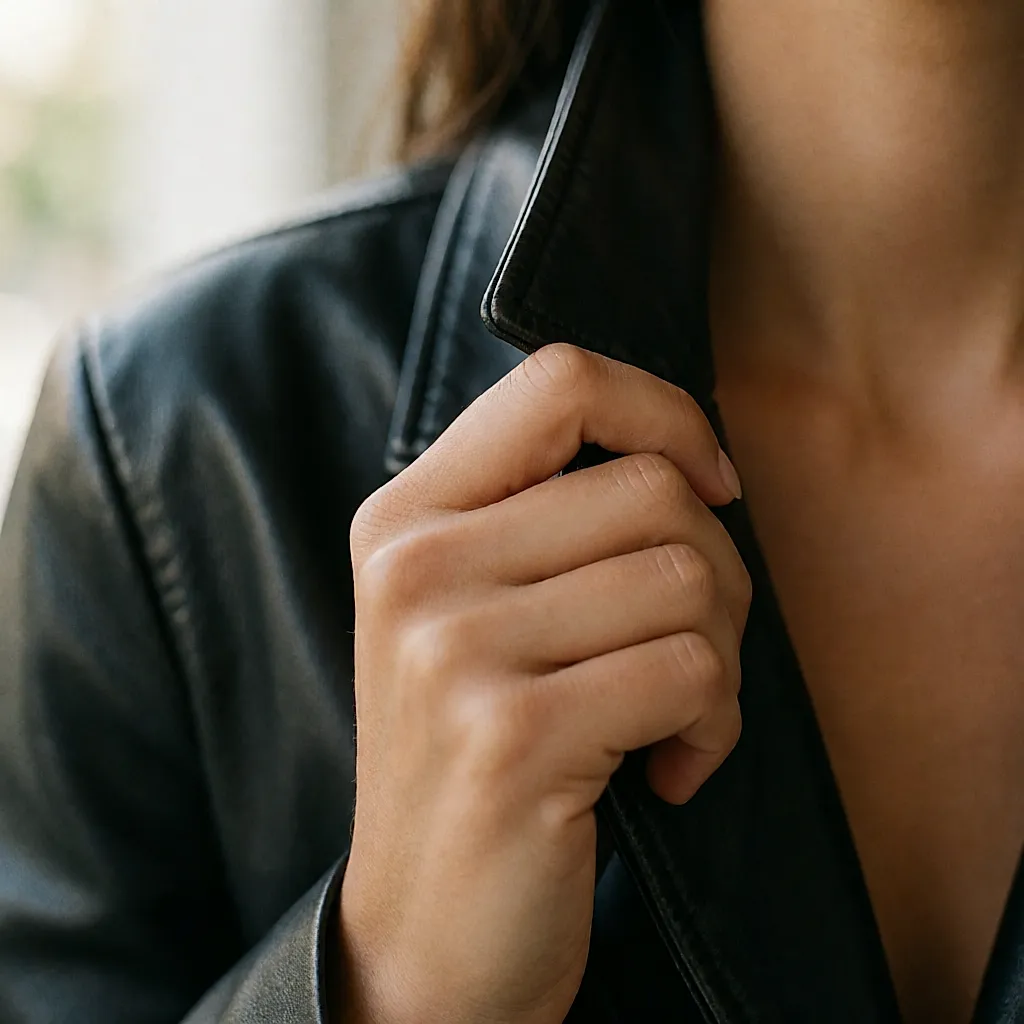
What you're really after is density. Leather that sounds hollow, that creaks like plastic when you rub it or that permanently deforms under your thumb won't go far. Lambskin tends to be finer and cowhide thicker — but thickness alone doesn't tell the whole story: it's the tanning and the finish that create the drape you can recognise from three metres away.
Full-grain, grained, smooth: how to read the label
Three words keep appearing on labels and are worth pausing over. Full-grain keeps the natural surface of the hide: visible pores, veins, irregularities. It's the most alive, the one that develops a patina, and also the most prone to marks. Grained leather has had a finish that evens out the grain, sometimes after light sanding: more scratch-resistant, more uniform, it tells you less but takes more punishment. Then there's the smooth finish, the discreetly velvety option.
Tanning matters just as much. Vegetable tanning, using tree bark and tannins, takes longer and often gives a firmer leather at first, which softens and turns honey-coloured as it ages. Chrome tanning is faster and produces softer, more uniform leather. Neither is a certificate of virtue: what matters is the traceability of the hide and the care taken over the finish. If in doubt, check the composition: as soon as a significant proportion of synthetic fibres appears in the main material, it's no longer quite a leather jacket.
Lining, zip, stitching: the three tell-tale signs
Turn the jacket inside out. The lining — cupro, viscose or cotton — should be stitched at the hem, not simply left loose: that's what stops it riding up into the sleeves over time. Then look at the zip: a heavy pull that glides without snagging signals a fastening that will last; a zip that catches the first time you open it is already warning you. Finally, the seams — even topstitching, tight stitches, reinforced armholes. A seam that pulls on the leather or puckers means the piece was rushed.
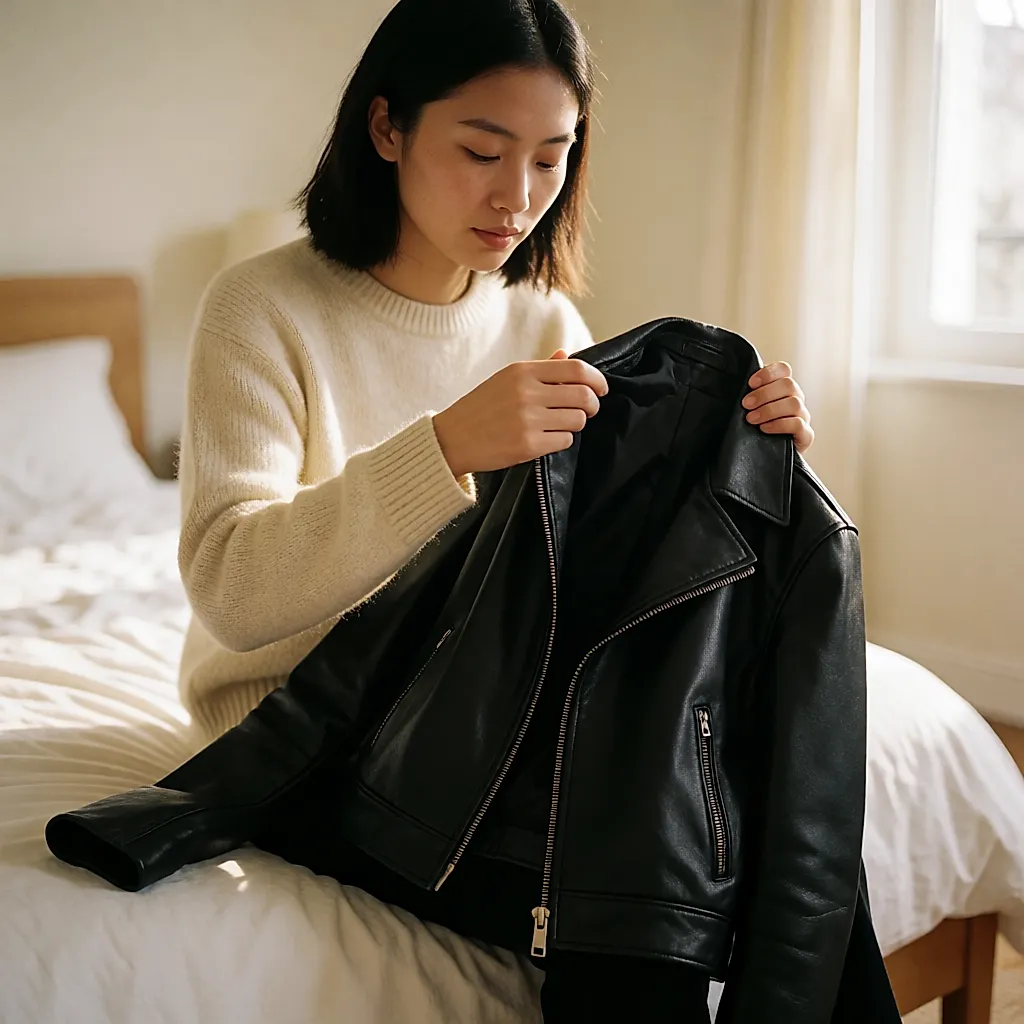
And one detail we always forget in the fitting room: the hem. Hang the jacket closed on a hanger and check whether the lower edge stays straight. A wavy hem is hard to put right — whereas a thirty-second try-on costs nothing.
Care, or why some jackets make it to twenty
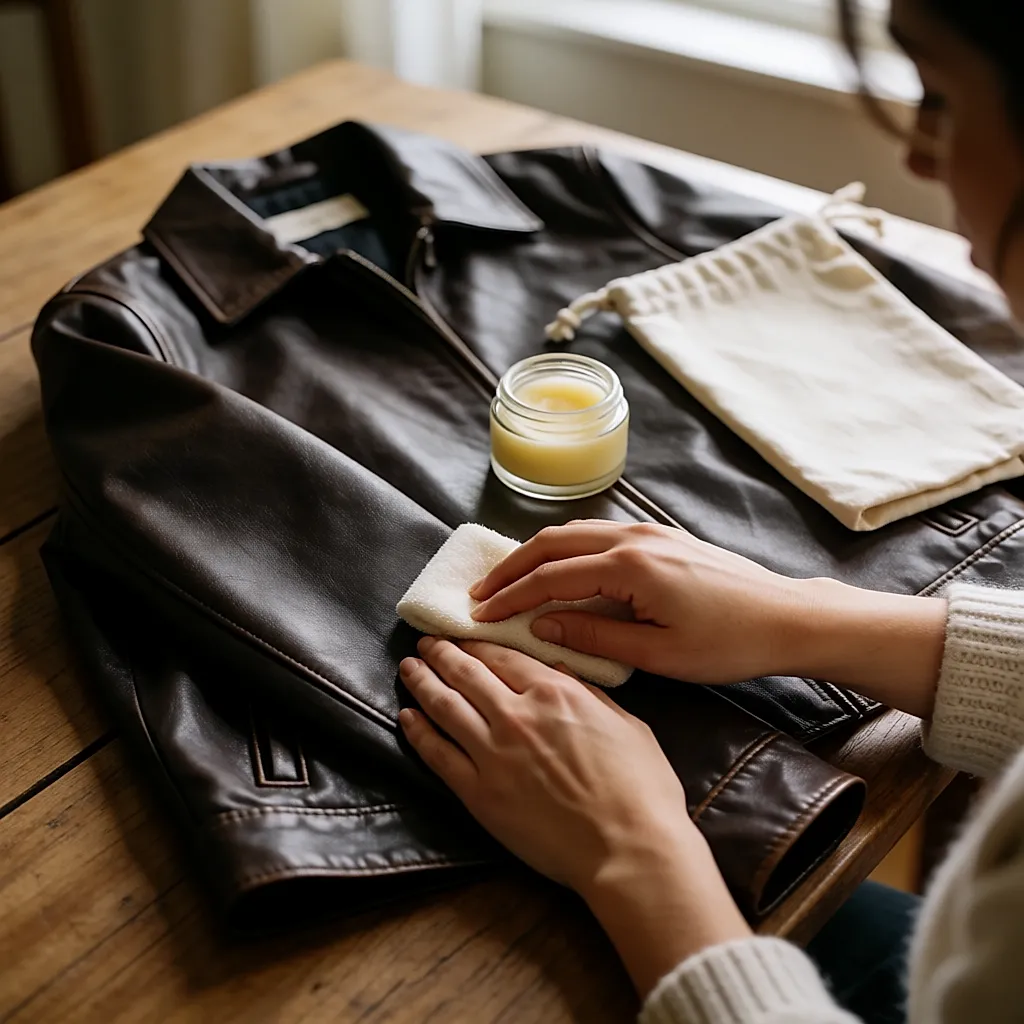
A leather jacket doesn't wear out; it gets neglected. The classic advice is to feed the leather with a colourless balm once or twice a year, and to waterproof it before the rainy season if you wear it outdoors a lot. The rest is common sense: dry it away from a radiator, blot water rather than rub, store on a wide hanger in a cotton bag — never in a plastic bag. No washing machine, no harsh soap, no tumble dryer. For a deep stain or a jacket that has lost its shape, go to a leather specialist: it's not an admission of failure, it's an investment.
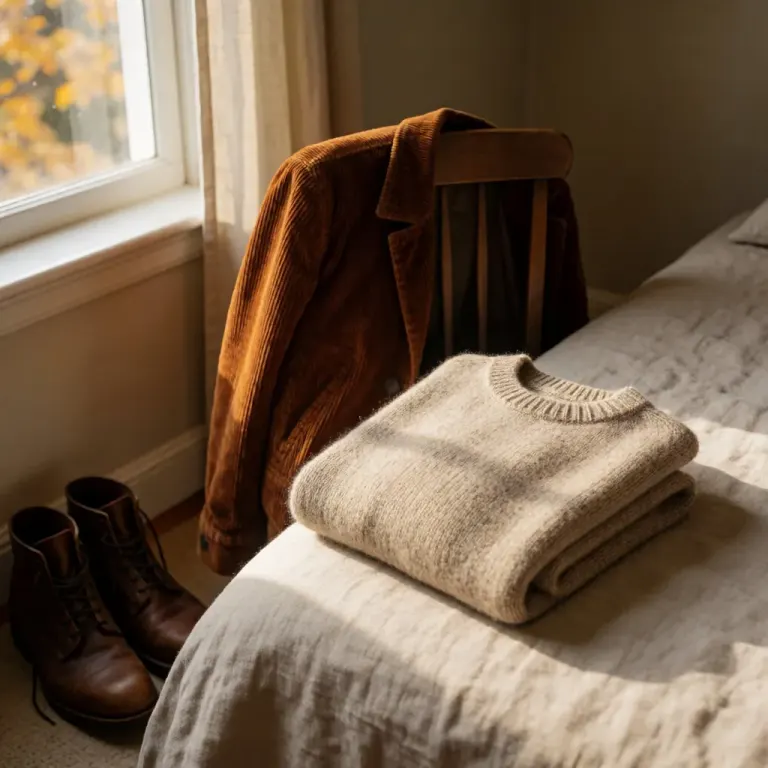
One final point that's easy to overlook: try the jacket over the knitwear you'll actually wear it with in November, not over a July T-shirt.
Budget: what you'll actually pay
No official price scale exists, so treat the ranges below as market estimates — rough guides at best. Expect around £80–£150 for an entry-level jacket, often in fine lambskin — read the label closely. Between £250 and £600, you're into better leather, better finishing, a stitched lining and a proper zip. Above £800, it's often well-made cowhide, vegetable tanning and European manufacturing. If new isn't essential, second-hand remains the smart move: charity shops, vintage shops, dress agencies, reuse centres and resale platforms are full of 90s jackets whose leather has lost nothing. For care, expect £10–£25 for a balm, and £30–£80 for a full clean at a specialist.
The three-pinch test, in the fitting room
- the collar: suppleness, density, how the crease springs back;
- the shoulder: the leather should be thicker, not stiffer;
- the jacket closed on a hanger: straight hem or wavy, there's no in-between.
Ultimately, a successful leather jacket isn't the most expensive or the softest: it's the one where the leather, the finish and your care routine all work together. Take the time to pinch it in the fitting room, accept that a good piece needs a little looking after, and let it age. The best ones aren't the ones you paid the most for, but the ones you're still wearing ten years later.

Comments
Your opinion matters: rate the article, react and reply to comments.
Comments are moderated; AI-assisted comments are flagged. Text emoticons (8-), :-), <3…) are automatically shown as images.