
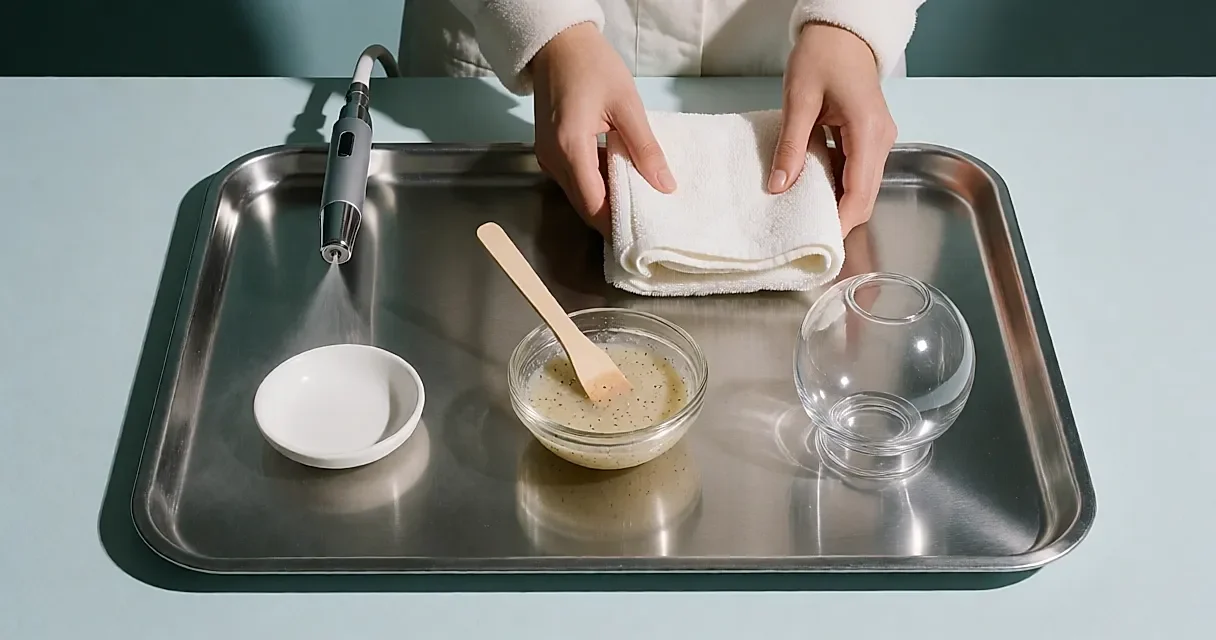
The name of the treatment on the clinic's menu tells you almost nothing about what will actually happen to your face. What decides it is the tool that goes on your skin, how many times it is passed over, and what gets smoothed on afterwards. Three families account for most treatment-room bookings — pressurised water, an abrasive head and cold — and they are not aimed at the same faces.
The water jet: rinse, suction, repeat
It is oddly satisfying to watch: a handpiece fires a warm water jet and sucks it straight back up in the same movement, gliding a serum or a solution across the face. The device works zone by zone, and the suction lifts away whatever the water has loosened. You often come out with a clearer-looking complexion, sometimes a bit pink straight after — it looks like a mechanical, hydrating clean rather than a treatment that erases anything.

This one speaks to combination to oily skin, congested pores, blackheads on the nose and chin, and dull complexions that want a proper clean without being roughed up. If your skin is reactive, or you have rosacea or an inflamed acne flare-up, ask a dermatologist or your GP first: repeated passes of a handpiece can irritate. And ask the question that actually matters: how many passes, and with which product? A pure water jet and one loaded with actives are not the same treatment.
The abrasive head: effective, with no safety net
Here, something rubs. A diamond-tip head, or crystals blasted on and then suctioned off, files away the most superficial layer of skin. It is the treatment that shows most on thick, textured skin, on a tired complexion, on superficial acne marks — as long as it is done gently. The protocol matters as much as the machine: light passes beat heavy-handed ones, and that is usually where the difference lies between a clear face and cheeks that feel tight.

This is not one for fine skin, for skin prone to thread veins and flushing, or for skin that has just had acids or retinol, or been out in the sun. Afterwards? Full-spectrum SPF, a plain moisturiser, and no at-home scrubs for a few days. Of the three, this is the one with the most room for error.
Cold: for skin that runs hot
Cold comes via nitrogen, a soaked cotton pad or a cryotherapy device. The pass is brief, often at the end of a treatment: you cool the skin to calm a feeling of heat, temporarily tighten the look of the pores, bring down diffuse redness. The effect is real but short-lived — and that is entirely fine. Cold soothes; it does not treat established thread veins.

This is the treatment for reactive skin, for faces that flush fast, for mornings when your complexion already feels heated, and for skin coming off a stronger protocol. Mention that history when you book: it can rule the treatment out or mean you need medical advice first.
The questions to ask before you book
Three are enough to sort the options, and you ask them on the phone, not on the treatment couch: which type of head, how many passes, and what is applied afterwards? A well-run clinic answers straight. If you get a "it depends" with nothing behind it, go elsewhere.
Add a fourth, the most important one: is this treatment right for my skin as it is today? Skin peeling after sunburn, an acne flare-up, a dermatology appointment last week — say so before you lie down. Be wary of the one-setting-fits-all approach, applied to everyone without adjustment. The right question is not "which is the best facial" but "which one for my skin, today". The detail that makes the difference is often one notch lower on the machine.
What it costs
Prices depend above all on the equipment. Expect roughly £60 to £110 for a mechanical exfoliation in the treatment room, £90 to £200 for a pressurised water-jet session — the machine is expensive for the clinic, and that shows up on the bill — and £35 to £70 for cryotherapy on its own. In London you will be at the top of those ranges; in a mid-sized city, nearer the bottom.
Multi-session packages bring the per-session price down. And if a course of six is winking at you, book a single one first to see how your skin reacts. I am not going to pretend there is one figure to quote: from one clinic to the next, the same machine can be set very differently.
The habit worth keeping. Note the name of the head used and the product applied afterwards. If your skin feels tight the next day, you will know what to avoid next time — and what to ask for in a gentler version.
In truth, none of these three is the best: they suit different skins, and sometimes different weeks. Oily, congested skin in November does not need the same thing as in July, after three weekends spent outdoors. What you should leave the room with is comfortable skin, not a porcelain complexion. And a diary in which you finally know what you came for.

Comments
Your opinion matters: rate the article, react and reply to comments.
Comments are moderated; AI-assisted comments are flagged. Text emoticons (8-), :-), <3…) are automatically shown as images.