

A product that stings isn't a product that's working. Skin doesn't always warn you when it's had enough: it takes it, carries on, then kicks off two days later. By which point you're blaming the wrong thing — and layering a soothing cream over the serum that caused the trouble in the first place.
Your skin doesn't file a complaint straight away
That's the great unfairness of skincare: you apply something, feel nothing, are quietly pleased with your skin the next morning, and then the following week it's tight, itchy, one cheek is hot, your forehead is covered in little bumps. A reaction can show up hours after application, sometimes the next day, sometimes later still — in practice, cause and effect are rarely as tidy as we'd like.

Hence the trap of the brand-new product. If you start a vitamin C and an AHA exfoliant within the same fortnight, which one do you blame when your cheek goes red? Impossible to say. Two new things at once is a bit like two children crying in the next room: you know there's a problem, you just never know who started it.
A pause, two products, no temptation
Our rule of thumb fits in one sentence: pause everything active — scrubs and chemical exfoliants, retinol and its relatives, vitamin C, fragrance, including the fragrance hidden inside a product — for the length of the pause, and keep only a gentle cleanser and a plain moisturiser. No masks, no "detox" serum, no stand-in dug out of the back of a drawer. Keep it short: cleanse with lukewarm water, pat dry, moisturise.
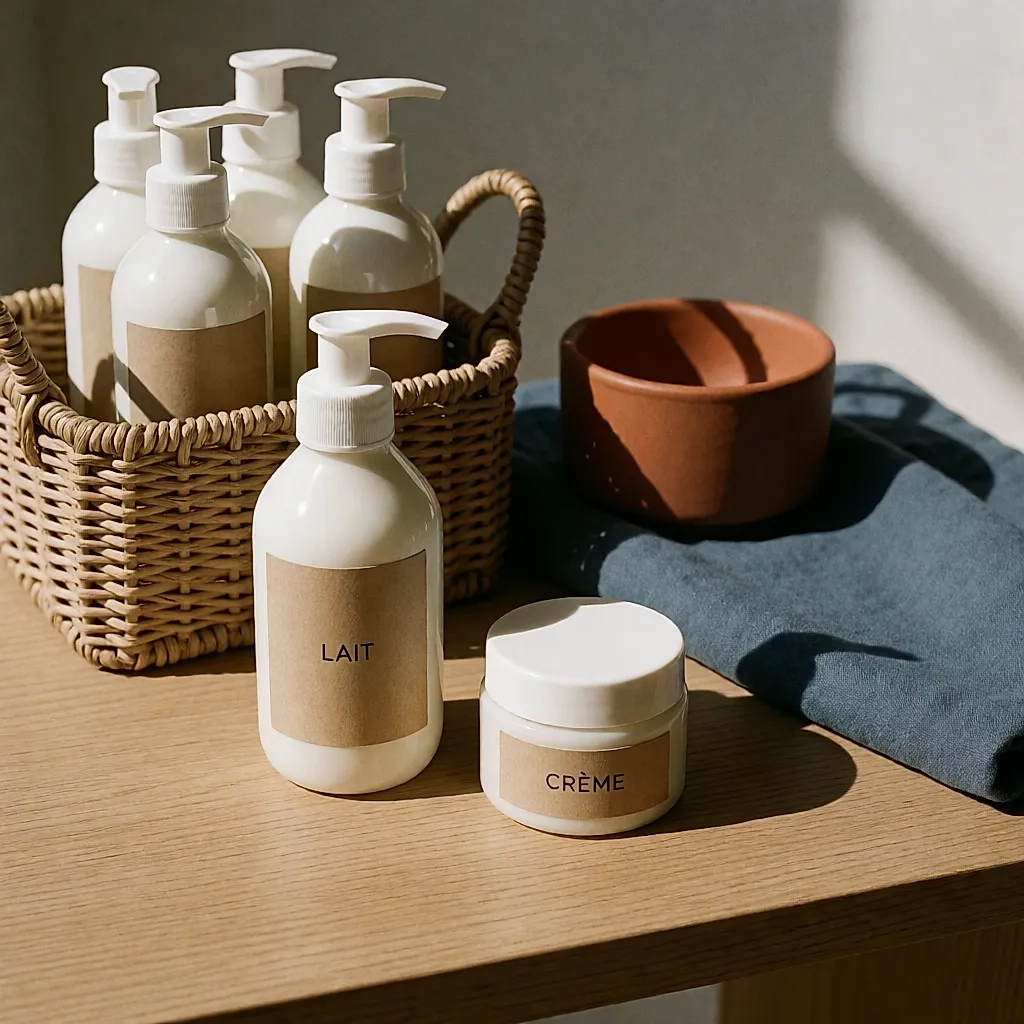
One caveat, and it matters: if a dermatologist prescribed an active — a retinoid, an acne treatment, something for rosacea — don't stop it without their say-so. The at-home subtraction method is for products you chose yourself.
It may well settle down during the pause. That's not a guarantee, and that's exactly the point of the exercise: if nothing changes, it makes "too many layers" a less likely explanation, without ruling it out entirely.
One product at a time, then wait before you judge
Then comes the hardest part: reintroducing. Put back one product at a time, then leave a gap — length to be adapted — before you judge, because that interval is precisely what lets a delayed reaction show itself. You can also patch test on a small area (the crook of your elbow, behind your ear) when a product doesn't fill you with confidence.

Then there's the question of what to write down. A tingle that fades in 30 seconds and a warmth that lasts ten minutes aren't telling you the same story; skin that feels tight after application and skin that itches three hours later aren't either. These markers are ours, not an official scale: the point is to compare against your own reactions, not against a friend whose skin is nothing like yours.
The three-column log. One line per application: the product, the day, the sensation (nothing / brief tingle / warmth / tightness). Regular notes beat ten hazy memories — and on the day you do go for advice, that log becomes a genuinely useful ally.
When to stop eliminating and see someone
Eliminating is a method, not an endless strategy. If a patch sets in, if skin swells, weeps or itches enough to wake you, if redness spreads or reaches your lips and eyelids, stop hunting for the culprit: see a healthcare professional, without waiting for the experiment to run its course. Difficulty breathing together with facial swelling is an emergency in its own right.

Same reflex if, after a spell of simplification, nothing improves, or if you recognise signs that point to eczema, rosacea or acne: those are diagnoses, and they belong to a dermatologist — in the UK, usually by way of your GP. Proper allergy testing is carried out with a healthcare professional too. You're allowed not to know — and that's often exactly where things start to move.
What it costs
The good news: the method doesn't require buying anything. If you do need to top up, expect in the region of £8–£20 for a gentle fragrance-free cleanser (chemist, pharmacy or supermarket) and £10–£25 for a plain moisturiser, depending on size and range. Solid formats and refills exist at those prices and cut down on packaging; what's worth checking is a short ingredient list and no added fragrance — that's where the substance of it lies, not in the name on the jar.
A pause, a notebook, one product at a time: the most useful routine is sometimes the one you don't do. And if your cabinet calls to you mid-experiment, write that down too — it's one more line to tell your skin about.



Comments
Your opinion matters: rate the article, react and reply to comments.
Comments are moderated; AI-assisted comments are flagged. Text emoticons (8-), :-), <3…) are automatically shown as images.