
The white cast on the sleeve of a black roll-neck tells you more about a sunscreen than its price tag ever will. It's the most honest test there is, and it doesn't appear on any product page. A tube that leaves a white cast, rolls under foundation or gets avoided because it feels tacky will never protect as well as one you apply without thinking. The question is what you're really comparing when you're weighing up the supermarket shelf against the pharmacy counter.
In winter, UVA doesn't take a holiday
A stubborn fact: the SPF on a tube mainly measures protection against UVB, the rays that burn. UVA, by contrast, passes through office glass and doesn't stop at a hazy sky. When UVB is weaker, UVA makes up a larger share of the radiation — winter doesn't remove anything, it shifts the dials. Because UVA is linked to photoageing, it's exactly what you'd want to filter in November, especially if your day is spent two metres from a window.
The tube on your shelf isn't a summer object abandoned there out of laziness. It still has to feel wearable until evening, and you have to actually want to reach for it.
Dose first, price second
The protection stated on the pack is measured in a lab using a standardised dose, which nobody replicates in the morning with one hand already on their bag. In practice, we often use far less. Which means: of two sunscreens with the same SPF, the one you apply generously protects you more than the other. The amount you're willing to apply is what separates two tubes, not the label.

A rule of thumb from the team, not an official dosage: allow about a teaspoon for face and neck, split over two layers if the texture is fluid. And this is where the supermarket tube scores: light texture, a price that makes generosity easy. A richer cream from a pharmacy or beauty retailer, more expensive per millilitre, often ends up rationed drop by drop. A sunscreen you skimp on is a half-effective sunscreen, whatever its pedigree.
Under foundation, staying power is what counts
The second deciding factor is the finish. A product that leaves a white cast, pills or makes foundation slide won't get a second outing — and a sunscreen skipped every other morning is a bad investment, whether it costs £6 or £30. Mineral formulas based on zinc oxide or titanium dioxide often go on whiter; tinted versions partly correct that, provided you find the right shade, which isn't a given.

The most reliable test is wear. Layer it on one half of your face for a few days and see what your make-up does by midday. If it holds, you're sorted. If it marks, no packaging claim will change your mind — and you already know that.
Read the UVA logo before the price tag
This is the criterion that should decide, aisle or no aisle. The UVA logo inside a circle is a practical clue, but it doesn't tell you the actual level of UVA protection: two SPF 50 tubes can carry the logo with different real-world protection. And a tube without it isn't useless either — it simply doesn't guarantee anything specific on that front.
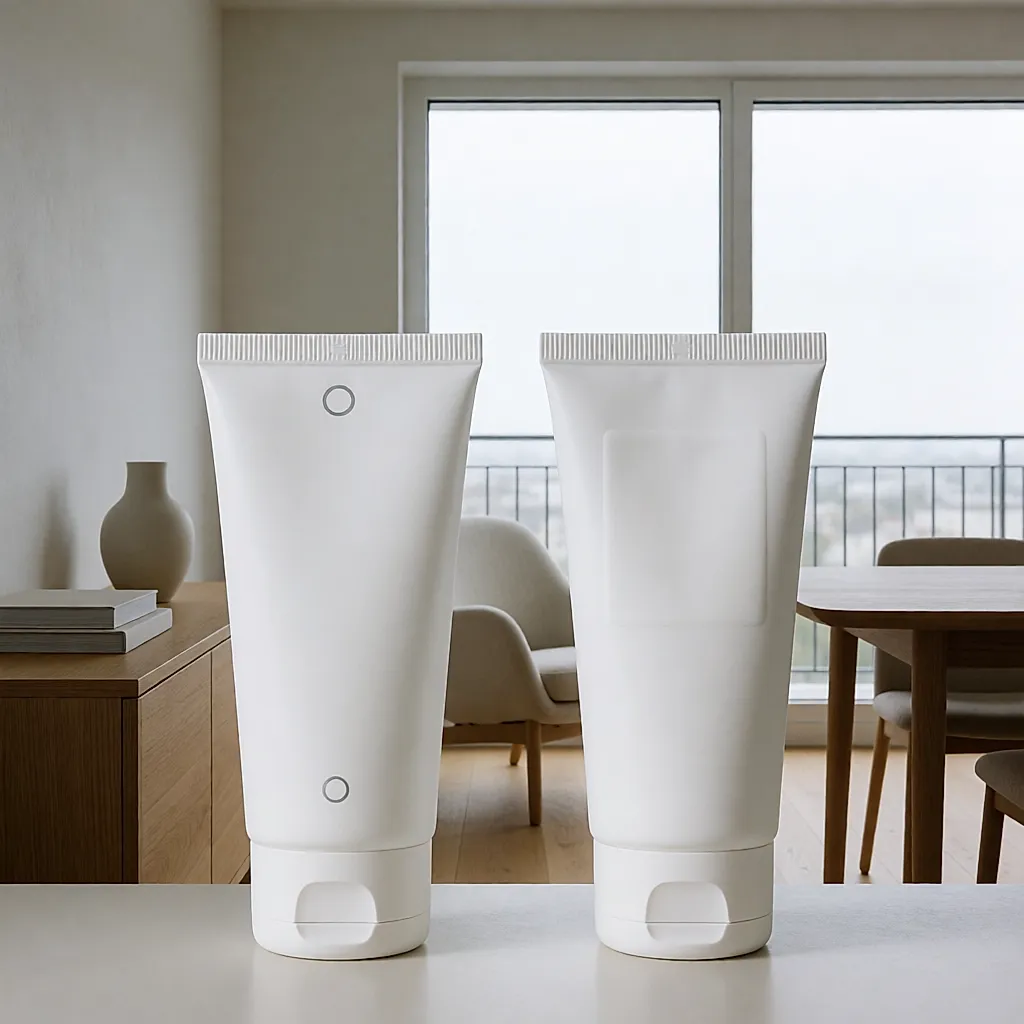
One last label habit: the protection gap between SPF 30 and SPF 50 is smaller than you'd think. Going up a notch never makes up for a stingy application. In other words, a generous layer of SPF 30 beats a drop-by-drop SPF 50.
The black-sleeve test, worth doing once: apply your sunscreen to your cheek, then press the sleeve of a dark jumper against it. No deposit, no fluff? The tube stays. If it leaves a veil, you'll abandon it — better to change formula now than to use it grudgingly.

Budget
On price, the differences are real but less dramatic than you'd think. In a supermarket, expect roughly £5 to £12 for a 50 ml tube; in a pharmacy or beauty retailer, more like £12 to £25; for a tinted mineral product or a certified organic formula, £18 to £35. Location, size, tinted format and range all move the figure — a 50 ml tube works out better value than a 30 ml one if you really use the full dose.
Where to buy? The supermarket is still hard to beat for the basic you're happy to apply in excess; pharmacies and beauty retailers more often offer refined textures and formulas for reactive skin; health-food shops and brand websites cover mineral options and refills. On packaging, refill formats and cardboard tubes are multiplying: check that the refill actually exists before committing, and choose glass or cardboard where it's offered.
What matters when you've only got five minutes
If you remember one thing, make it this: choose the tube whose texture you like and whose price doesn't make you hesitate to squeeze out the full dose. The rest — logo, SPF, brand — takes thirty seconds to check on the pack. And if, at eleven o'clock, you're still sitting under a window, your sunscreen is the one you'll be glad you didn't skip.

Comments
Your opinion matters: rate the article, react and reply to comments.
Comments are moderated; AI-assisted comments are flagged. Text emoticons (8-), :-), <3…) are automatically shown as images.