
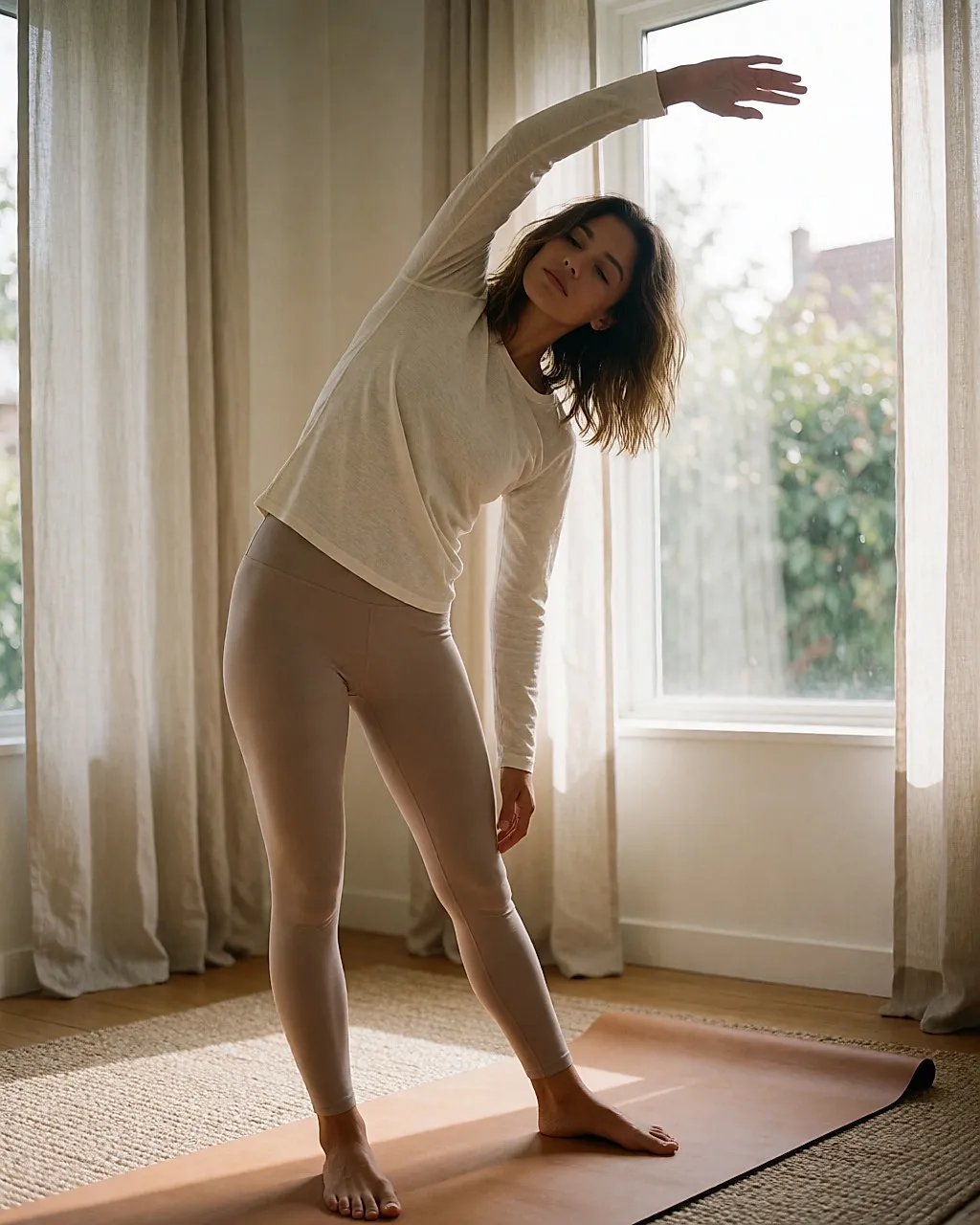
A back that pulls by the end of the day, shoulders creeping up towards your ears, that faintly rusty feeling after hours at a desk: nothing to worry about, but your body is quietly asking you to move differently. And when you have neither the time nor the inclination for a run of workouts, stretching is often the simplest answer.
The principle takes a few lines to explain: slow movements held for a few tens of seconds, with steady breathing you never hold. Arm circles, chest openers, hamstring stretches — you work through each muscle group without jerking and without chasing performance. At home it soon turns into a ritual: a mat on the floor, ten minutes, and the body settles.
Why it helps
The less you use a muscle, the shorter and tighter it becomes: joints move less freely and stiffness sets in. Done regularly, stretching maintains your range of motion and eases tension in the back. Current evidence also suggests an effect on how stressed you feel, particularly when your breathing goes along with the stretch instead of staying in the background.
That said, no magic promises: stretching is no substitute for a diagnosis or for treatment. If a pain settles in, speak to a professional — your GP or a physiotherapist — before you start.
What we know, and what we don't yet: stretching durably improves range of motion, and that is well documented. Its exact role in preventing sports injuries is still debated, with findings varying between studies. So stay in a comfortable range, never in pain.
In practice
A few markers are enough: two or three sessions a week, ten to fifteen minutes, each position held for twenty to thirty seconds. Breathe slowly, don't bounce, and come out of the stretch as soon as the sensation turns sharp — it should stay pleasant, never painful.
You can stretch before or after another sport, or in the evening as a wind-down before sleep. The aim isn't touching the floor in the first session but feeling each area lengthen a little more. Over time, it becomes a genuine moment for yourself.
Budget
- On your own: free. A mat usually costs £15 to £40 from a sports retailer or online — look for natural rubber rather than PVC, which carries a heavier load of additives, and check how to dispose of it: few recycling routes take them, so most end up at the household waste site.
- Group classes: £10 to £20 per session, £30 to £60 a month on a membership or class pass, at a gym or studio.
- Small group or one-to-one: £45 to £80 an hour.
- Online: £10 to £20 a month.
Prices vary by city, class size and the length of commitment required.
Sources
- World Health Organization, WHO Guidelines on Physical Activity and Sedentary Behaviour, 2020.
- UK Chief Medical Officers, Physical Activity Guidelines, 2019.
- NHS, exercise and fitness guidance.
- American College of Sports Medicine, recommendations on flexibility.


Comments
Your opinion matters: rate the article, react and reply to comments.
Comments are moderated; AI-assisted comments are flagged. Text emoticons (8-), :-), <3…) are automatically shown as images.