
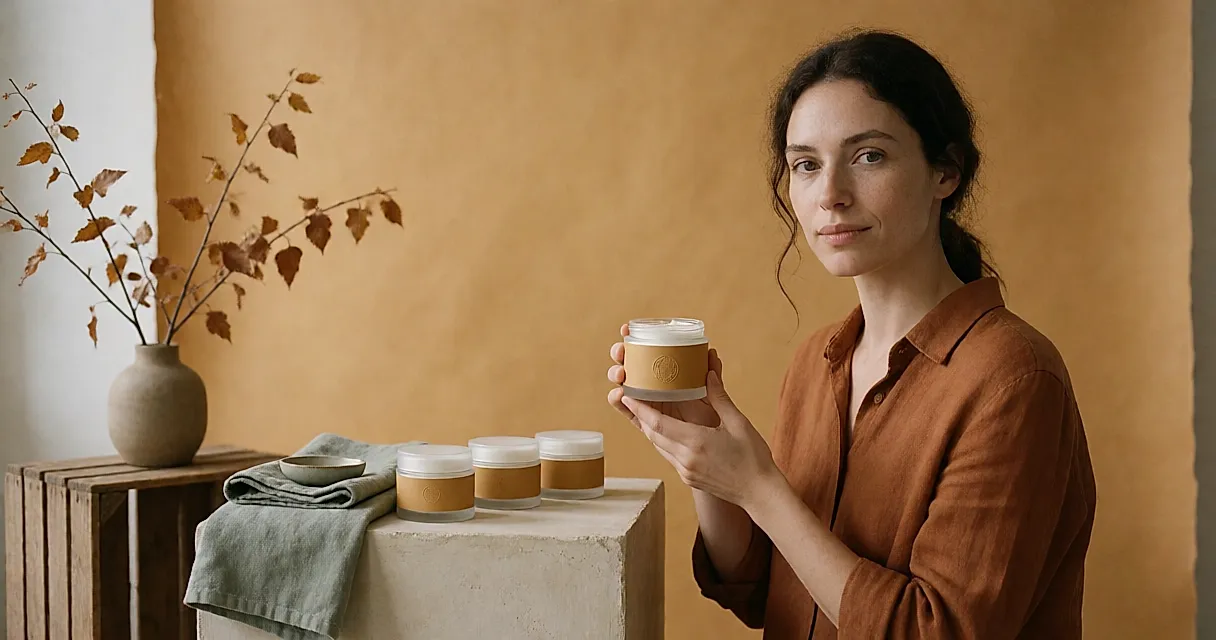
A new jar is a promise; a jar you opened six months ago is a case file. The distinction sounds trivial; it changes everything: a case file can be investigated without spending a penny. Ask a pharmacist what is wrong with a routine and the answer rarely starts with a product to buy. More often it starts with a question: what are you already using?
The urge to buy the next jar
Three weeks without visible results, and doubt creeps in. You decide the cream is wrong, your skin has got used to it, you need to move up a level. Cue one more bottle. Except skin has no sense of politeness: it reacts to what you give it, not to what you are promised.
The trouble with layering is that you lose the ability to read your own routine. When eight products take turns on the same face, it is impossible to know which one is working, which one is irritating, which one is pointless. And if things improve, you do not know why either — so you have learned nothing for next time. That is the real cost of the extra jar: not its price, but the information it erases.
The audit, or the art of finishing what you own
The first step costs nothing and takes 20 minutes: take everything out. Put it on a table, a towel, anywhere except in front of the mirror, where you will inevitably end up restyling your hair instead of sorting. Line up the tubes, count them, and the verdict is often harsher than expected. Two identical serums? Three unopened samples? An oil nobody can remember how to use?
Next, read your stash like a logbook. The PAO — the little open-jar symbol on the label, followed by 6M or 12M — is the use-by date after opening. Textures that have separated, a rancid smell, a colour that has turned: bin them, no regrets. For everything else, one simple rule: finish before you buy. In practice that means one product at a time — the one already open, the one you need now, and nothing else.
One variable at a time, please
If you really want to know what a product is worth, do not add it to a pile. Remove something, add one product, and give yourself time to watch. A few weeks, long enough for your skin to go through its cycle, is a reasonable marker — not an exact science, just a method. The principle fits in one sentence: one change at a time.
And make a note: one line in your phone, the date, what you changed, what you are seeing. No triumphant conclusion after four days: skin has its moods, the weather has its own, and work stress does not check with anyone first. I do not know whether this kind of rigour suits everyone; it does at least make the question readable: is it worth it, yes or no?
When the jar is not to blame
There are times when the routine is perfectly sensible and the problem sits elsewhere: broken nights, very hard water, a mask left on for too long, hands drifting to your face without thinking. These are leads to explore, not suspects named in advance.
And if it persists despite a simplified routine, with no layering, it is no longer a matter of bottles. That is when you ask a healthcare professional — your GP or a dermatologist — to take a look. It is not an admission of failure: it is the logical next step of the audit, once you have ruled out everything that wasn't a skincare issue.
The four-step method
- Take everything out, count it, and bin anything that has changed in appearance or smell.
- Finish the opened product first, in the order in which it is likely to deteriorate.
- Make one change at a time, over a few weeks.
- If nothing changes: the question is no longer 'which jar?' but 'who should I see?'
What layering really costs
A face product is a price tag that creeps up quickly. As a rough guide in the UK, entry-level face creams in supermarkets and high-street chemists tend to sit somewhere between £8 and £25; pharmacy and beauty-counter lines between £20 and £50; niche brands can go higher still. The price rises with size, where you shop and the product line — rarely with how useful it actually is in your routine.
The calculation to make before adding a bottle: one extra product per quarter means four extra bottles a year joining the open-jar ranks. By contrast, finishing what you own costs nothing and makes your routine readable. And if you genuinely lack something, the simplest move is to ask for advice somewhere they know you a little — a pharmacy or a beauty counter — rather than piling up discoveries found online at 11pm.
At heart, an audit is not glamorous: no novelty to unwrap, no promise to believe. Just order and a proper count. And a question we ask far less often than we should, even though it is the most useful one of all: is this bottle doing something for me, or is it just keeping me occupied?

Comments
Your opinion matters: rate the article, react and reply to comments.
Comments are moderated; AI-assisted comments are flagged. Text emoticons (8-), :-), <3…) are automatically shown as images.