
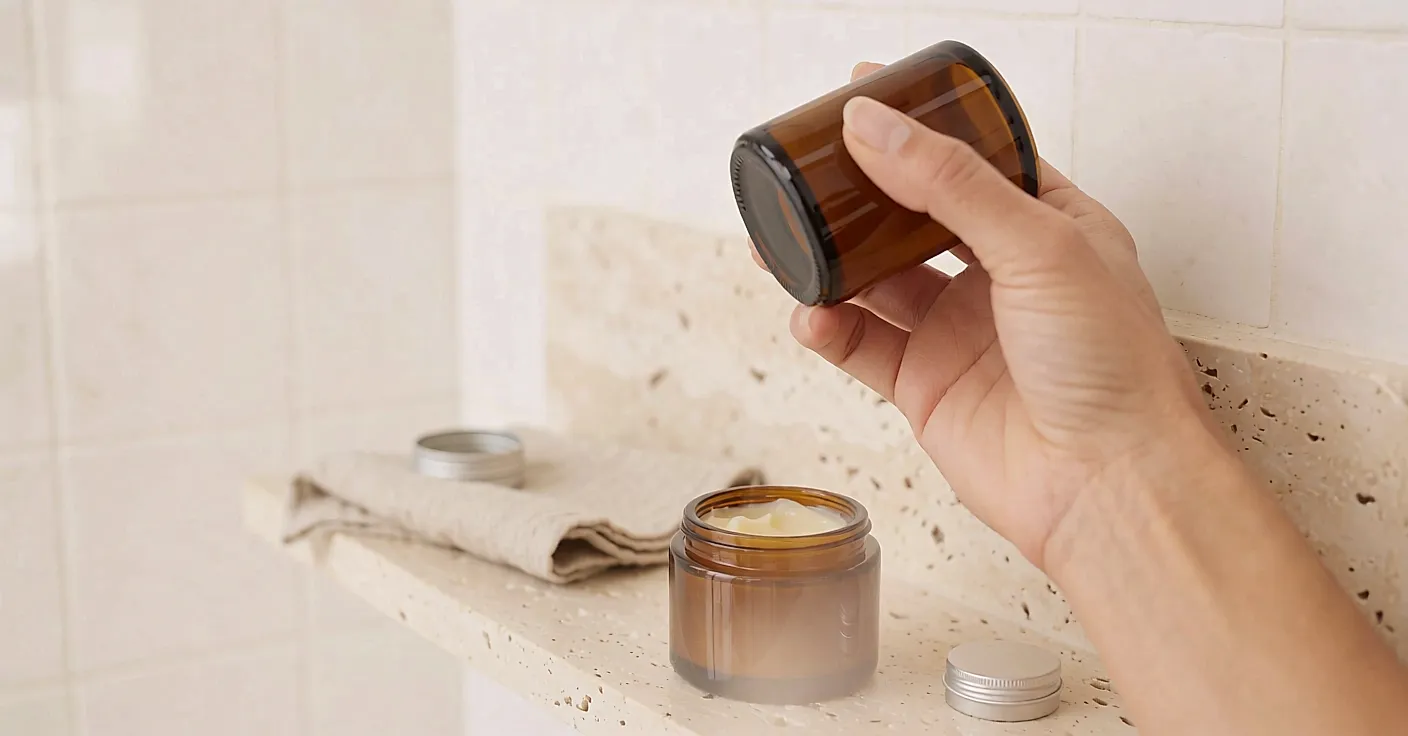
Do the maths on a Sunday clear-out: how many tubes, jars and bottles are sitting on your shelf? Twenty, thirty — and two whose age you can no longer remember. Then comes the Saturday when your weekend bag is packed in five minutes: one product goes in, always the same one. It might be the product that deserves the best spot.
Three jobs, one jar
For years, beauty talk was built around the hero ingredient: one cream for an acid, one for a vitamin, and a third because the bottle looked nice. The shift taking hold is less dramatic and far more practical: we look at how many jobs one product can do. Face, hands, body, lips, sometimes the mid-lengths and ends of hair — some balms, oils and solid soaps claim three or four uses on the label. One jar, several jobs is the fashionable promise, and at least it can be checked.

The textures that tend to do this best are often the simplest: a plant oil, an anhydrous balm, a solid soap, a cleansing powder. They are easy to read — you know the texture inside out, and you're not rummaging in the cupboard at 7.45am. The buying test changes too: instead of asking which active ingredient is trending, you ask how many things you no longer need to buy.
What a multi-purpose formula won't replace
Let's be clear: a multi-purpose product does several things well, rarely all of them perfectly. A formula designed for the body is often too rich for the face; a light face cream won't be enough for dry legs in January. And if the label says to avoid the eye area, that isn't a printer's quirk. In short, it makes an excellent first jar, not a Swiss Army knife.
The second caveat is more mundane: what gets used everywhere runs out faster. 50 ml on the face lasts a long time; the same 50 ml spread over your legs on a Sunday night is another story. On hygiene, a jar you keep opening and closing ages less well than a pump bottle. The period-after-opening (PAO) date — the little cream-pot symbol on the back, with its "6M" or "12M" — is still the reference, not your memory.
Getting the dose right
On slightly damp skin, an oil or balm spreads with far less product. In practice, start with a pea-sized amount for the face, a few drops for an oil, and add more only if skin feels tight. Warm fingers and gentle movements: nothing magic, but enough to avoid emptying the jar in three goes.
A rough guide to volume helps you decide what a product is for: 30 ml used morning and night on the face alone lasts several weeks; the same 30 ml on the body won't make it to the end of the month. Decide in advance — one jar for face and hands, another for body — rather than asking one to do everything.
A jar that travels ends up covered in bag fluff and crumbs. Keep the large size at home, fill a small labelled glass pot for your bag, and wash your hands before dipping your fingers in — or use a spatula, which is tidier.
Budget
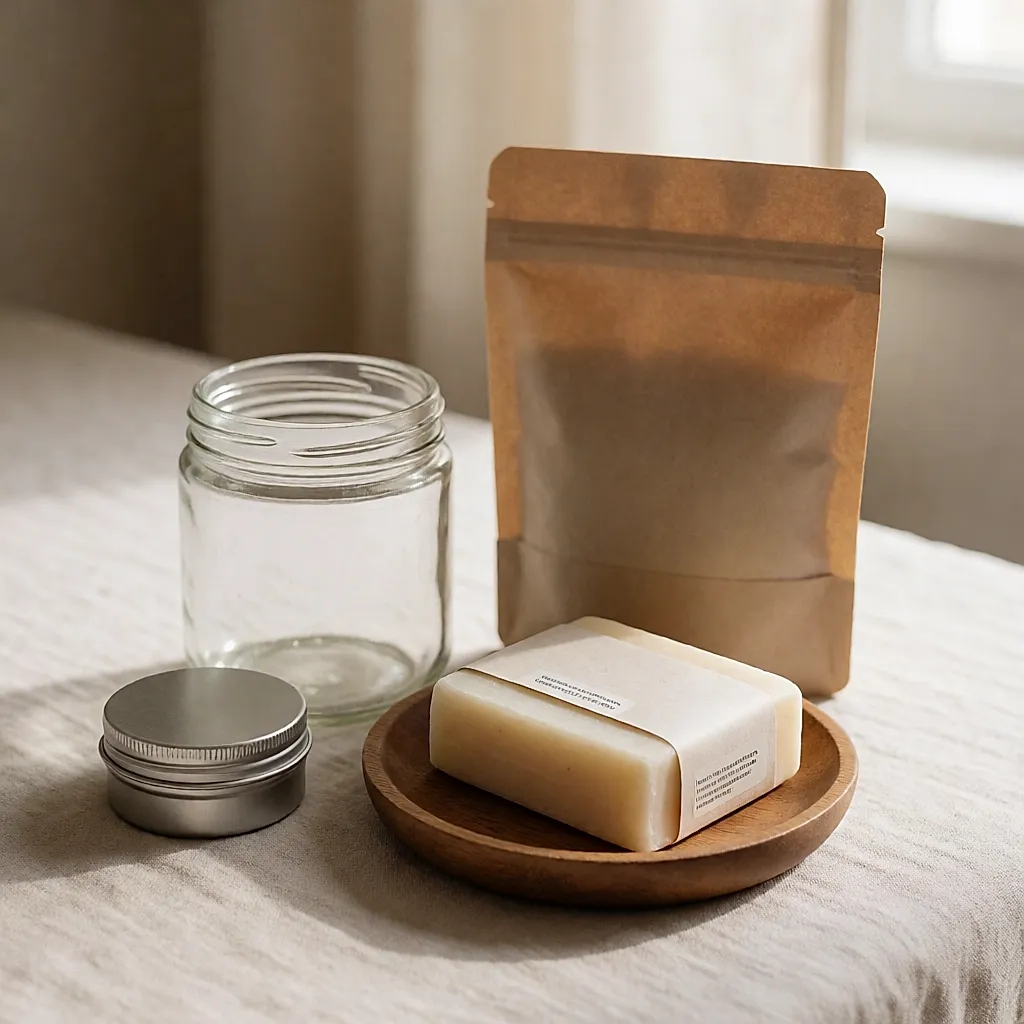
As a rough guide, expect to pay around £5–18 for an organic plant oil (50–100 ml), £7–27 for a multi-purpose balm depending on size, £3–8 for a 100 g solid soap, and £9–22 for a cleansing powder or solid shampoo. Prices vary by retailer, so check before you buy. You'll find them in pharmacies, health-food shops and supermarkets for the simplest formulas, and online, where refills can sometimes offer better value per gram than the starter size.
Does it actually save money? Not automatically: three products replaced by one expensive jar is not a saving. Three products replaced by a jar you actually finish is. The rule that works is to finish what you open before buying the next one, and to resist the "just in case" bottle.
The quiet packaging hero
The most restrained formulas are often the most packaging-light: solid formats do away with plastic bottles, waterless products — balms, oils and powders — keep well in glass or metal, and some brands offer refills. Check that a refill actually exists for the exact product you're buying: not every line has one. Label certifications can help you choose: COSMOS Organic, for example, sets standards for the formula — ingredient origin, the share of organic ingredients, and banned ingredients. It certifies a formula standard, never efficacy.
Be careful: multi-purpose is not an excuse to buy everything. The reflex comes down to three verbs: use, finish, keep. A jar that lasts three months and gets repurchased in exactly the same form is better than four tubes abandoned at the back of a drawer.
The rest is just talk. Tonight, take a look at your shelf: there's a good chance one object is already doing the work of three. Keep it, finish it, give it pride of place. Beauty that actually works often starts there.
Comments
Your opinion matters: rate the article, react and reply to comments.
Comments are moderated; AI-assisted comments are flagged. Text emoticons (8-), :-), <3…) are automatically shown as images.