
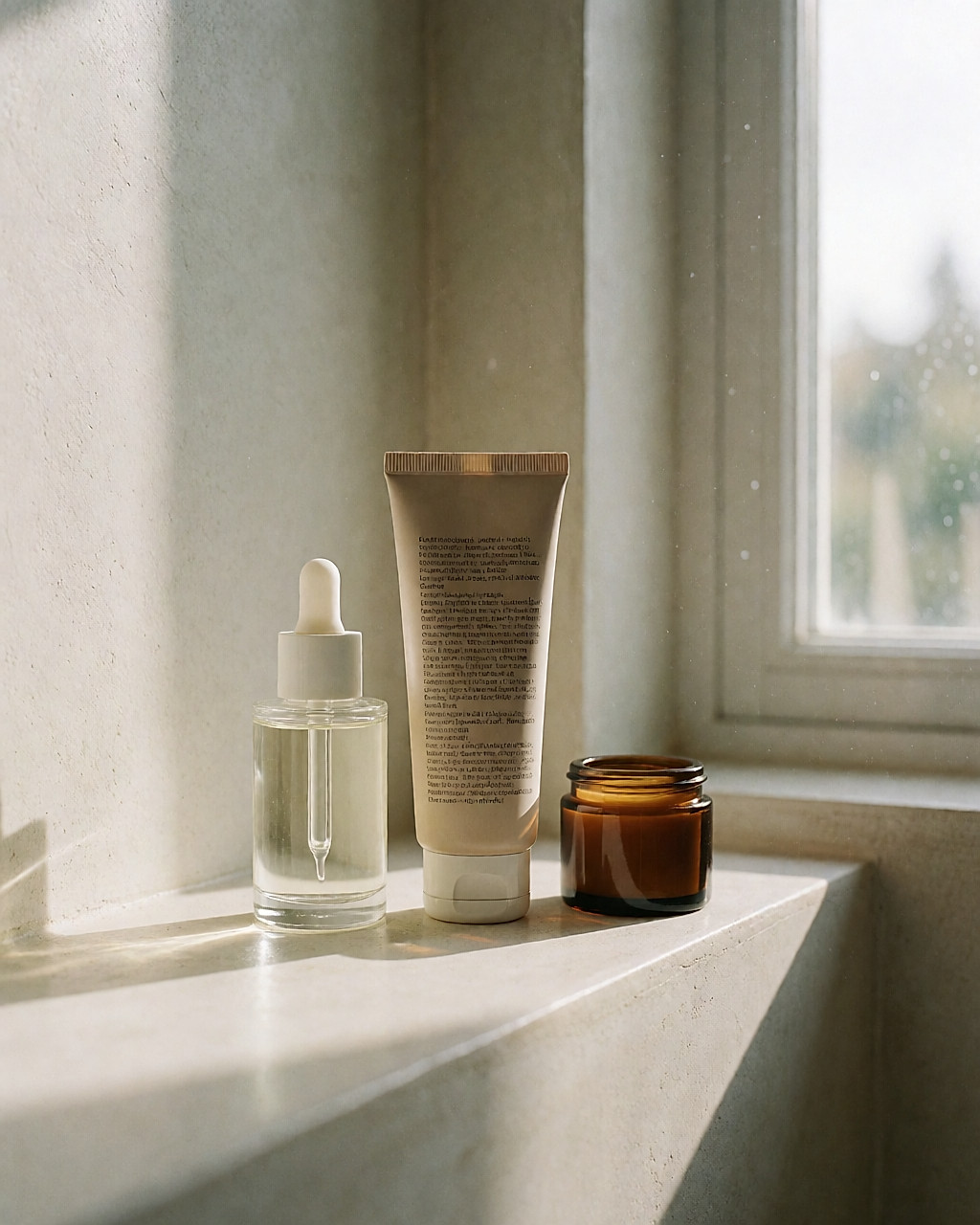
Let’s be honest: the bottle is pretty, the label promises the earth, and you’re there in your bathroom wondering what you’re actually putting on your skin this morning. A serum, a day cream, a make-up remover, a lip balm, a perfume — the little collection builds up, often without ever taking the time to read what’s inside. Then one day, the question arrives, the one you’ve been putting off: what is really hiding in those bottles? A quick look over a cup of tea, promise, with no confusing jargon.
Reading the INCI list: your first habit
In the UK, as in the EU, the good news is we’re not completely in the dark: cosmetics rules require ingredients to be listed in descending order of quantity, at least for those present above 1%. In the UK, this comes from the UK Cosmetics Regulation, which mirrors EU Regulation (EC) No 1223/2009. That’s the famous INCI list, printed on the back of the packaging, in tiny type, the one you squint at. Names are standardised internationally: aqua for water, glycerin for glycerine, parfum for the fragrance blend. Once you get the habit, it reads almost like a recipe.

This list has its blind spots, though, and that’s where it gets interesting. It says nothing about the exact concentration, nor the quality of the raw material. The word parfum can cover dozens of molecules on its own, and a formula labelled 'no added fragrance' is not necessarily free from allergens. Safe to say, between the marketing and what’s actually in the bottle, there can be a small gap.
Three families that spark debate
Since the 2000s, we no longer look only at immediate toxicity: we also ask about low-dose and long-term effects. Three families come up regularly in scientific and regulatory discussions, and deserve a couple of minutes.

Some phthalates, used as solvents or fragrance fixatives, are suspected of acting as endocrine disruptors. Some synthetic musks, very persistent in the environment, can accumulate in living tissues. Some alkylphenols, such as nonylphenol, are also suspected of disrupting the hormonal system, as well as being toxic to aquatic life. Three guests we’d rather do without in our routine.
The framework has moved, though, and that’s fairly reassuring: several of these substances are now banned or restricted in cosmetics, and UK REACH and EU REACH regulate their industrial use. Restricted does not mean zero — that’s the nuance, and it’s exactly this kind of detail that justifies keeping an eye open without tipping into paranoia.
Labels and tools to help you make sense of it
Really, the move that changes everything takes thirty seconds: scan the barcode. Apps such as Yuka, INCI Beauty or Think Dirty decode the INCI list and give a score — handy for comparing two creams on the shop shelf, provided you don’t mistake that score for medical advice. It’s a sorting tool, not a diagnosis.
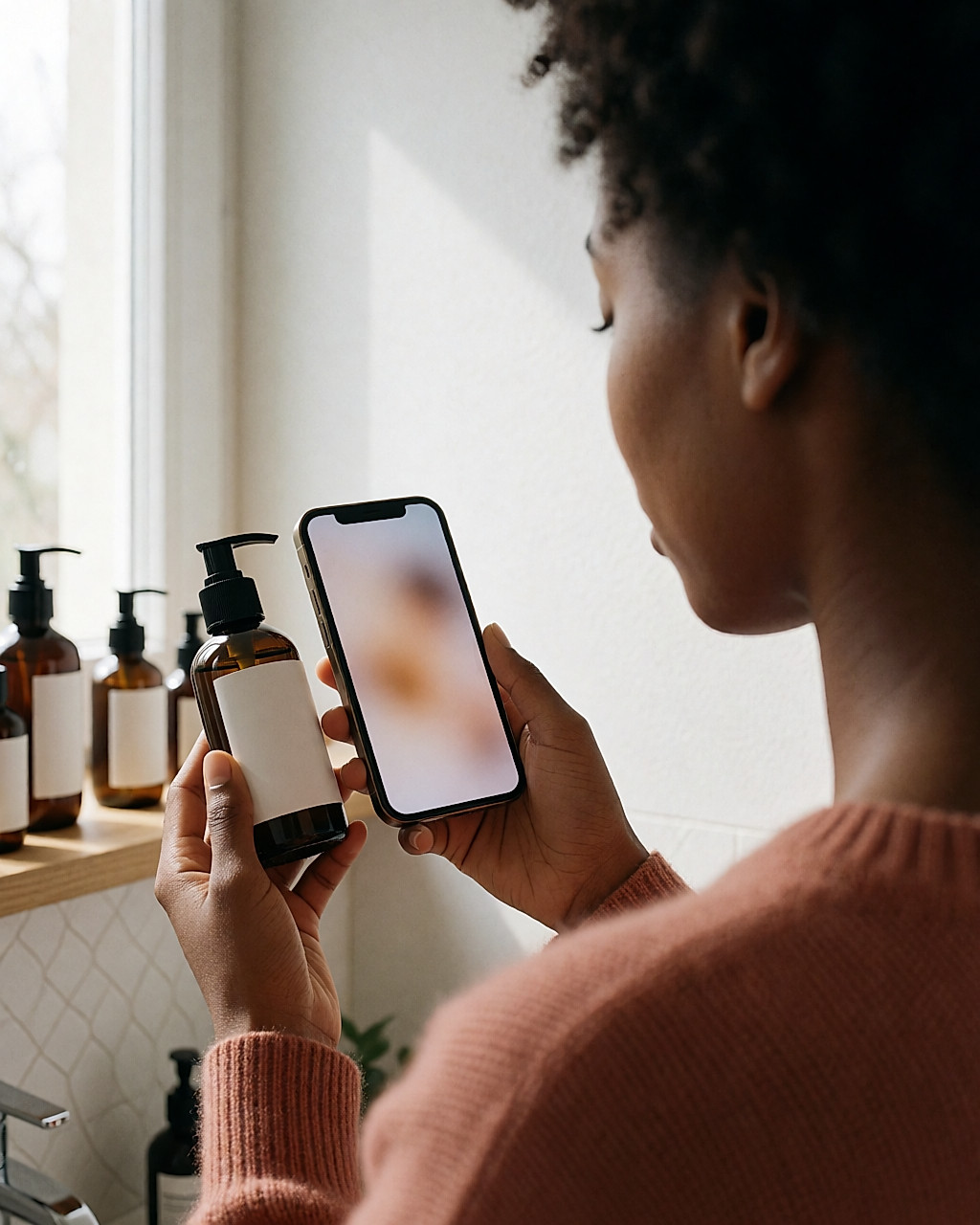
On the certification front, Cosmos Organic is a recognised organic standard, awarded by bodies such as Soil Association Certification in the UK and Cosmébio/Ecocert in Europe. It requires a minimum percentage of organic ingredients and a set of standards on processing. A word of caution, though: a certification confirms origin and process, not that a product is harmless for your skin. And if a conventional product remains the best choice for a specific need — a well-documented UV filter, for example — own it without guilt: organic is a preference, not a dogma.
Three habits before you reach the till:
- Look for a recognised certification (Cosmos Organic, Ecocert) rather than purely marketing-led 'natural'.
- Choose a refill, glass or cardboard packaging, and UK or European manufacturing where the information is given.
- Test any new product on a small area for 48 hours if your skin is reactive.
Budget
Price differences come mainly from the distribution route and certification, not necessarily from the intrinsic quality of the formula.
In supermarkets, a basic day cream often costs a few pounds. In perfumeries or organic beauty stores, a Cosmos-certified cream often sits around £15 to £40. A serum from a niche brand tends to climb to between £30 and £70. In pharmacies or online, margins vary and promotions are frequent: expect around £10 to £50 depending on the range.
What pushes the bill up: organic certification, patented actives, glass packaging. What doesn’t bring it down: the number of ingredients — a short formula isn’t automatically cheap. The smart move is to start by changing one product, the one you use every day, rather than emptying the whole cupboard at once.
Sources
- UK Government — Cosmetics regulation in Great Britain, consulted in 2026.
- Health and Safety Executive — UK REACH, consulted in 2026.
- European Union — Regulation (EC) No 1223/2009 on cosmetic products, 2009.
- European Chemicals Agency (ECHA) — Substance database, consulted in 2026.
- Soil Association — COSMOS organic certification, consulted in 2026.


Comments
Your opinion matters: rate the article, react and reply to comments.
Comments are moderated; AI-assisted comments are flagged. Text emoticons (8-), :-), <3…) are automatically shown as images.