

Sunday night, bags still in the hallway, the kids finally asleep, and skin that feels tight after six hours on the road with the air con on full blast. In the bathroom, you do the simplest thing going: two spritzes of thermal water mist on your face from about 30 cm. Two minutes later, your complexion looks reasonably human again. It isn't magic, it's physiology — and that's exactly why it works.
What's really in these waters
Before they reach your bottle, these waters have travelled a long way. They seep through rock, sometimes for decades, picking up minerals and trace elements along the way: calcium, magnesium, silica, bicarbonate, and sometimes selenium, zinc or manganese.
The detail that matters is that not all waters are alike. La Roche-Posay's is documented for its selenium content, a trace element studied in dermatological research for its role against oxidative stress. Avène's, by contrast, is very low in minerals, which explains why it's used on the most reactive skins, including after certain dermatological procedures. Two waters, two compositions, two uses — so how do you choose?
In plain English: a low-mineral water soothes, while a silica-rich water leaves skin feeling comfortable and supple. Neither replaces a moisturiser. If you mist without sealing it in afterwards, you're just letting the water evaporate and your skin will feel even tighter.

How to use it properly, in order
- Clean skin, after cleansing.
- Mist from 20–30 cm, two sprays, holding the can upright.
- Pat dry with a clean towel, or go straight in with serum and then moisturiser.
- Repeat through the day if you fancy it: after exercise, after sun exposure, on a flight, or simply when your skin needs a refresh.
Don't confuse this mist with a makeup setting spray: setting sprays often contain polymers and glycerine, and are used after makeup, not before.
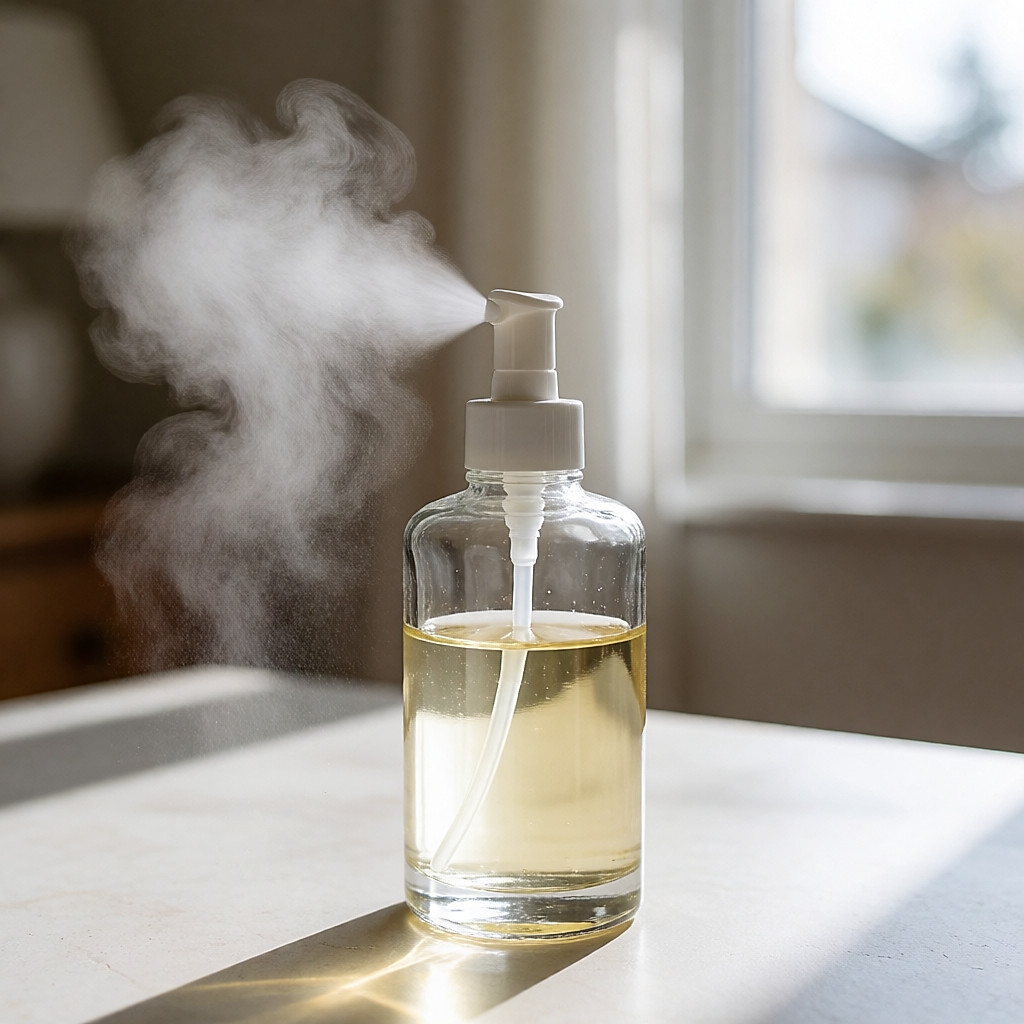
Choosing your mist, honestly: look first at the ingredient list (short is a good sign), the water's origin and the bottling site named on the label. As for packaging, most mist bottles are recyclable metal cans, and some brands state that no propellant has been added — check case by case rather than taking a nice phrase on the carton at face value. A large 300 ml format lasts several months and creates less packaging than a series of 50 ml bottles. Finally, never refill an empty can with tap water: limescale and bacteria have no place in it.
Budget
Expect to pay around £7–£12 for a 150–300 ml bottle from a high-street retailer or online pharmacy, and around £10–£20 at a chemist or beauty retailer for dermatological thermal brands. The 50 ml size, usually about £5–£8, is mainly a top-up or travel format.
What moves the price: the brand, bottle size, where you buy it, the city and promotions. Per litre, thermal water remains one of the cheapest parts of a routine — provided you're not buying a new small bottle every month. You'll find it in pharmacies, beauty retailers, supermarkets and online, often at similar prices in the latter two.
Léna's verdict: yes, but on one condition. Keep your mist for what it does well — refreshing, soothing and prepping skin — and let moisturiser do the background work. Ten seconds of spritzing for immediate comfort is not a treatment in itself, and that's absolutely fine.
Sources
- Avène dermatological laboratories — avene.co.uk (product information, thermal water composition and thermal centre)
- La Roche-Posay — laroche-posay.co.uk (thermal water, selenium content)
- French National Academy of Medicine — academie-medecine.fr (reports on thermal medicine)
- ANSM — ansm.sante.fr (regulation of mineral waters and skincare products in France)
- French Ministry of Health — sante.gouv.fr (framework for thermal care in France)
Comments
Your opinion matters: rate the article, react and reply to comments.
Comments are moderated; AI-assisted comments are flagged. Text emoticons (8-), :-), <3…) are automatically shown as images.