
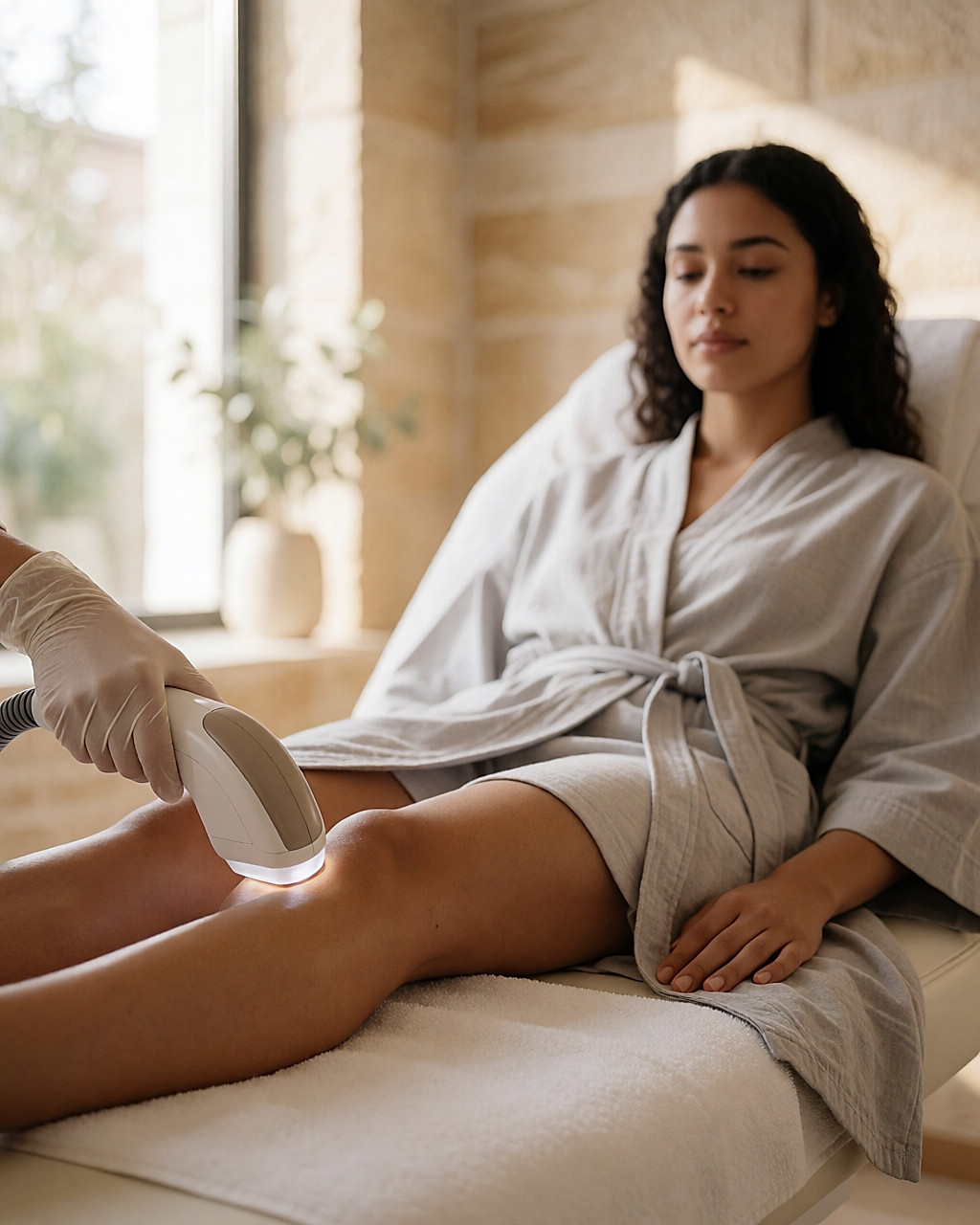
You’ve done the maths. Waxing every three weeks, a razor for emergencies, and regrowth already showing five days later. Laser hair removal is something you’re seriously considering — you just want to know what to really expect, between clinic promises and warnings. Let’s go through it calmly.
How it actually works
One sentence sums it up: the laser targets melanin, the pigment that gives hair its colour, and the heat damages the follicle. The detail that changes everything: only hairs in the growth phase contain enough melanin to be affected. And at any one time, they’re only a small part of your hair growth. That’s why one session is never enough, whatever a clinic tells you.
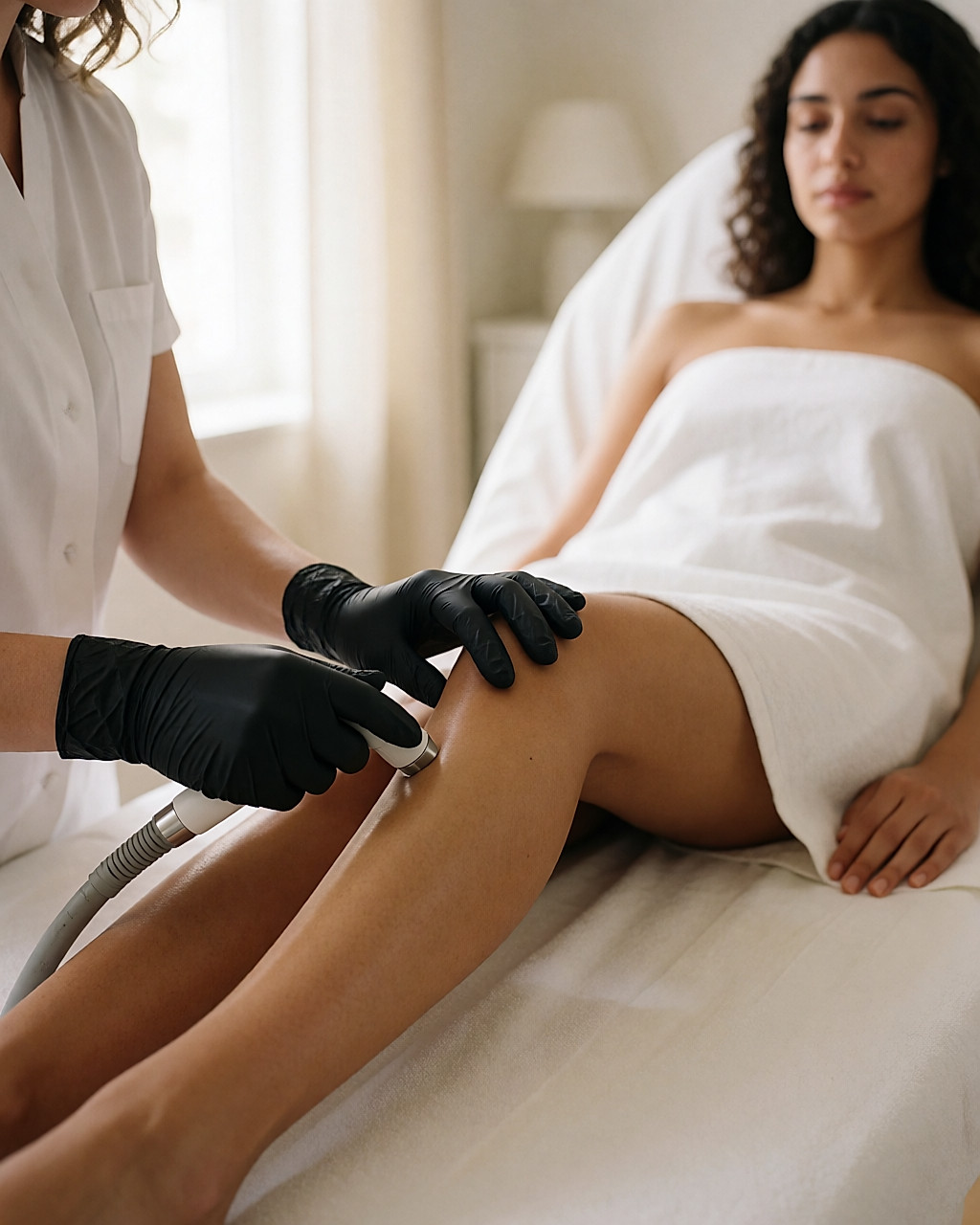
Most courses involve 6 to 8 sessions, spaced 4 to 8 weeks apart depending on the area and your hair cycle. After that, one or two top-ups a year are often enough to keep things tidy.
Does it hurt?
Honestly, it stings. It feels like small elastic bands snapping against the skin, especially where hair is thick. Newer devices include cooling — cryogen or contact cooling — which makes sessions very manageable; a numbing cream is often offered as an optional extra. On the bikini line, you grit your teeth for two minutes.

Who it suits, and what it can do
Laser needs contrast: dark hair on light skin is the ideal scenario. White hair, without melanin, and very fine downy hair respond poorly or not at all; blonde or red hair, low in eumelanin, is also difficult to treat, with often limited effectiveness — much depends on contrast with the skin and the settings. For medium to dark skin, an Nd:YAG (1064 nm) laser is suitable and reduces the risk of depigmentation, but doesn’t remove it entirely: technique and settings remain crucial, so it’s best to be in good hands.

Two firm rules: no session on tanned skin or skin that has just been exposed, and no sun for the weeks afterwards. Autumn and winter remain the best seasons to start.
The right words: “long-lasting”, not “permanent” Dermatologists prefer to talk about long-term hair reduction. Under the influence of hormonal changes — pregnancy, polycystic ovary syndrome, menopause — nearby fine hairs can thicken and darken. It’s not back to square one, but annual top-ups are not a luxury.
Budget
There’s no single price: it all depends on the area, the device and the number of sessions. In the UK, prices vary widely, but as a rough guide you might pay around £50–£150 per session for a small area (upper lip, underarms, basic bikini) and £150–£450 for a larger area (legs, back, chest), with courses of 6 to 8 sessions often discounted. A dermatologist’s clinic will charge more than a specialist medical clinic; online booking platforms sometimes show teaser prices, so check exactly what’s included.
In the UK, laser and IPL hair removal isn’t restricted to doctors, but practitioners must be properly trained, insured and follow safety rules. Ask for several quotes, note the device used and the number of sessions included, not just the price.
Before and after: the step that changes everything
Shave the area 24 to 48 hours before, and forget waxing or tweezing in the month beforehand: the hair needs to stay in its follicle. No self-tan, no sun, and tell your practitioner about any photosensitising medication. After the session: soothing cream, no sauna or swimming pool for 48 hours, and SPF 50 on exposed areas.
The real advice, the kind I’d give a friend: start with a small area. You’ll test your tolerance, see how regrowth comes back, and know whether the budget is worth it elsewhere. Seen that way, it’s no longer a repeated chore, it’s a longer-term ritual — and that changes how you feel about it.
Sources
- MHRA — Medical devices: laser and intense pulsed light (IPL) equipment, accessed 2026.
- NHS — Laser hair removal, accessed 2026.
- British Association of Dermatologists — Laser hair removal information, accessed 2026.



Comments
Your opinion matters: rate the article, react and reply to comments.
Comments are moderated; AI-assisted comments are flagged. Text emoticons (8-), :-), <3…) are automatically shown as images.