

It's 11pm, the sofa has swallowed you whole, and you're reading "barrier repair" on the third label of the evening. Next to the words, a little drawing of stacked bricks. A few years ago that drawing meant nothing to anyone in the queue at the pharmacy counter. Now your colleague is talking about it by the coffee machine, and she's not wrong.
From glass skin to skin barrier, the vocabulary has changed hands
For a long time Korean skincare was an imported range: you walked into a shop with a pastel frontage, walked out with a ten-step roadmap, and the roadmap ended up under a magazine. Pretty to look at, decorative in practice.
These days it's no longer a range, it's a grammar. We say skin barrier for that surface layer that holds on to water and takes the hits — the cold, the over-foaming cleanser, the absent-minded scratching on a Sunday night. We talk about ceramides, lipids, the microbiome, without having done any chemistry since A-levels. And in an enormous skincare market, that vocabulary is no longer exotic: it has become technical.
The upshot: any brand that wants to exist now has to speak that language. "Moisturising" isn't enough any more. You have to say what, how, in what order — and why.
Seoul no longer exports creams, it exports methods
People don't go there for a jar to copy any more: they go for textures, formats, ways of formulating — and for the words to tell the story with somewhere else.
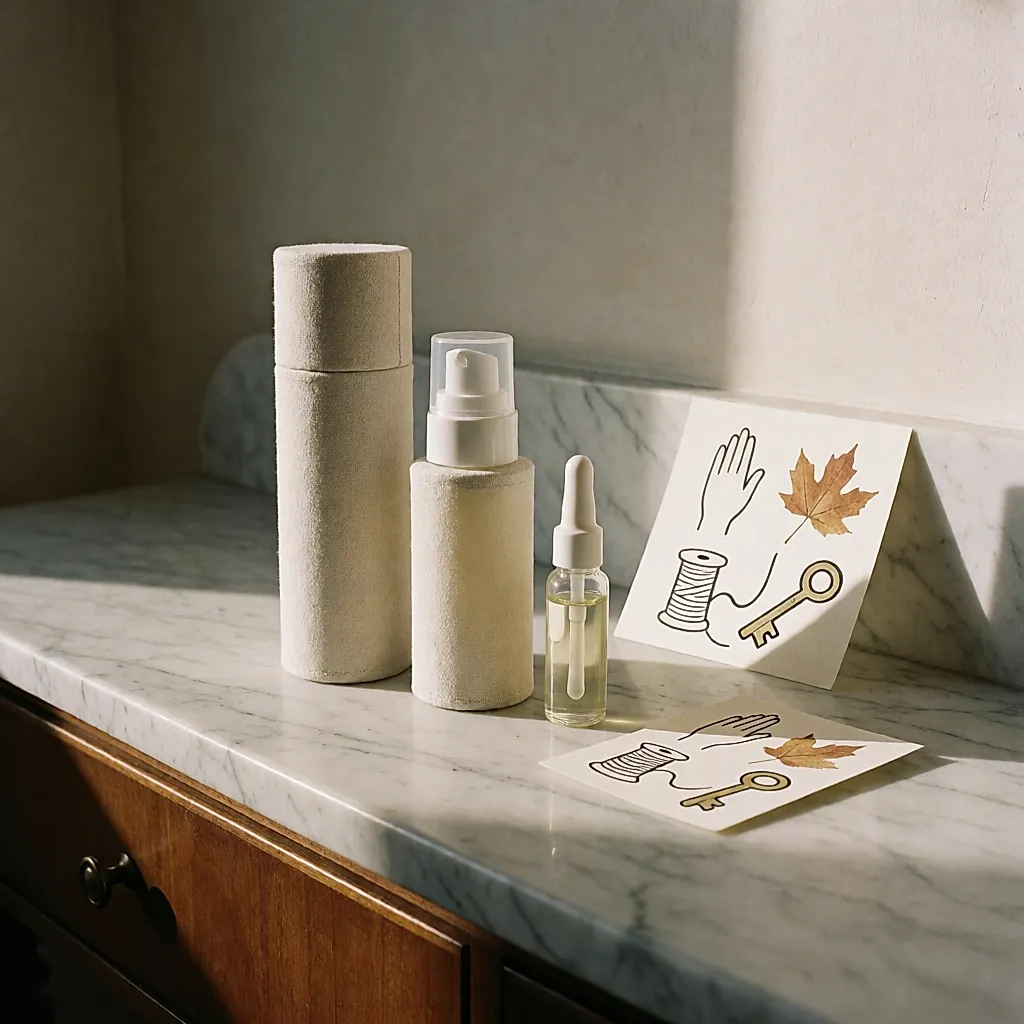
Because that's where it's decided. An essence, an ampoule, a toner: three containers that look like water and yet each have their part to play in the layering. Western brands took years to dare sell an almost transparent bottle while explaining that you had to pat it in with the flat of your hand. They do it now without blushing, and sometimes with a little drawn instruction sheet.
The gesture follows the vocabulary. Double cleansing — an oil, then a gel — has left Seoul tutorials for the instruction leaflets of French brands. You can find the method a touch solemn for a Tuesday night. You can also admit it settles the question of stubborn mascara. Both positions are defensible.
The pocket glossary
- Essence: a very fluid liquid, between toner and serum, to pat in before moisturiser.
- Ampoule: a concentrate in a small bottle, often richer than a standard serum.
- Double cleansing: cleansing oil then a water-based cleanser, in the evening.
- Glass skin: a smooth, luminous finish, achieved by thin layering — not by a single product.
- Chok chok: the feeling of skin "plumped with water", just after application.
What comes next is played out in words
What's happening right now is less spectacular than a new cream, and far more lasting: Korean skincare has become the sector's dictionary. We no longer buy "a brand from Seoul"; we buy a logic that plenty of houses have taken up, including those that have never set foot in Asia.
So the next time you read "barrier" on a label, you'll know it isn't just another marketing line. It's a precise word, one that arrived via Seoul, telling you what to do with your five minutes of an evening. And if you've only got two, keep the moisturiser.
Comments
Your opinion matters: rate the article, react and reply to comments.
Comments are moderated; AI-assisted comments are flagged. Text emoticons (8-), :-), <3…) are automatically shown as images.