
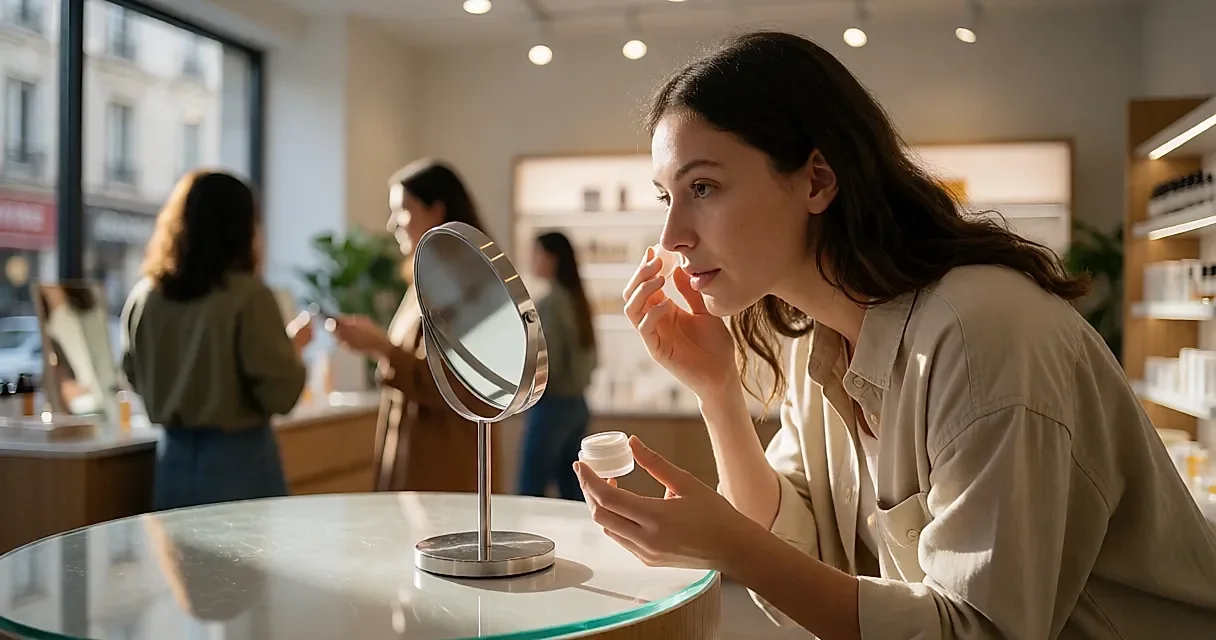
A pump, a little product in your palm, and the gesture happens on your own skin. Skincare isn’t just something to admire in a bottle. Ask to try it at the counter, between the till and the shelf, and you’ll see that it can only really be judged once it’s on.
What the bottle won’t tell you
How many times have you bought a cream because of a slogan? A serum is read on the back of the label and judged on the back of the hand. Except the back of the hand doesn’t tell you everything. Two moisturisers can look like sisters on paper; on the face, one sinks in under your fingertips and the other sits on the surface. The difference lies in the texture, how quickly the product sinks in, and how it wears under foundation by the end of the day. No product description can quite capture that.
That’s why it’s worth asking for a testing station — a sink, honest lighting, clean spatulas, a mirror — and someone who shows you how to apply it rather than reciting the claims. In practice, use a small amount for the whole face, and even less around the eyes: you’ll see straight away if it’s too rich, too heavily fragranced or too sticky. Sometimes ten seconds at the counter tells you what three articles couldn’t.
The counter, though, won’t tell you anything about what happens to the packaging. Ask whether there’s a refill, a solid format or a larger size, and check whether the pump unscrews. If organic credentials matter to you, a label such as Cosmos Organic sets the rules for the formula and the proportion of organic ingredients — read the ingredients list, not just the logo. And be wary of a fragrance that smells gorgeous in store and then follows you onto the bus like a regret.
The method, not the sales patter
The real point of a testing station isn’t the product; it’s the order you use things in. Serum before cream, oil last, the warmth of your fingers to loosen a slightly stiff balm: these details can’t be improvised, and they change how the product feels on your skin. A gel-cream and a rich cream can make the same promise; what separates them is how they go on.
When it comes to hygiene, keep your wits about you. An open jar that everyone has been dipping their fingers into? Not for you: ask for a clean spatula, or choose a pump instead. If your skin reacts easily, stick to a sample rather than smearing three formulas on in quick succession — a beauty counter isn’t a lab. And as for whether the formula will suit you in a month’s time, no one can promise that in five minutes. A good sales assistant will tell you so; the others will just sell you the jar.
Three habits before you start: — ask for a clean spatula, never fingers in the jar; — test the texture along your jawline, not on the back of your hand; — look for a refill before you choose the bottle.
What it costs
As a rough guide in the UK, expect around £20 to £55 for a moisturiser and £30 to £75 for a serum at a department store beauty counter or salon; at a pharmacy, high street store or online, prices can be lower. It all depends on the city, the range, the size and where you buy it. So ask the price before you try it, and check what’s included. Samples are a smart move: ask for one before buying a serum on the strength of a first impression. Refills, where they exist, can cost less than the original bottle — check case by case. Online, compare at the same size, not at the advertised price.
One gesture still matters most: taking a few moments to apply what you already own properly, rather than stacking up more bottles. The rest — flattering light, a well-placed mirror — is a bonus. A lovely bonus, let’s be honest.
Comments
Your opinion matters: rate the article, react and reply to comments.
Comments are moderated; AI-assisted comments are flagged. Text emoticons (8-), :-), <3…) are automatically shown as images.