

“I’ve had stretch marks since my pregnancy — is there still anything I can do?” This question comes up often under my articles, and I understand why it niggles — especially when you come across an ad promising to “erase” what your skin has permanently etched. So let’s look at it together, without magic and without telling you fairy tales.

A stretch mark is a scar
When skin stretches faster than it can adapt, its collagen and elastin fibres break. The result: streaks that are first red or purplish — this is the active phase, when most can be done — and become white and pearly once healing is complete. In other words, an old stretch mark isn’t a skin flaw to correct, it’s a scar to live with.
They appear where skin pulls: abdomen, breasts, hips, thighs, sometimes arms. Pregnancy, rapid weight gain, a growth spurt in adolescence, repeated dieting — the causes are many, and nothing to do with a lack of care. A quick reminder: this isn’t strictly a female issue; men get them too, and no one should ever have to apologise for them.
The point that has to be accepted, even if it’s not the one you’d like to read: once healed, a stretch mark doesn’t disappear. You can soften it, not erase it. Hence the value of focusing on prevention while the streaks are still red — that’s when you can make the most difference.
The step that changes everything: moisturise and massage
We moisturise our face diligently, and our body… in a rush. Yet that’s where it counts.
After a shower, take five minutes to massage at-risk areas with a rich plant oil — argan, avocado, sweet almond — or raw shea butter. The product matters, but the technique matters just as much, if not more: it’s the kneading and rolling of the skin between your fingers that makes it supple and gets circulation going. The famous “step that changes everything” is neither a bottle nor a brand.
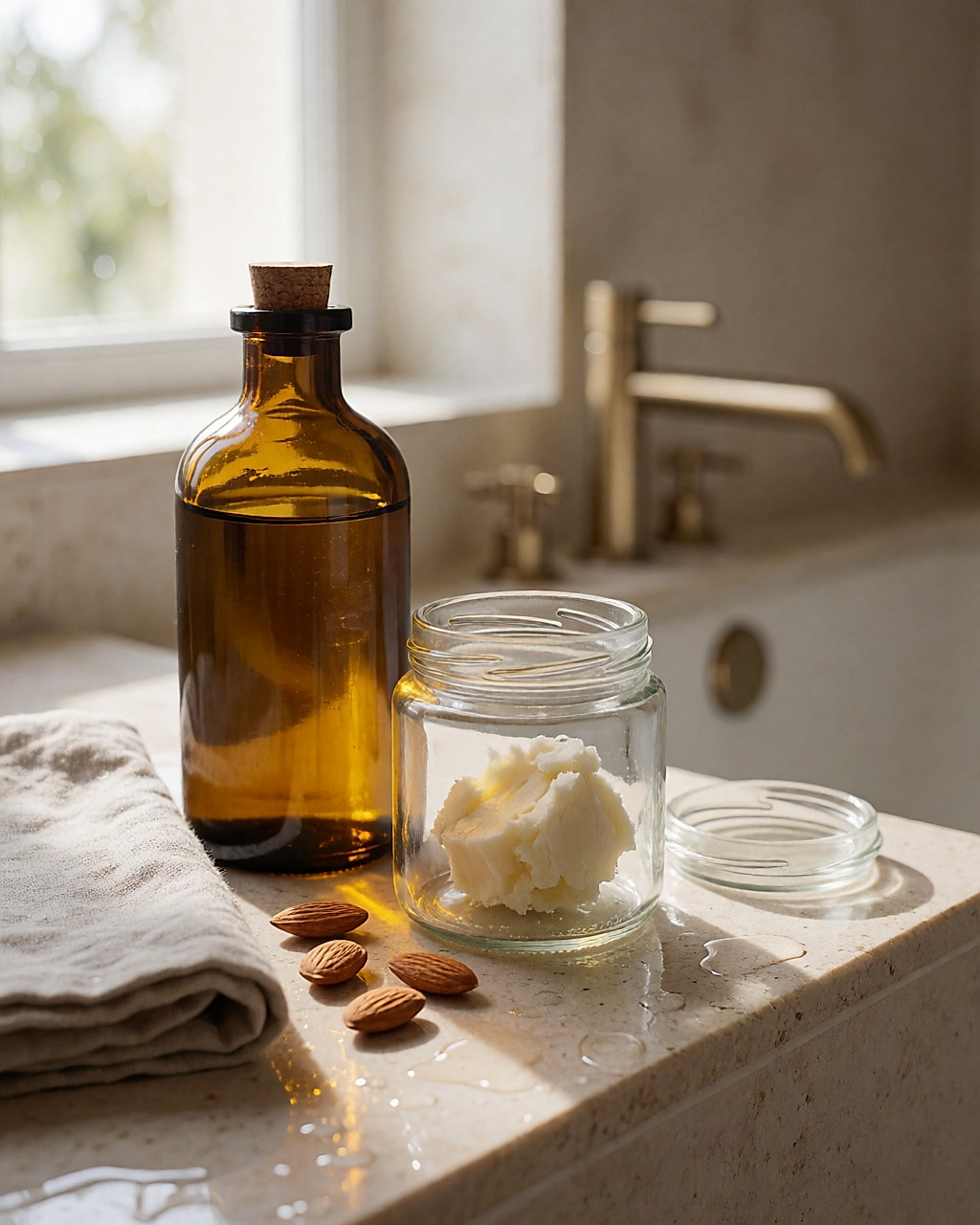
When it comes to natural options, it’s easy to choose well: an organic certification (Cosmos Organic, Ecocert), a glass bottle rather than a plastic tube, a cold-pressed oil. These labels guarantee the cosmetic’s composition and production method, not its effectiveness on stretch marks — let’s say that straight away. But at least you know what you’re putting on.
During pregnancy, this moisturising routine is among the steps often mentioned to support skin as it stretches. However, retinoid-based products require precautions during pregnancy and breastfeeding. Your midwife or doctor can advise you based on your situation: here, we’re staying with general information.
“Stretch mark” creams: what they really do
Let’s be honest: no cream makes an established stretch mark disappear. Products sold in pharmacies, based on retinol, hyaluronic acid or plant actives, are mainly offered for prevention, or on streaks that are still red. On a ten-year-old white stretch mark, the benefit remains cosmetic — that is, real for the skin’s comfort, but not something to hail as miraculous.

I haven’t tested these products myself: I’m passing on the information as documented, for you to discuss with your pharmacist. And if you’re hesitating between three tubes, remember that one routine kept up over time is better than a cupboard full of promises.
To camouflage white stretch marks for an evening, a light self-tan or body make-up can soften the contrast between the streak and the surrounding skin. Test on a small area first: pigmentation isn’t the same everywhere, and some textures transfer onto light clothing.

When to see a dermatologist
Several in-clinic techniques exist: fractional laser, microneedling, microdermabrasion, radiofrequency. Depending on the case, these aim to smooth the skin’s surface and/or stimulate skin renewal; their mechanisms and results vary. Dermopigmentation, close to tattooing, recolours lightened areas. These are procedures, not bathroom treatments, and a dermatologist or surgeon will decide whether your skin is suitable.
Expect several sessions, a real budget and a partial result: the streak fades, it doesn’t vanish. And one last point that matters: a scar doesn’t tan. Exposing these areas to the sun doesn’t blend them into the background — quite the opposite: the more the skin is exposed, the more visible the contrast. On the protection to use afterwards, a health professional is best placed to answer you.

Budget
For plant oils and shea butter, expect around £7 to £22 for 50 to 100 ml in a health food shop, pharmacy or on the brand’s website. In health food shops, refilling by weight is often cheaper — and you reuse your bottle, which is no bad thing.
For so-called “stretch mark” creams, it’s more like £13 to £35 per tube in a pharmacy or beauty retailer, including advice. The price climbs quickly if you multiply products, so it’s better to stick to one routine over time, even if you finish it before buying another.
In clinic, sessions are around £70 to £220 depending on technique, area, city and practitioner; dermopigmentation more like £85 to £260 per area, with a touch-up sometimes included. The number of sessions and spacing vary — to be defined with a health professional. These aesthetic procedures are generally not covered by the NHS: always ask for a written quote before starting. Where to find everything? Oils in health food shops, refill stores or pharmacies; creams in pharmacies; technical procedures only in clinic, with a dermatologist or qualified doctor.
Léna’s verdict: yes, you can act, but on one condition — start before they settle, and remember that we improve, we don’t erase. The rest is simply life on the skin, and there’s nothing shameful about that.
Sources
- Cochrane — Topical preparations for preventing stretch marks in pregnancy, 2012.
- NHS — Stretch marks, accessed 2026.
- American Academy of Dermatology — Stretch marks: why they appear and how to get rid of them, accessed 2026.
- CRAT — Retinoids and pregnancy, French reference centre on teratogenic agents.



Comments
Your opinion matters: rate the article, react and reply to comments.
Comments are moderated; AI-assisted comments are flagged. Text emoticons (8-), :-), <3…) are automatically shown as images.