

You leave the salon with a luminous hazelnut brown, a neat nape and soft, supple hair. Three weeks later, the shade has turned a dull honey and the ends are going coppery. It's neither luck nor fate: colour shifts with water, heat, sun and repeated washing. In reality, a few well-placed habits really do make your colour last longer. The step that changes everything is treating it as something delicate, not as a given.
Before colouring, prepare the hair
Clean hair holds pigment better than hair weighed down by residue. So wash it the day before or on the day, but not with just any formula. Avoid formulas loaded with film-forming silicones, with dimethicone at the top of the INCI list. These molecules coat the hair, make it soft to the touch and create a barrier: the colour slides over it instead of penetrating.

The catch is that many products labelled 'for coloured hair' contain exactly that. Read the ingredients, not the promise printed on the bottle. A gentle, sulphate-free shampoo is more than enough for this step.
Then you nourish. A silicone-free mask, applied 15 to 20 minutes before colouring, gives damaged lengths their elasticity back. Soft, hydrated hair takes colour more evenly than dry, porous hair. It's the step most often skipped, and the one whose effect you see immediately afterwards.
After: the routine that keeps the shade fresh
Frequency matters as much as products. Space out washes (two to three a week is enough for most hair types) and lower the water temperature. Water that's too hot opens the cuticles and lets pigment escape. A final cool rinse at the end of washing closes the cuticle and makes hair look smoother.
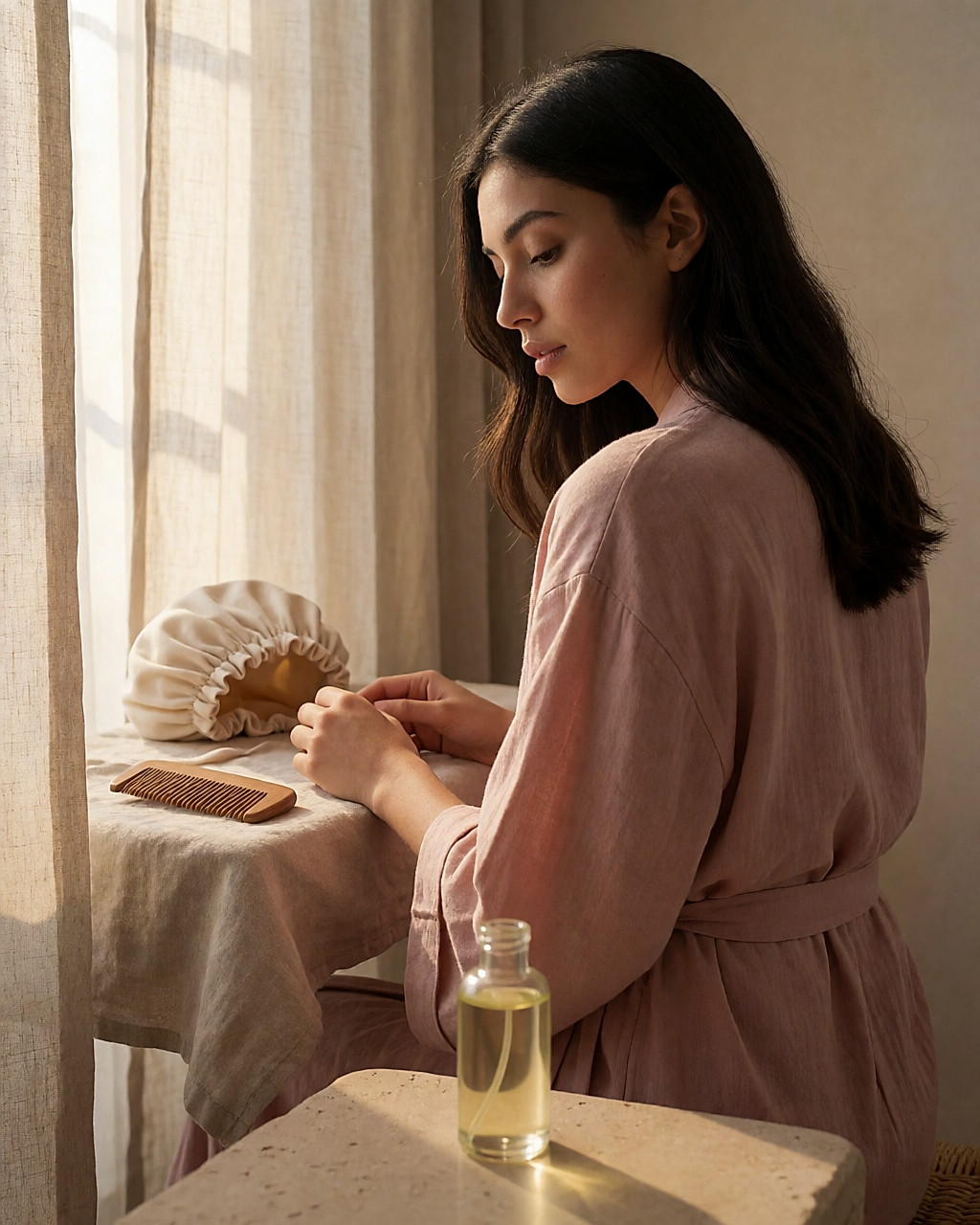
For care, alternate a weekly hydrating mask with an oil treatment. A pure plant oil — argan, sunflower or sesame — applied to dry hair, left for an hour under a shower cap and then washed out: simple, economical and with no residue. Check that it's a cold-pressed virgin oil in a glass bottle, with no added fragrance — that's often what separates a treatment oil from a lightweight cosmetic oil.
Before swimming or long sun exposure, protect it. Wet your lengths with clean water before you dive in: hair that's already saturated absorbs less chlorine and salt. Add a protective oil and a hat, and you'll seriously limit the damage.
Colour-depositing shampoo, yes, but no more than once a week. Applied after conditioning, it revives the shade. Any more often and the pigments cling more to porous areas — often the ends and the parting — and the colour becomes uneven. In a salon, a shade is mixed for you; in supermarkets, you'll find the basic blonde, brown and red options. On the eco front, certified options are still rare in this category: the realistic compromise is a refill or a glass container from brands that offer them.
Space out your colour appointments
It's the number-one temptation: you like the colour, so you redo it more often to keep it intense. Bad idea. All colouring weakens the hair, even ammonia-free, because so-called gentle formulas use other alkaline agents, such as monoethanolamine. Over time, you end up with split ends, breakage and colour that holds even less well because the hair is damaged.

In practice, leave four to six weeks and just have the roots touched up. The rest of your hair doesn't need a full colour every time. For maintenance, a gentle shampoo suited to your hair type does the job: there's no point chasing a 'for coloured hair' label if the formula doesn't suit your scalp.
Budget
- Gentle or sulphate-free shampoo: £4 to £10 in supermarkets or health food shops; £15 to £30 for 250 ml in salons or beauty halls.
- Colour-depositing shampoo: £7 to £14 in supermarkets; £18 to £35 in a salon for a custom-blended shade.
- Nourishing mask or pure plant oil: £7 to £18 in health food shops for 50 to 100 ml; £20 to £45 in beauty halls.
- Deep conditioning treatment in a salon, without colour: £25 to £60 depending on the salon.
- Colouring: £7 to £14 for a home box; £35 to £80 in a salon for a root touch-up; £50 to £130 for a full colour.
What changes the price: the city and the salon's standing, hair length and density, how technical the work is, the product size, and organic certifications, which often push the price up. Where to find it all: salon, beauty retailer, supermarket, health food shop, or the brand's official site when it offers refills. I'm not naming any brands here: these are reading criteria and observed price ranges, not a product test on my part.
Sources
- Regulation (EC) No 1223/2009 on cosmetic products — EUR-Lex, eur-lex.europa.eu.
- American Academy of Dermatology — aad.org, public resources on hair and scalp.
- Cosmébio — cosmebio.org, charter and standards for organic beauty.
- COSMOS Standard (Ecocert) — cosmos-standard.org, specification for natural and organic cosmetics.



Comments
Your opinion matters: rate the article, react and reply to comments.
Comments are moderated; AI-assisted comments are flagged. Text emoticons (8-), :-), <3…) are automatically shown as images.