
Have you ever found yourself on a Sunday morning counting the strands left on your pillow? Me too. Twenty-three, last time — and a hairbrush filling up faster than usual. Nothing alarming, but enough to keep you wondering for weeks.

The reflex is familiar: buy an "anti-shedding" serum for £35 without thinking. That's what I did — and I'd put the cart before the horse.
Not very glamorous, I'll grant you, but hair has simple needs, and a good part of the job happens on your plate. We'll stay on beauty routine ground here: for anything health-related, it's a professional you should see, not an article.
B vitamins, the quiet fuel
Where do you find them? A bit of everything: meat, fish, seafood, eggs, dairy, wholegrains, wheatgerm. The simplest approach is to vary your sources and go easy on heavily refined products.
My grandmother's tip comes down to a teaspoon of brewer's yeast flakes, sprinkled over a salad or a hot dish. The taste is punchy, and the nutrients really are there.

Protein: the raw material
A hair is keratin, so it's protein. Eggs, meat, fish, dairy — but also tofu, lentils, chickpeas, kidney beans: alternating between them does the work.
Do you need to count the grams? No. One protein source at each meal is already plenty. For anything more, a registered dietitian will be more useful than a blog post.
Zinc, magnesium, iron: where to look
You often read that these three fall short. Zinc plays a part in cell renewal: it's found in shellfish and seafood, meat, offal, wholegrains and egg yolk.
Magnesium follows a similar shopping list: dark chocolate, green vegetables, nuts and seeds, pulses.
Iron, finally: meat and offal, cocoa, fish and shellfish, vegetables, eggs, pulses.
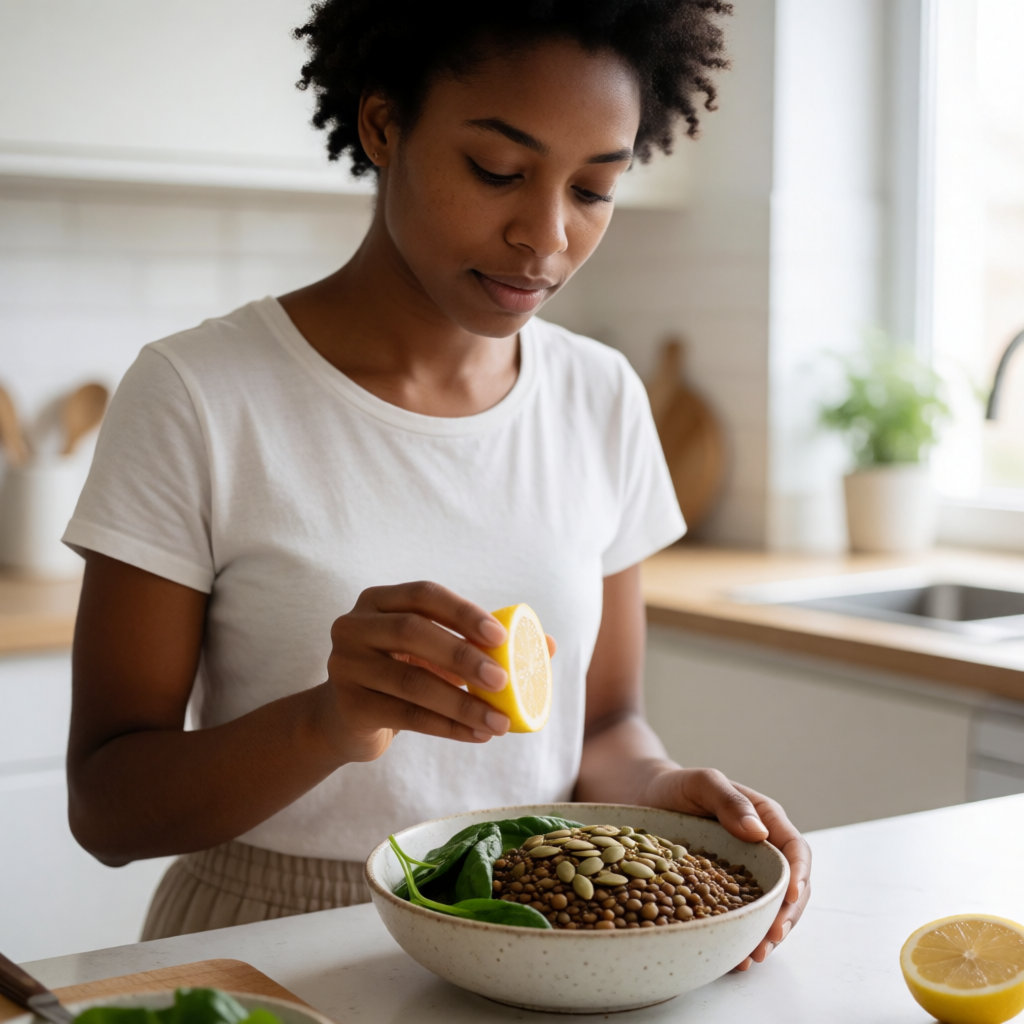
You'll also read that plant iron is absorbed better alongside vitamin C — a squeeze of lemon over lentils, for example. A kitchen habit, not a promise. And if you feel tired or irritable for no clear reason, speak to a healthcare professional rather than treating it blind.
What's worth a look
Smoking and excess alcohol help no one, that much we know. No need to feel guilty about it. But if shedding drags on, it's the kind of thing to look at with a professional.
Stress plays a part too, and exercise helps day to day: it boosts circulation and can help bring nervous tension back down. One simple precaution if you sweat a lot: rinse your hair afterwards, so sweat and dust don't sit on the scalp.
On the care side, we simplify
A gentle shampoo, massaged into the scalp with your fingertips. Rinse with lukewarm water, never hot. Brush twice a day, without forcing, starting at the ends and working up. It sounds obvious, but it's what causes the least damage.
On the formula, I look at two things: the surfactants, and what appears at the top of the list. I prefer formulas that don't put silicones and PEGs first — without making that an absolute rule. A gentle, biodegradable shampoo, in a refillable bottle or a solid bar, does the job very well — and the solid version, with no water, is lighter to ship too.
Supporting products, masks or serums, can help the hair hold up better.
The three-week notebook. Before investing in anything, spend twenty-one days noting what you eat, how much you sleep and how you feel. This notebook is for you, not a diagnosis. It will, however, be useful to share if you see someone.
And what about seasonal shedding?
Why do we read everywhere that we lose more hair in autumn? It's often said that the hair cycle follows light and the seasons, a bit like leaves. It's common, and usually temporary.
Seasonal changes are also when many people start a supplement course: it may help some, but it replaces neither a balanced plate nor proper sleep.
So when should you see someone? If shedding is bothering you, or if it settles in without you being able to see why, the reflex is to talk to a healthcare professional. That's their role, and they'll be able to tell you what's worth looking at — far better than an article, however well-meaning.
Budget
How you order your spending changes everything. Expect around £4 to £13 for 200 to 500 g of brewer's yeast flakes, loose or in a bag, from a health food shop or supermarket — enough to last months. A gentle shampoo usually sits between £7 and £18 in health and beauty shops, pharmacies or online, with refills often cheaper than the initial bottle; a solid bar runs from £5 to £10.
For a serum or targeted treatment, prices climb quickly: £13 to £26 in supermarkets or online, and £26 to £60 in beauty halls and pharmacies for the more concentrated formulas. And if you go through a healthcare professional, a GP appointment is free on the NHS; a private dermatologist typically charges in the region of £150 to £250, depending on where you are and the clinic. Prices vary with the city and the range you choose.
The advice I'd give a friend: look at your plate and your brushing first, before buying anything. And if it really worries you, it's a healthcare professional you should turn to, not a serum.
Sources
- NHS — Hair loss, nhs.uk.
- British Association of Dermatologists — Patient information leaflets on hair loss, bad.org.uk.
- NHS — Vitamins and minerals: food facts, nhs.uk.
Food supplements do not replace a varied, balanced diet and a healthy lifestyle.



Comments
Your opinion matters: rate the article, react and reply to comments.
Comments are moderated; AI-assisted comments are flagged. Text emoticons (8-), :-), <3…) are automatically shown as images.