
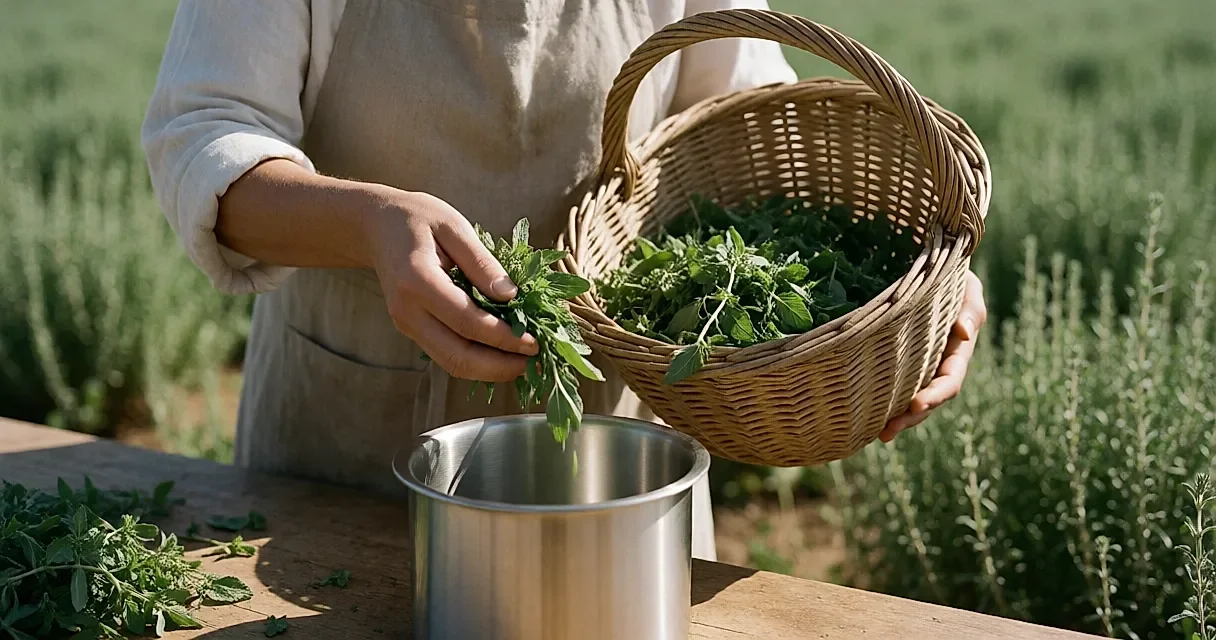
You've turned a bottle over in the aisle before, trying to decipher the list on the back, squinting as if it were a wedding invitation written in Latin. Thirty seconds later you put it back, not much the wiser. Except that list has just changed in kind: behind some of those names there is no longer only a field or an oil rig. There is a fermentation tank.
Three origins, one list
For decades the question fitted into two boxes: petrochemical or plant. Silicones and petrochemically derived ingredients on one side; vegetable oils, butters and flower extracts on the other. It was simple, a little caricatural, and at least it helped you find your way round the shelf.
Two industrial announcements, close together, have just added a third box. On one side, a biomaterials platform billed as global; on the other, a cosmetic acid made by fermentation. In other words, the molecule no longer comes out of a field someone cultivates, but out of a tank someone feeds. Reading a label has become an exercise in supply chains — petrochemical, plant or tank.
Hyaluronic acid is still the clearest example. It used to be extracted from rooster combs; today the overwhelming majority comes from fermentation. Same molecule, same behaviour on skin, completely different supply chain. That's the kind of shift that makes no noise at all and yet rewrites the whole chain.
How the tank works
The principle is nothing new: micro-organisms — yeasts, bacteria — are fed sugar in a fermenter and produce the molecule you're after. You filter, you purify, and out comes an ingredient of almost boring consistency. It's the logic of wine and yoghurt, moved into a tank several metres tall, with a specification sheet propped up next to it.
So why is the industry going there? Because tank production is often less exposed to the weather than some crops — although its agricultural substrate (sugar, for instance) still depends on growing conditions, pesticides and availability. It's not hard to see the appeal.
That said, fermentation isn't free, ecologically speaking: it uses energy and water, and its substrate — often agricultural sugar — has an origin of its own, and therefore a footprint. The ISO 16128 standard, the usual compass for calculating the natural-origin share of a formula, says nothing about the real impact of the supply chain. Useful, but not enough.
What 'natural' doesn't tell you
In European cosmetics regulation, 'natural' has no single official definition. It's private standards — Cosmos, Natrue — that police the term, with specifications of varying strictness. And a naturality claim attached to an ingredient speaks about that ingredient, not necessarily about the finished product in the bottle.

Above all, natural doesn't mean more effective. An identical molecule behaves the same way on skin whether it came out of a plant or a fermenter. Does it change anything for your face? Not the molecule, no. That's not an argument against the tank — it's an argument against the reflex of paying more for a word on the label.
Reading a list without becoming a chemist
First reflex: the list orders ingredients from the most concentrated to the least, although anything under 1% can be listed in a different order. If the active being shouted about in the advertising appears ninth, you know where you stand — and you can put the bottle back without guilt.
Second reflex: look for provenance when the brand provides it. Some specify 'fermented', 'from cell culture' or the country of harvest; others stay silent, and that silence is information too. You don't need a chemistry PhD to ask those two questions, or to notice that a refillable bottle can cut packaging — provided the refill itself uses less of it.
Three words to look for on the back: 'ferment' or 'fermented' (tank), the Latin name of a plant (field), and silicones ending in -cone and -siloxane (synthetic silicones, often petrochemically derived depending on the process). None of them is a dirty word: you're simply choosing with your eyes open.
What it costs
Price-wise, the tank doesn't necessarily show up on the label. As a rough guide, expect somewhere around £15–£30 in a pharmacy, beauty retailer or online for a serum or essence built on a fermented active, and closer to £45–£90 from the premium brands that make it part of their pitch. Packaging, fragrance and marketing copy often carry more weight than where the molecule came from.
Where to look? Pharmacies and chemists remain the right ground for short formulas and well-documented actives; certified-organic retailers for certified standards; direct from the brand for refills, when they genuinely exist — check the official website rather than a sponsored story.
Ultimately, this third box doesn't ask you to choose between the field and the factory. It asks you to know what you're buying, and on what grounds. Next time, turn the bottle over: two minutes, one list, and you're better informed than half the shelf. Whether the tank route will keep all its promises is hard to say at this stage — but at least you'll know it exists.


Comments
Your opinion matters: rate the article, react and reply to comments.
Comments are moderated; AI-assisted comments are flagged. Text emoticons (8-), :-), <3…) are automatically shown as images.