

You know the scene. You come out of the beauty hall with a £35 foundation, the assistant swears it's your shade, and an hour later, in daylight, your face is distinctly orange. It happened to me twice before I understood something simple: a shade isn't chosen by eye, it's tested. The ones I haven't tried myself, I'll say now, are documented, not tested.
Choosing the right foundation shade
Let's be honest: this is where almost everyone gets it wrong. The classic mistake is testing on the back of your hand or the inside of your wrist. That area is rarely the same colour as your face — often lighter, pinker or paler in winter. The result: you leave with a shade that doesn't look like you.
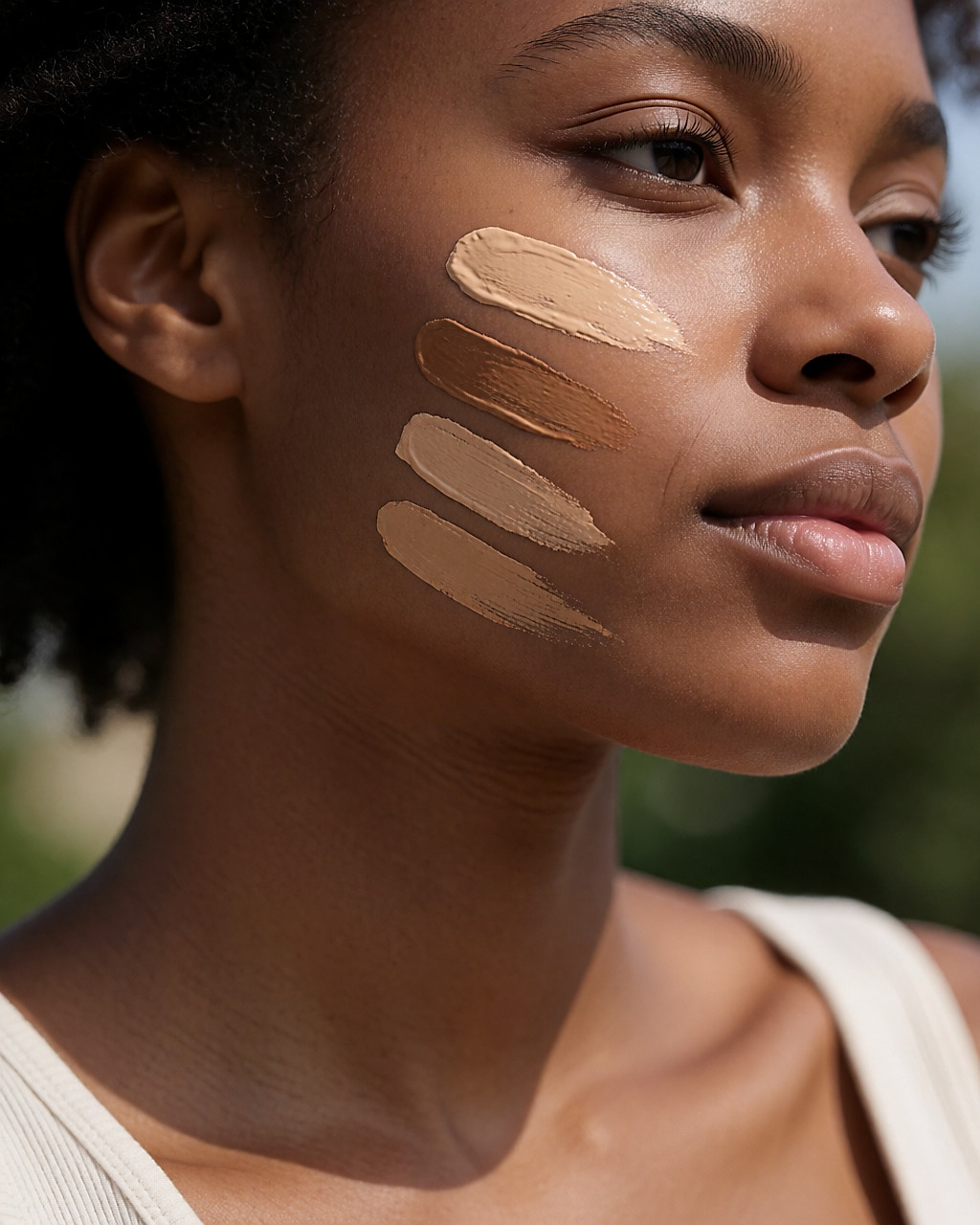
The move that changes everything: test on the jawline. Draw three stripes of different shades, from lightest to deepest, blend with your fingertip, then step outside for five minutes. Look at your reflection in natural light, not in the shop mirror. The right shade is the one that disappears — the one you can't see any more.
Second point: undertone. A shade can be light and still be too pink or too yellow for you. A useful clue: the colour of the veins on the inside of your wrist. If they look blueish, you lean cool; greenish, warm; a mix of both, neutral. It doesn't replace a test, but it rules out half the bottles.
If you're still unsure, ask for a sample: many shops give them, and a 2 ml sachet is enough to get a feel. It's always cheaper than a bottle that ends up at the back of a drawer. On formula, look at foundations with organic certification (COSMOS Organic, for example) if your skin reacts easily: the label sets rules for the share of naturally derived and organic ingredients, which can reduce synthetic fragrance and UV filters. There's a trade-off: some conventional formulas last longer on very oily skin.
Making your foundation last longer
Even long-wear formulas fade. Sebum, rubbing, the hours passing: all of it hits the forehead, chin and around the nose first.
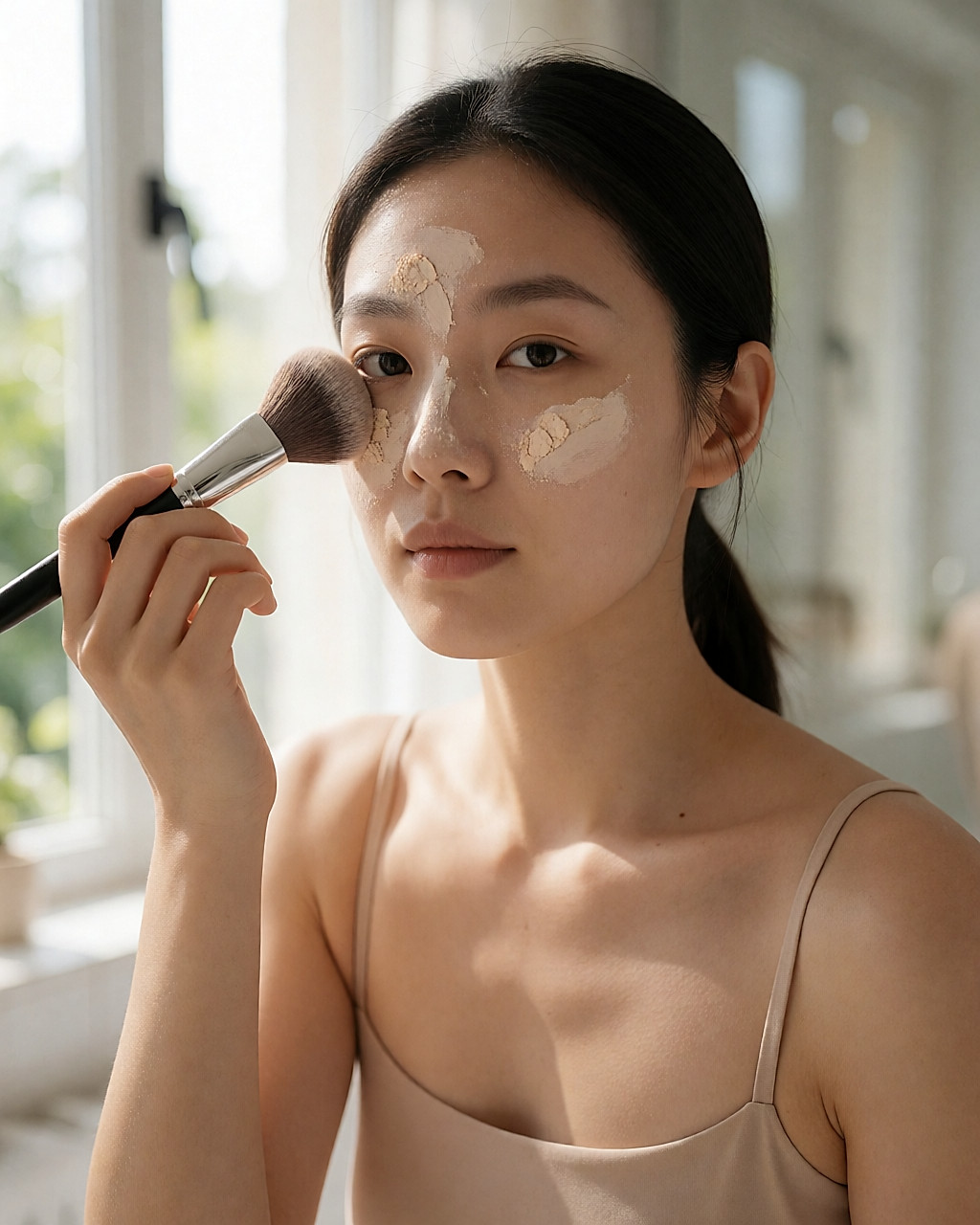
Powder. Foundation needs powder, especially on the T-zone. Choose a translucent loose powder if you don't want to change the colour, or a lightly tinted one if you want a soft-focus finish. Apply in small touches, with a large brush or a powder puff, only where you shine. Powder sold loose or in a refillable compact cuts packaging without changing the finish.
Primer. A primer can help, as long as you pick the right one. Silicone-heavy bases work well on dry skin, but on combination or oily skin they make foundation slide. If your skin gets shiny quickly, look for a lightweight, silicone-free primer with niacinamide.
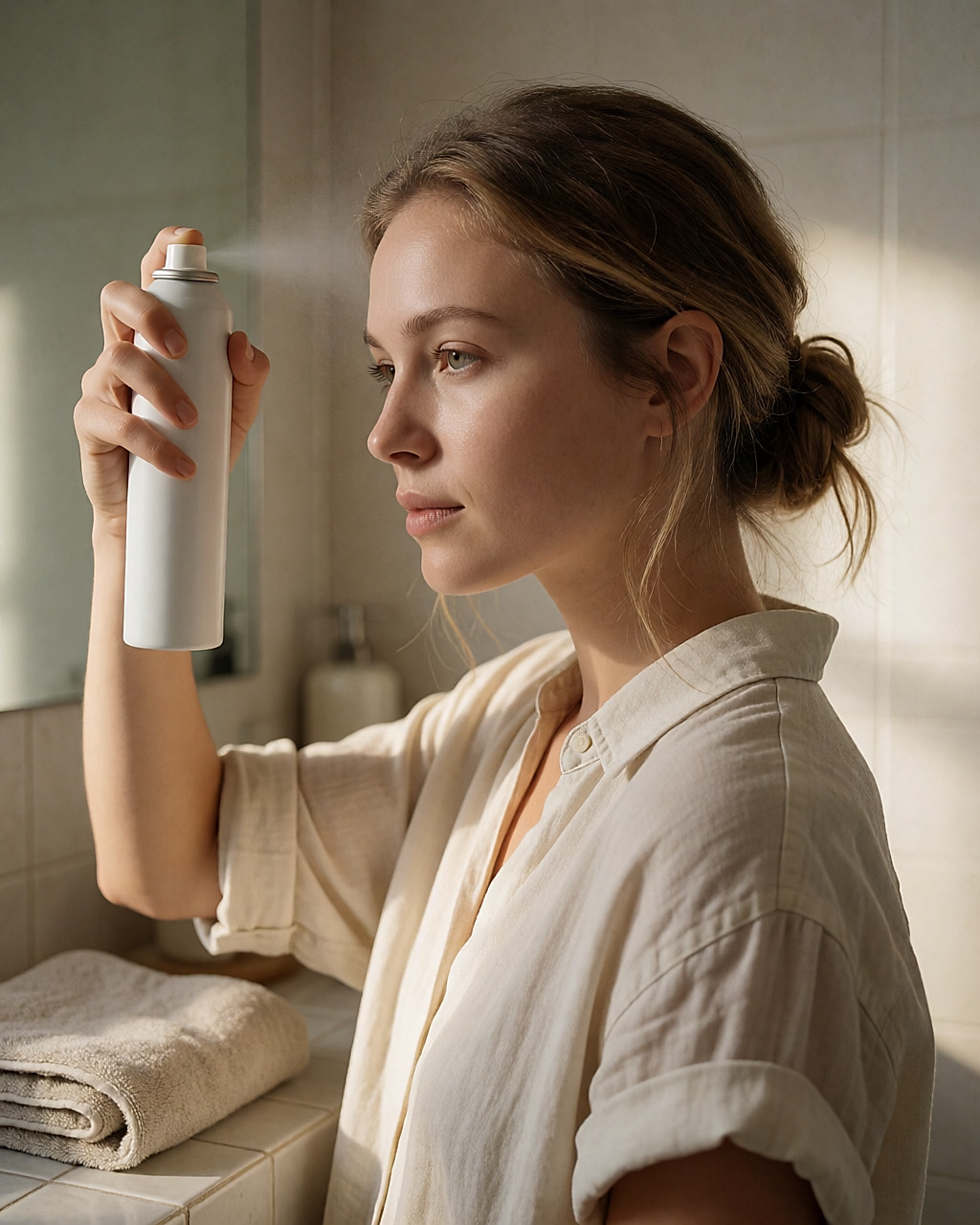
Setting spray. This is the step I took years to adopt. A thermal water spray doesn't set anything: it refreshes, full stop. A proper setting spray contains polymers that form a light film over make-up. Spray from about 30 cm away, one mist only, and let it dry without touching. This is where natural formulas are hardest: the longest-lasting ones are often conventional — you'll need to weigh up the trade-off.
The test I always do in store: I ask for the shade to be applied to one half of my face, and leave the other half bare. At midday, I compare. If the line is visible, I have my answer — and I haven't spent a penny.
Fixing foundation that's too dark
It happens to everyone, and when the bottle was expensive, you don't necessarily want to throw it away.

The simplest solution is mixing. On the back of your hand, put a small blob of foundation and add a little moisturiser: you lighten the shade, but you also sheer out the coverage. Save this for days when you want a light finish.
Another option, more precise: brightening drops, those white pigments sold separately. Half a drop is enough to adjust a shade that's slightly too dark. And if you have a liquid concealer lighter than your complexion, take a touch and mix it straight in: it works very well.
One last use: keep it for summer and apply a very thin layer on the areas you'd contour, temples and jawline. A foundation that's too dark makes a perfectly decent shadow.
Applying mascara well
Mascara is often the only thing we apply before heading out. It's also where we make the most mistakes.
The right method: place the wand at the root of the lashes and wiggle upwards to the tips. This little movement separates lashes and coats the full length, rather than leaving a clump at the end. Then let it dry completely — two minutes, not five seconds — before going in with a second coat. That drying time is what prevents clumps.
A quick tip: stop pumping the wand in the tube. It lets in air, the formula dries faster, and your mascara dies in three months. Twist the wand instead, that's enough. If you want to cut waste, some mascaras come as refills or in glass tubes: worth it when you like the formula, but still rare.
To remove any clumps, pinch the tips of your lashes with a tissue while the mascara is still wet. Never on the eyelid: you'll just smear everything.
Making eyeshadow last
A bare eyelid is an eyelid that transfers. Eyeshadow migrates into the crease after two hours, and the colour turns.
Simple step: apply a thin layer of concealer over the whole mobile lid, then powder lightly. The concealer grips the pigment, the powder stops oil dissolving it. Two products, one result. If you want to go further, there are eye primers, often more covering: they even out the lid and hold well, especially under highly pigmented shadows.
One extra trick: start with a cream shadow, then layer a powder shadow from the same colour family over the top. It lasts much longer than powder alone.
Avoiding eyeshadow fallout under the eye
It's the classic rushed-morning moment: you apply your eyeshadow, and half of it lands on your cheeks. Two ways to prevent it.
First, order. If you can, do your eyes before your base: fallout comes away with a quick sweep of cotton wool, without ruining your foundation. Then tap your brush before every pass — excess product does nothing on the lid except make a mess.
If you prefer to finish with eyes, apply a thick layer of loose powder under the eye first. It acts as a pigment trap: at the end, you sweep it away and everything goes with it. That's how to keep make-up looking neater through the day, without redoing everything every two hours. Start with one thing, the jawline test for example, and give yourself time to see what works best on your skin.
Budget
You don't need to change everything at once. In the UK, expect around £7 to £18 for a high-street or own-brand foundation, £22 to £40 at a beauty counter, and £50 and up for some niche brands. When a refill is available, it often costs 15 to 25% less than the full compact — check case by case. Loose powder sits between £5 and £13 on the high street and £18 to £35 at a beauty counter; loose or in a refillable pot, prices are similar, sometimes a little higher on the first order. A lightweight primer starts at around £9 to £18 on the high street and rises to £22 to £35 for a premium brand; a setting spray is about £7 to £18, or £22 to £30 premium. Mascara remains the most affordable: £7 to £13 on the high street or in a health food shop, £18 to £30 at a beauty counter. Brightening drops come in at around £9 to £25.
These differences depend on the city, the range, the packaging and whether a refill exists. To find all this: beauty halls and high-street beauty aisles to test shades, pharmacies and organic shops for certified formulas, and online sites for refills and loose formats. Samples, meanwhile, are still free in store — make the most of them before you get out your card.
Sources
- UK Cosmetics Regulation (as retained in UK law).
- Cosmetic, Toiletry and Perfumery Association (CTPA).
- Which? cosmetic product comparisons and investigations.


Comments
Your opinion matters: rate the article, react and reply to comments.
Comments are moderated; AI-assisted comments are flagged. Text emoticons (8-), :-), <3…) are automatically shown as images.