
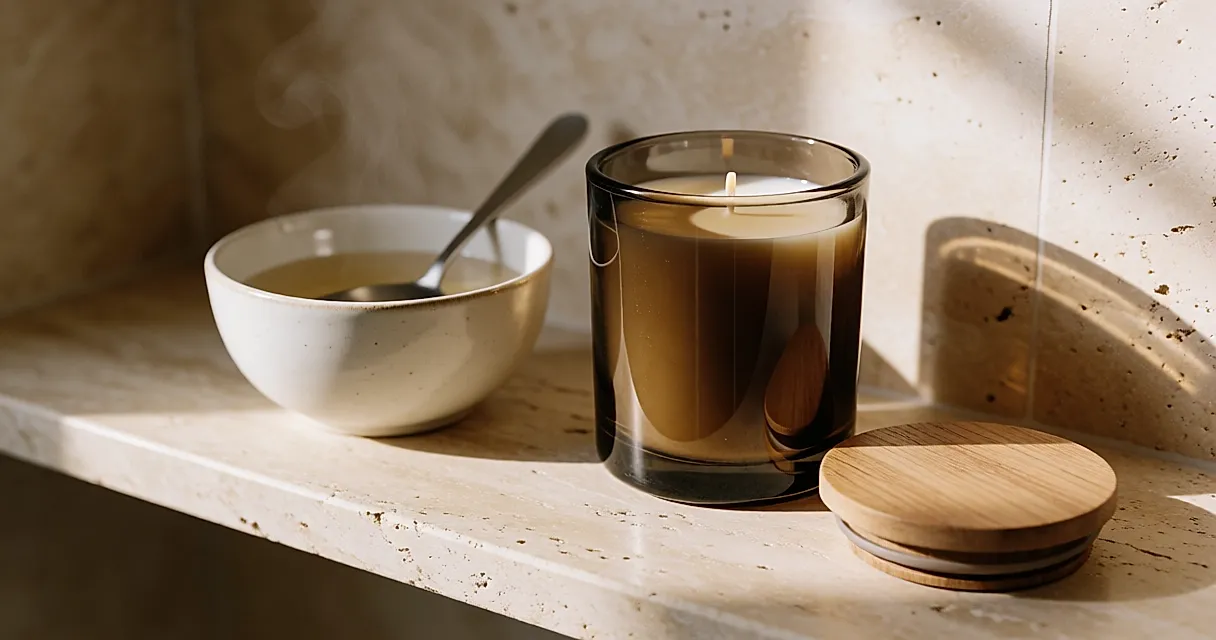
The candle has burned down to a stub and you're left holding a smoked-glass jar — too pretty for the bin, too sticky for the shelf. Right then: sink, hot water, a spoon, five minutes. Then the real question, the one you never asked at the till — was this container worth what you paid for the wax?
The jar speaks before the scent
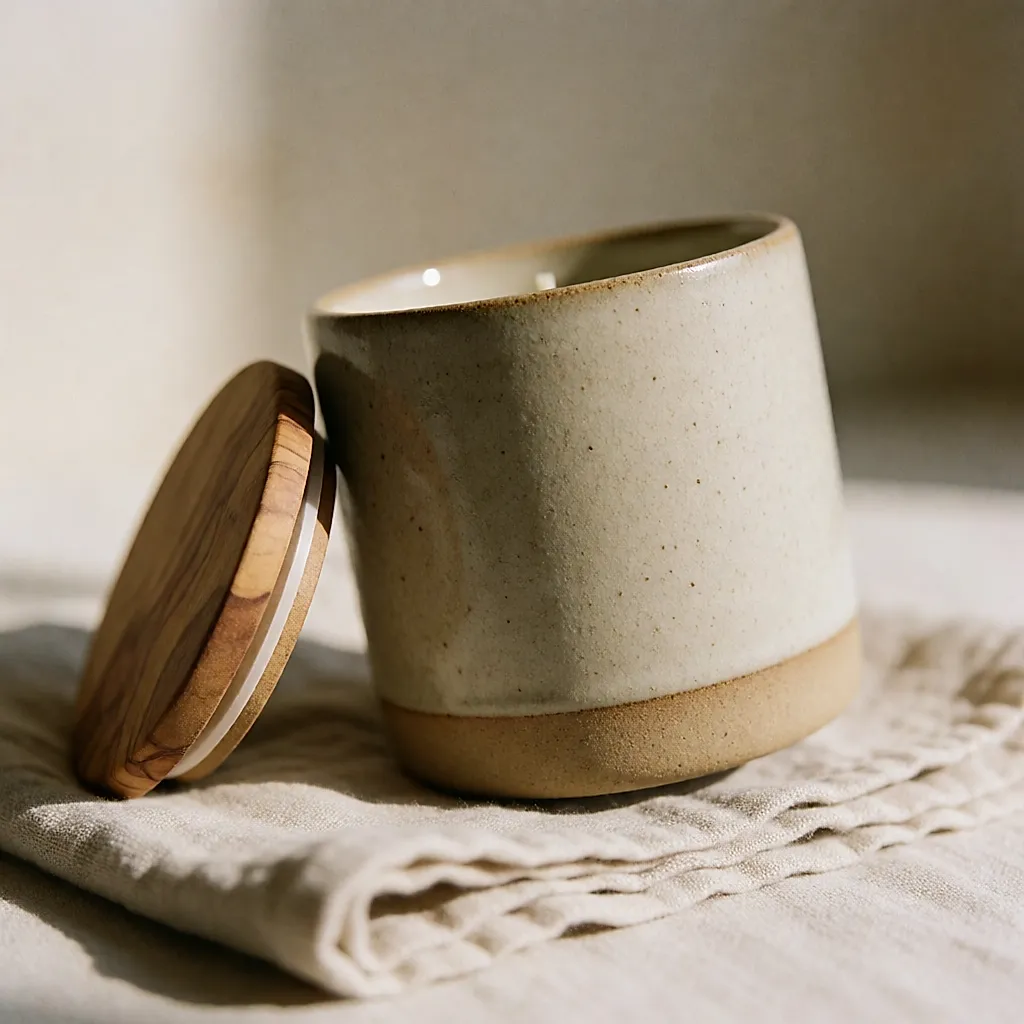
In a small-batch range, the jar talks before the wick is even lit. You can guess the material by its weight: thick glass, glazed stoneware, thrown ceramic, sometimes a wooden lid that sits flush. Look at the base — a signature, a workshop name, a city, occasionally a batch number. None of that is absolute proof, but such details are clues that a container wasn't ordered from a catalogue and then filled under someone's label.
At the other end of the shelf, the standard jar is often very good-looking. That's its job. Amber glass, a gold lid, nicely set type: the same container can turn up across a dozen brands with only the label swapped. It isn't a con; it's economies of scale. But don't count on it to hold a tealight for ten years — thin glass, fragile threads and sticky label residue will remind you soon enough.
Which leaves the third test, the one that tells you most: can the jar take a refill, a fresh wick, or at the very least end up as a jewellery dish on the bedside table? That single question rules out a lot of candidates. And at that point it's worth turning the box over.
The wax first, the wick second
What the wax is made of matters more than the name on the lid. A plant wax — rapeseed, soya, coconut — or an animal wax such as beeswax comes from a renewable source; paraffin is a petroleum derivative. That tells you nothing about the quality of the fragrance, but it tells you plenty about what's in the jar. Be wary of vague wording: "vegetable wax" can conceal a blend, and "natural" means precisely nothing until the composition is spelled out.
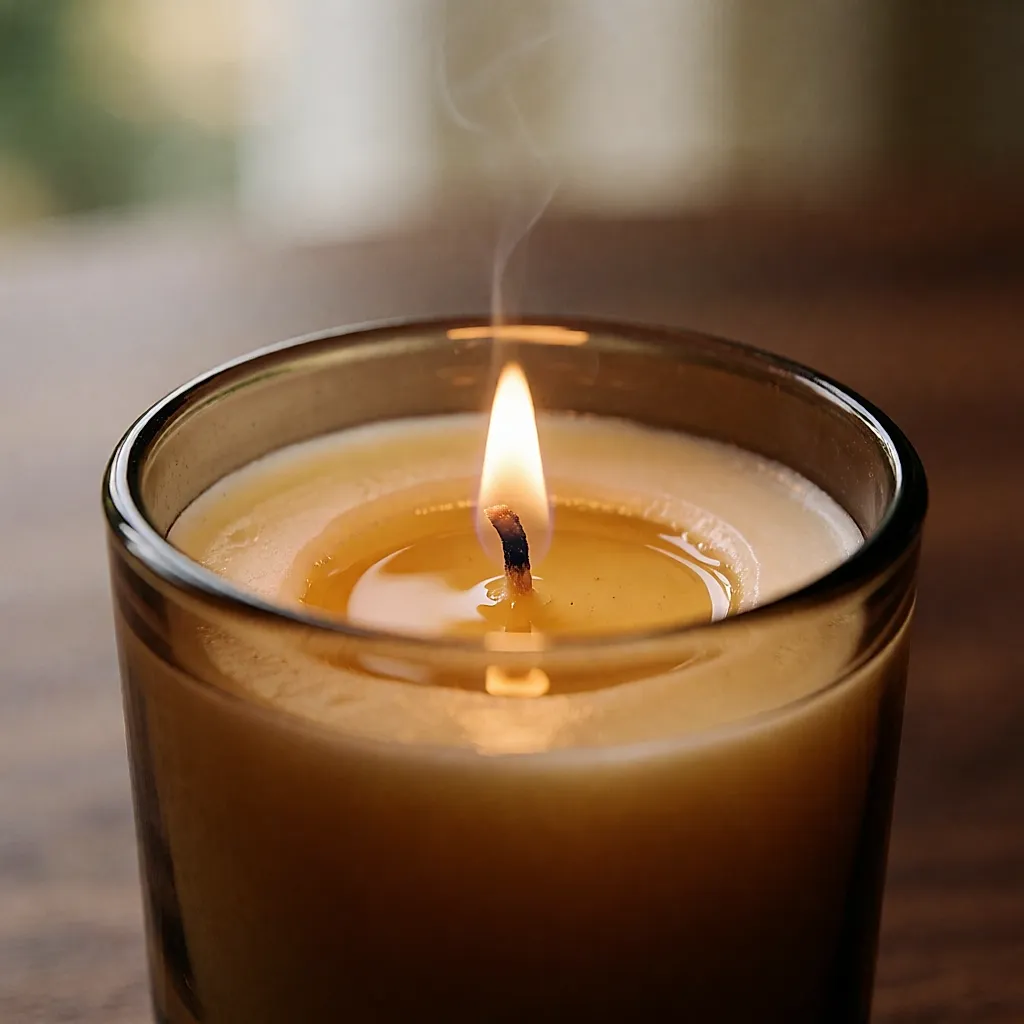
As for the wick, look for braided cotton, or possibly a wooden wick, which crackles gently. But the real sign that a candle has been properly set up is your first flame. If it smokes, tunnels down the middle or mushrooms at the tip, those symptoms can have several causes — wick size, burn sessions that are too short, draughts — and shouldn't be pinned on any single one. The first simple move is to trim the wick short, before you buy a replacement.
And if the scent doesn't carry you away? Smell it cold, lid off, unlit: a scented candle sometimes throws more on the shelf than it does in the room. That's part of a purchase you won't regret, too.
The workshop, the detail nobody reads
The workshop where the wax is poured is the most useful piece of information on the box, and the one most often missing. A brand that names its workshop, its town, the person who pours the wax, and sells direct from its own site or at a local market is more likely to be working in small batches than one that stops at a tightly framed "made in the UK". A "made in the UK" claim tells you where the candle was made, not where the wax came from — and the wax often comes from elsewhere.

A very simple test: look at who answers the messages. A small operation can come back to you within days, with the first name of the person who poured your candle. A brand whose customer service is a faceless form may sell brilliantly, but it owes you nothing on how the thing was made. No label replaces that. There's no public data that settles how much of what's on the shelf is really made by small producers, but the habit alone will sort a good few.
The trick that does the work: to get the last of the wax out, put the jar in the freezer until the wax lifts away in one piece. A dip in hot — never boiling — water and a cloth, and the jar is ready for make-up brushes, cotton wool pads or earrings.
What it costs
Expect roughly £8 to £20 in a supermarket or a homeware chain for a standard candle, £25 to £45 from an independent maker or a small-batch brand in a shop, and £50 to £90 at a perfume house that charges for the olfactory signature as much as for the jar. Refills, where they exist, tend to sit between £15 and £30. These ranges are indicative and make no claim to being an exhaustive survey: they cover the common sizes sold in the UK, in supermarkets, shops and online. Price varies a lot with city, wax weight, jar material and the sales channel — online, delivery charges change the sums.
The sensible way to work it out is to count the jar as an object in its own right. At £40, a candle that leaves you with a container you'll use for years isn't necessarily the most expensive thing in the cupboard. At £12, the one that ends up crushed at the back of a drawer didn't cost much either — but it left you nothing.
Which leaves one move: lift the jar, smell the cold wax, read who poured it, and ask yourself whether you'd keep it once the wick is finished. If the answer is yes, you're no longer buying a scent; you're buying an object with a second life. And as a bonus, you'll stop being taken in by the beauty of a label alone — well, we try.
Comments
Your opinion matters: rate the article, react and reply to comments.
Comments are moderated; AI-assisted comments are flagged. Text emoticons (8-), :-), <3…) are automatically shown as images.