
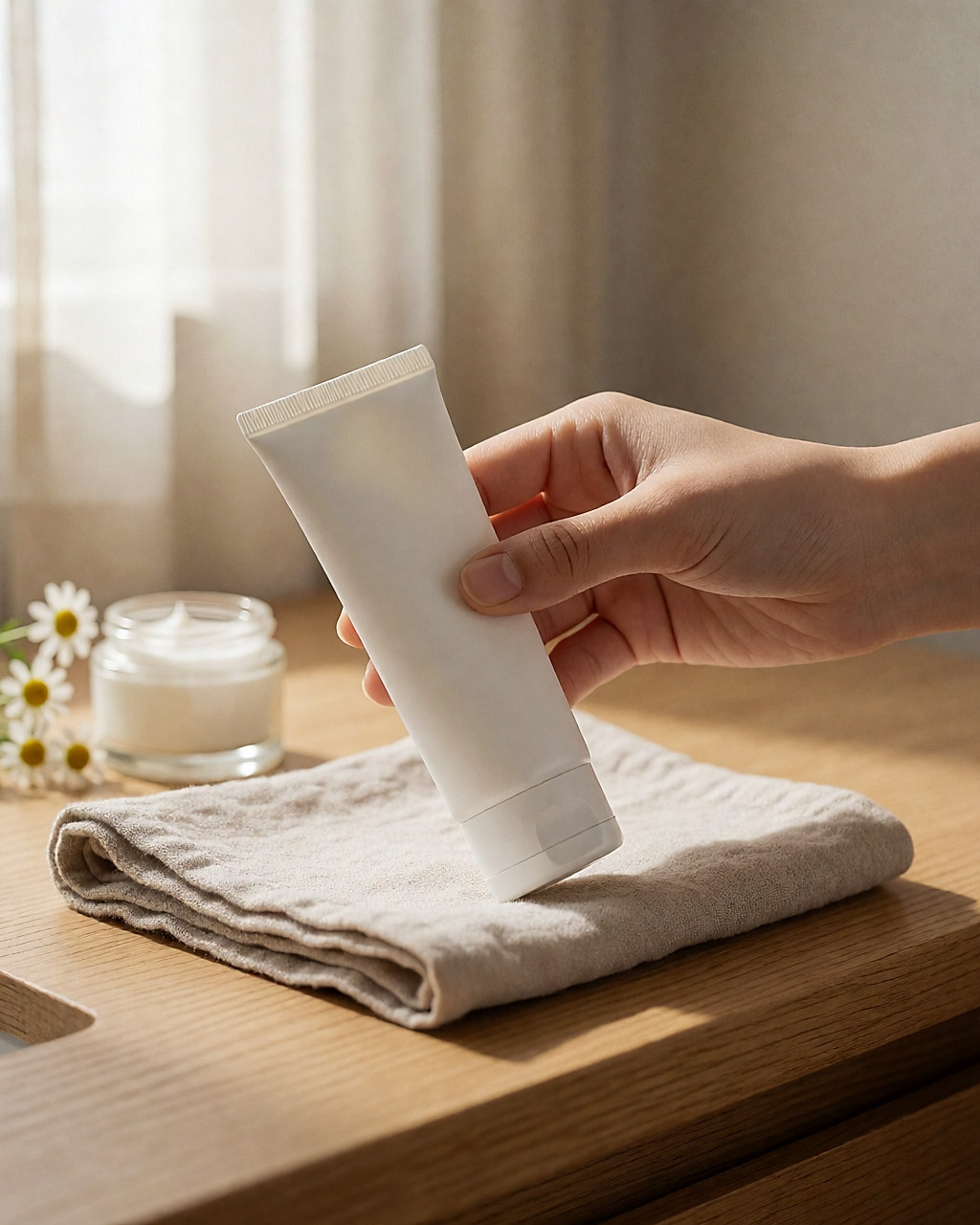
In the skincare aisle, tube turned over in your hand. 'With chamomile', 'natural formula', '97% plant-derived'. The front tells a lovely story, and nothing forces you to check anything. Except that an organic cosmetic is worth mainly because of its logo. Without a precise standard behind it, you're buying decoration.
Natural, organic, 'plant-based': three different things
A product labelled 'natural' can quite easily contain synthetic preservatives, and a 'chamomile' treatment may include only a few drops, just enough to feed the marketing copy. The word 'natural' has no legal definition on a cosmetic. The word 'organic' is no more protected by default: it only becomes meaningful once an independent body certifies it.
In other words, what matters isn't what the bottle says but who has checked what. And on this front, your best ally remains the small logo printed on the back.
The standards that hold up
The COSMOS standard, created in 2010, has become a common reference in Europe. It is backed by several organisations, including BDIH in Germany, Cosmébio in France, Ecocert, ICEA in Italy and Soil Association in the UK. Two levels exist. COSMOS NATURAL requires a proportion of naturally derived ingredients and a specification on processes. COSMOS ORGANIC, more demanding, also requires that at least 95% of plant ingredients come from organic farming.
Cosmébio, the French association, filed its charter in 2002 and offers its own labels, 'Bio' and 'Eco', aligned with COSMOS. Ecocert, a certification body founded in 1991, carries out a large share of the audits. Nature & Progrès, historically activist, is among the strictest: its charter, applied to cosmetics since 1998, strongly limits synthetic ingredients and prioritises short supply chains.
Careful not to mix everything up either. REACH is not a cosmetics label, but the European regulation on chemical substances, in force since 2007 and led by ECHA. It applies to manufacturers, not to your jar of cream. In the UK, UK REACH covers chemicals, while cosmetics sold here fall under the UK Cosmetics Regulation. For products sold in the EU, the general framework remains Regulation (EC) No 1223/2009, applicable since 2013.
The one move that changes everything: look for the logo, not the words. A jar without certification can be honest, but you then have no verifiable guarantee. Conversely, a COSMOS ORGANIC, Cosmébio or Nature & Progrès logo tells you who checked what, and by which rules.
The market has changed
The four pioneers cited in the 2000s — Dr. Hauschka, Lavera, Logona, Weleda — are still here. The landscape has widened. Large groups have bought up organic brands, and a wave of younger French labels — Typology, Respire, Lamazuna, Les Petits Prödiges — has shaken up prices. Refills, solid formats and waterless formulas have also changed textures and routines.

The result: a certified cleanser can remain affordable in supermarkets, while an organic serum can quickly climb in beauty halls. Certification is no longer a luxury in itself. What pushes the price up is the concentration of active ingredients and the format — not the seal. That's why the same standard can be found on products costing £10 and £70!
Budget
Typical UK price ranges:
- Certified facial cleanser (gel, foam, cleansing oil): expect around £7 to £20.
- Organic moisturiser: expect around £13 to £40.
- Facial serum or oil: expect around £18 to £55.
- Solid or refillable shampoo: expect around £7 to £18.
What makes the price vary: the level of certification, the proportion of real active ingredients, the packaging (glass, card, refill) and the sales channel. In supermarkets and high-street pharmacies you'll pay less; in specialist organic shops or beauty halls, a little more. Online, brands selling direct often cut out the retailer's margin.
A tip to finish: start with a single product, the one you use every day. Stick with it for a full month before expanding your routine. It's the cheapest way to sort the real thing from the veneer.
Sources
- Regulation (EC) No 1223/2009 on cosmetic products — EUR-Lex
- UK Cosmetics Regulation — GOV.UK
- REACH and ECHA — European Chemicals Agency (echa.europa.eu)
- UK REACH — Health and Safety Executive (hse.gov.uk)
- COSMOS Standard — cosmos-standard.org
- Cosmébio — cosmebio.org
- Ecocert — ecocert.com
- Nature & Progrès — natureetprogres.org
- Agence Bio — agencebio.org



Comments
Your opinion matters: rate the article, react and reply to comments.
Comments are moderated; AI-assisted comments are flagged. Text emoticons (8-), :-), <3…) are automatically shown as images.