
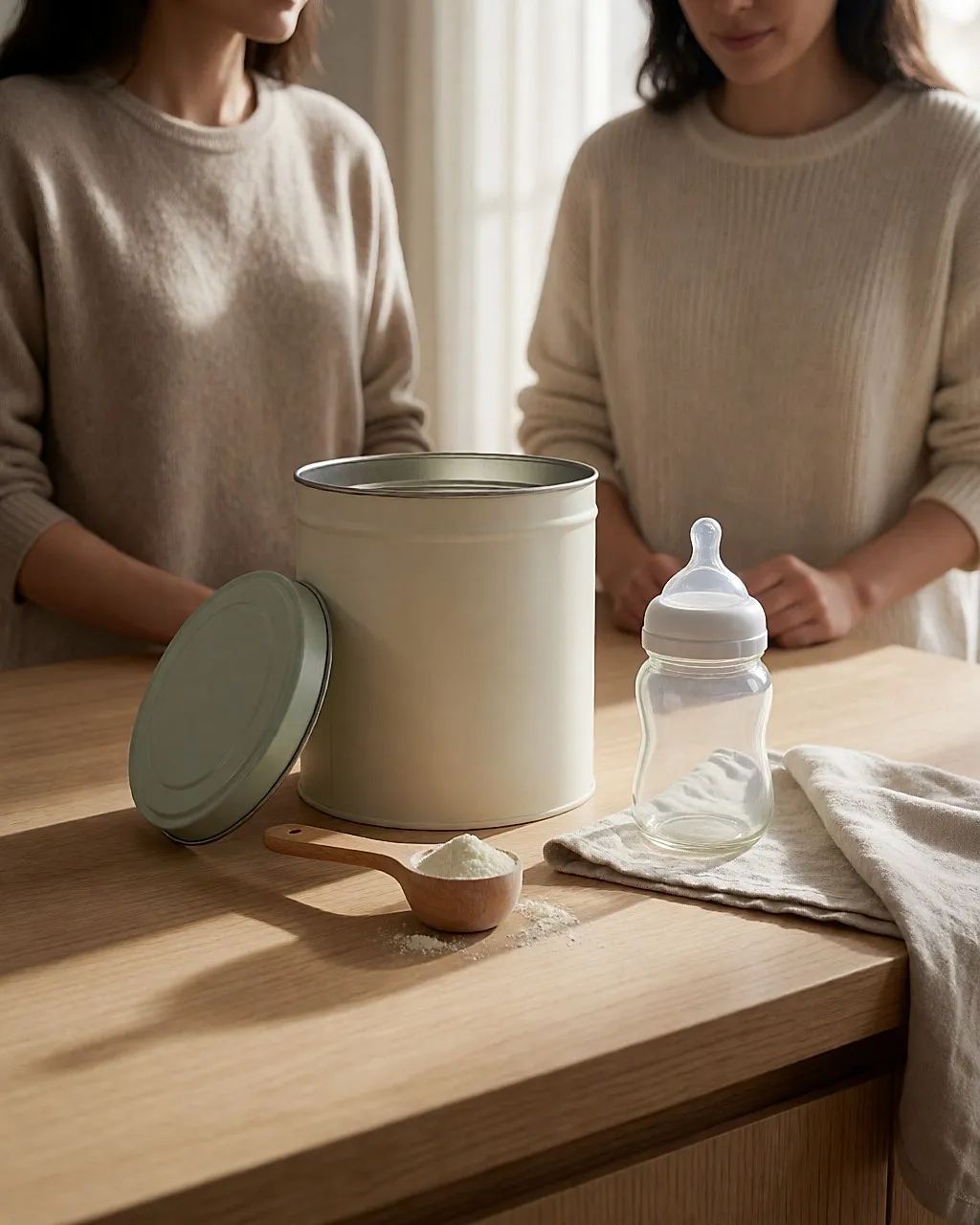
You thought choosing a pushchair was the hard part? The formula aisle comes next, with its colourful tins and conflicting advice. Good news: most of the time, your baby's age makes the decision. The rest – taste, digestive comfort, tolerance – is best worked out case by case with your health visitor, GP or paediatrician.
Before 6 months: first infant formula
If you are not breastfeeding, first infant formula is the only formula your baby needs for the first 6 months – and it remains suitable right up to 12 months. In the UK, all infant formula must meet strict compositional rules, based on retained EU Regulation 2016/127. This sets minimum and maximum levels for a long list of nutrients and tightly controls the claims printed on tins. Since 2020, DHA – a fatty acid involved in development – has also been mandatory, with specified amounts. In other words, the basics are already covered: you do not need to spend hours decoding labels, because the formulas on the UK market share the same foundation.
From 6 to 12 months: follow-on formula
When weaning starts, often between 4 and 6 months, follow-on formula (Stage 2) is marketed for use until around 1 year. It is enriched with vitamins and essential fatty acids, and especially iron – a point that matters, because at this age the stores built up before birth are running low and meals do not yet cover everything. Cows' milk contains much less iron, which is why it is not used as a main drink before 12 months. In the UK, follow-on formula is not necessary: first infant formula can be used throughout the first year. If you do choose it, follow-on formula is suitable from 6 months.

After 1 year: growing-up milk
Growing-up milk does not fall under the same regulatory framework as infant and follow-on formula: it is a separate product aimed at 1–3 year olds. In the UK, it is not a required part of a toddler's diet. The NHS advises that children aged 1 to 3 need about 350 ml of milk a day, and whole cows' milk can be given as a main drink from 12 months. Growing-up milks are marketed for this age group, but they are not essential. If you use one, follow the tin and discuss it with your health visitor or GP if you are unsure. What and how much your child eats alongside milk will guide the decision.

A practical warning: plant-based drinks – almond, rice, oat – are not a substitute for infant formula. They are too low in protein, iron and calcium, and rice drinks in particular should not be given to children under 5 because of arsenic. Without medical advice, do not use them as a main drink before 2 years.
You were breastfeeding and now you're moving to bottles?
No guilt needed: modern formulas are designed to cover a baby's needs when breastfeeding stops. Sometimes baby refuses the first bottle, as taste and smell vary. You can try two or three options, but once one suits your baby, it is better to stick with it: frequent changes can unsettle digestion.

A formula that doesn't suit: signs to watch for
Wind, persistent constipation, diarrhoea, worsening eczema, repeated refusal of bottles: these signs deserve a consultation, not a lone decision to change tins. Current data suggest that primary lactose intolerance is rare in infants, while cows' milk protein allergy (CMPA) affects around 2 to 3% of babies. The diagnosis is not made at home: a doctor will establish it and, if needed, prescribe a hydrolysed or specialist formula, available on prescription from a pharmacy.

An anti-allergy formula is not something to choose off the shelf. If digestive or skin symptoms persist, make an appointment rather than changing tins: a specialist formula given without a diagnosis can mask the problem and delay proper care.
Bottle-feeding in practice
- Water. Fresh tap water is fine if local quality allows: run it cold and use it to fill the kettle. Otherwise, use bottled water with low mineral content, labelled 'suitable for infant feeding'. Avoid water from a water softener or filter.
- Preparation. At feed time, wash your hands and clean the worktop. Never reheat in a microwave. Test the temperature on the inside of your wrist.
- Leftovers. A bottle that has been started should be thrown away within an hour, without refrigerating it for later.
- Water temperature. The WHO recommends water at 70°C or above for reconstitution, and UK NHS advice follows this. Freshly boiled water should be left to cool for no more than 30 minutes before mixing. If you are unsure, ask your health visitor or GP.

Budget
On price, expect around £15-£25 for an 800 g tin of first or follow-on formula in supermarkets, more like £20-£35 in pharmacies or online pharmacies, and a little more for certified organic ranges. Liquid growing-up milk is around £2.50-£5.50 per litre. Hydrolysed and specialist formulas cost considerably more, around £25-£55 per tin, though they may be available on prescription depending on the reason.
What changes the bill: the age stage, the range, the format (metal tin or cardboard refill), where you buy it and whether you have a prescription. The useful habit is to compare by the kilo or litre, not by the price on the tin.
Sources
- NHS, 'Breastfeeding and bottle feeding' and 'Drinks and cups for babies and young children'.
- Scientific Advisory Committee on Nutrition (SACN), Feeding in the First Year of Life, 2018.
- The Infant Formula and Follow-on Formula (England) Regulations 2007 (as amended) and retained EU Regulation 2016/127.
- World Health Organization (WHO), recommendations on the preparation, storage and handling of powdered infant formula, 2007.
- NHS, 'Cow's milk protein allergy' and 'Food allergies'.
- Food Standards Agency, guidance on infant formula and follow-on formula.


Comments
Your opinion matters: rate the article, react and reply to comments.
Comments are moderated; AI-assisted comments are flagged. Text emoticons (8-), :-), <3…) are automatically shown as images.