
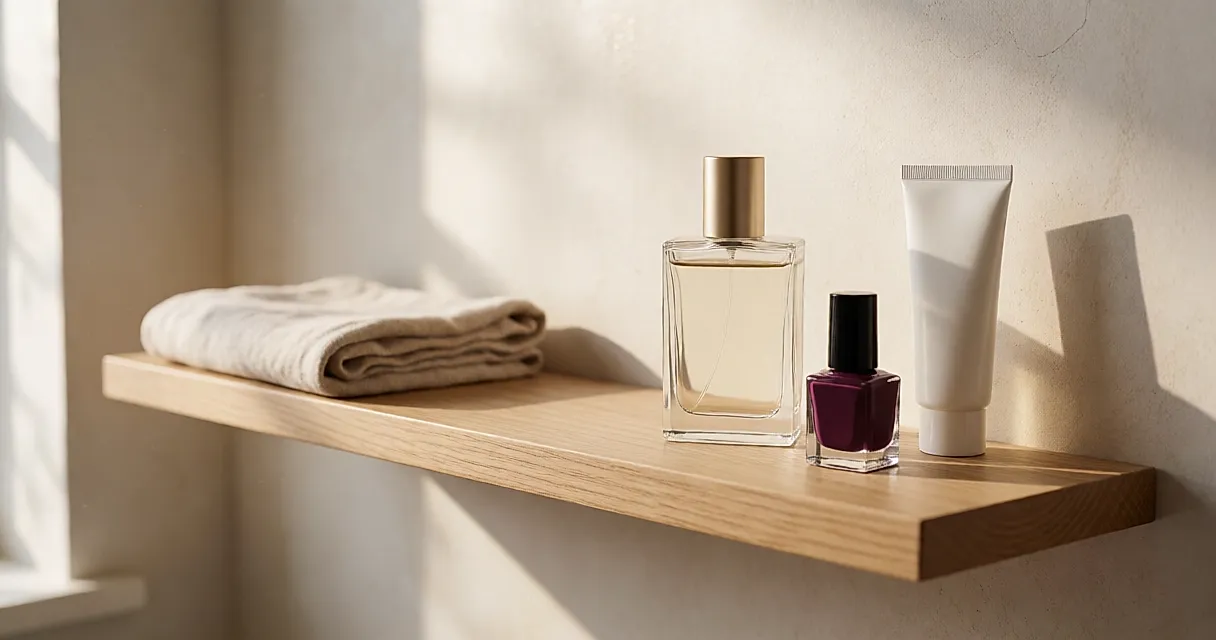
Is it worth clearing out your bathroom cabinet when you're expecting? The question tends to arrive with a positive test, a folder of maternity notes and an ingredient list found online — and it deserves better than a panicked clear-out. Three spritzes of perfume before dashing out of the door, a coat of polish on Sunday evening, a colour top-up every six weeks: that is the real substance of the issue.
What the evidence suggests, and what remains uncertain
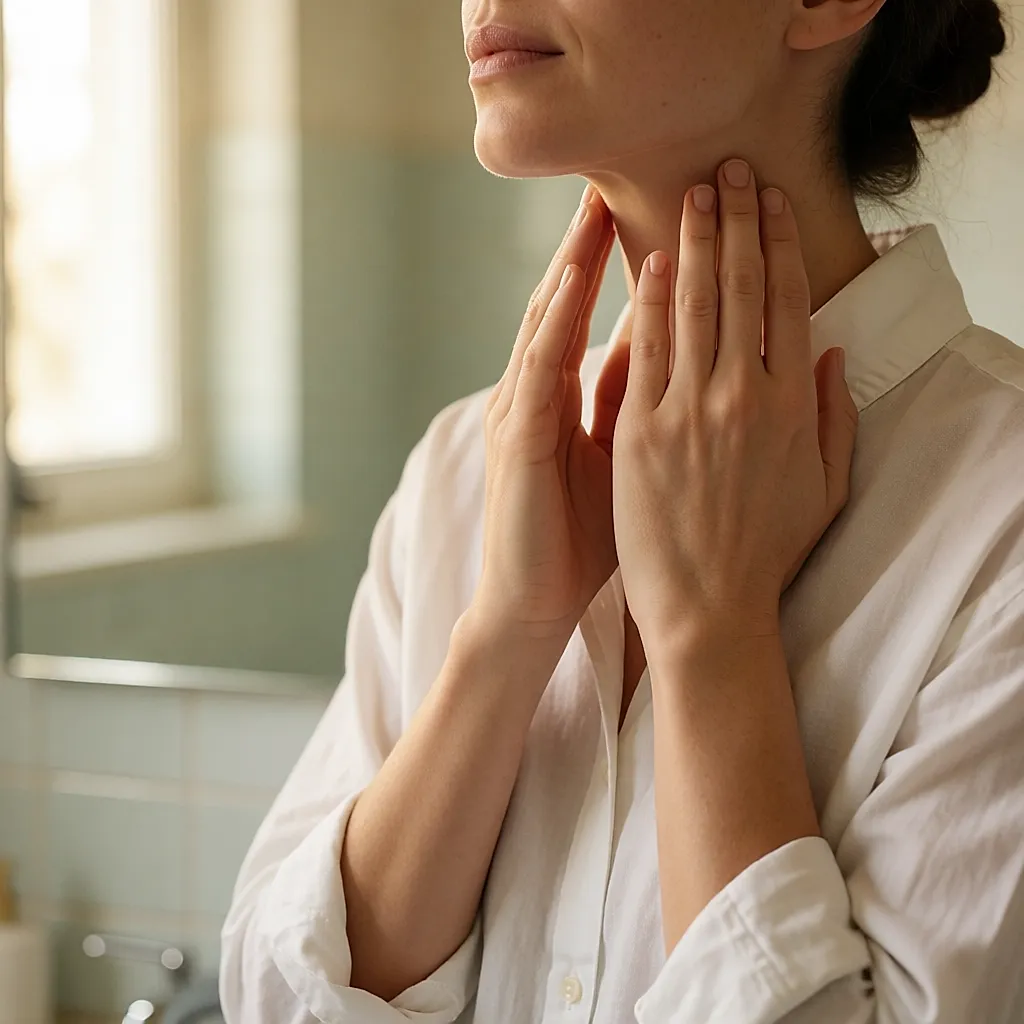
Skin isn't a sieve; it's a barrier. It can let certain substances pass through in small amounts, depending on the molecule, the formulation and the state of the skin — with somewhat more on certain areas (the neck, the chest, the lip line). In everyday use, exposure from cosmetics is generally low. We cannot conclude that there is an effect on how a pregnancy progresses — nor can we rule one out.
That uncertainty doesn't mean anything goes: a permitted ingredient is not a proven harmless one; it is permitted under defined conditions. Everyday exposure like this deserves to be discussed without turning it into an alarm. Hence the logic: scale back what goes on often and over large areas, and keep the rest without guilt.
First step: perfume
It comes top of the list, and not because it would be toxic. It ticks every box: worn daily, over a large area, sometimes more than once if your hand is generous, and the formula is very high in alcohol. Above all, the word "parfum" on an INCI list can cover a complex mixture whose full composition is not disclosed; some allergens must nevertheless be declared above regulatory thresholds.
So you don't stop, you dose. In practice that means a small amount, on clothes or hair rather than directly on skin, and never on your bump. Avoid layering too: scented shower gel, scented body lotion, then eau de parfum is three layers for one impulse. Cutting frequency and layering reduces exposure — keeping the bottle for days that matter is already part of the job.
Nail polish: the bottle isn't the main culprit
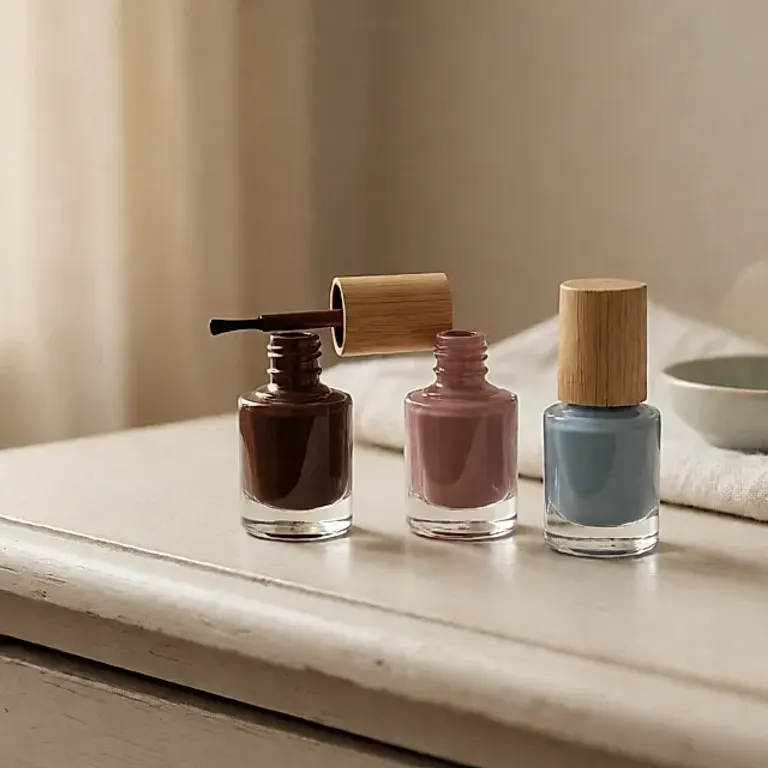
Polish is mostly solvents — ethyl acetate, butyl acetate — which evaporate while you paint, in a room that is often closed, with your nose 30 cm away. It's the air in the bathroom on a Sunday evening that deserves your attention.
Two habits are enough: ventilate, even in November, and space out your manicures. Remover deserves the same thought as polish — you breathe it in for ten minutes, hands under your nose, often with no window open. If the smell bothers you, water-based formulas exist, though they tend to be less long-lasting. Fewer solvents doesn't mean none, but the compromise is an honest one.
Hair colour needs treating separately
It doesn't play in the same league: a colour designed to penetrate the hair fibre, applied to the scalp and left on according to the product instructions. And pregnancy sometimes changes what your skin will tolerate: a shade that never caused a problem can, one day, stop suiting you.
In practice, leave longer between appointments and favour techniques that don't touch the scalp, such as highlights or balayage. On the risk during pregnancy, what we know remains limited: which is exactly why being cautious beats shrugging it off.
What you keep, and the "natural" trap
Cleansing, moisturising, sun protection: none of that disappears. Skin often becomes more reactive during pregnancy, and sun exposure makes melasma — the mask of pregnancy — more likely, so sun protection is something to step up rather than scale back. A simple moisturiser, fragrance-free if your skin asks for it, does the job perfectly well.
The trap is the word "natural". Essential oils are not harmless: during pregnancy and breastfeeding, it's better to ask a healthcare professional before using them. A bottle stamped organic is no more of a free pass. And fragrance isn't only in the spray: it's in your moisturiser, your cleanser, your laundry detergent. The total is what counts.
If you remember only one thing: in practice, frequency and surface area often carry the most weight. If you're unsure — reactive skin, asthma, a current treatment — talk to your midwife or GP, who knows your history.
What it costs
Scaling back doesn't mean restocking the bathroom cabinet. The bottle of perfume you already own is enough: you cut the dose, not the budget. If you do need to replace it one day, expect roughly £40 to £120 for 50 ml at a department store or on the high street, depending on concentration. A water-based polish costs about £7 to £18 (pharmacies, health-food shops, online), and an acetone-free remover £4 to £12 at a supermarket or chemist.
For hair, a salon colour comes to around £60 to £150 depending on length and technique: balayage costs more than a root tint but can be stretched further, which evens out the bill across the year. A fragrance-free moisturiser sits between £8 and £25, and price says nothing about how well it works. One thing worth remembering: in a pharmacy or a salon, ask for the full ingredient list rather than settling for the word "gentle" on the label.

Comments
Your opinion matters: rate the article, react and reply to comments.
Comments are moderated; AI-assisted comments are flagged. Text emoticons (8-), :-), <3…) are automatically shown as images.