
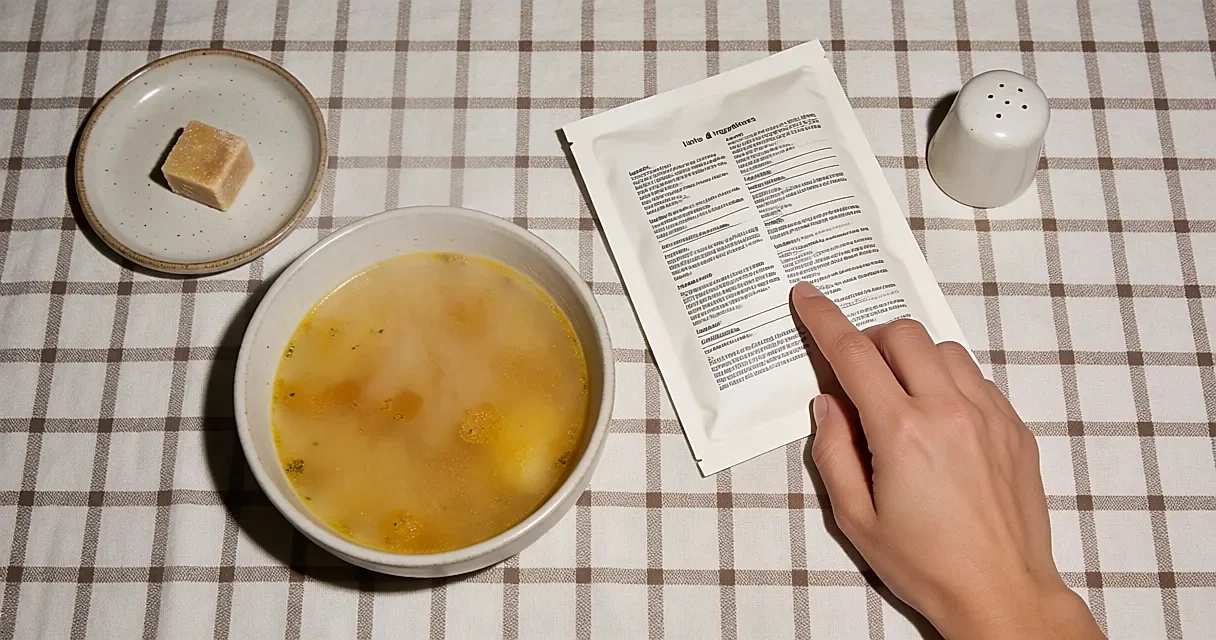
Turn the box over: six lines of ingredients, some cooking instructions, a date. The first line is almost always salt — and it tells you more about what is simmering in your pot than the price per litre. Since December 2014, UK food labelling rules have required ingredients to be declared in descending order by weight: the higher up the list, the more there is inside. In other words, the recipe reads top to bottom, like a detective novel where you know the culprit from the first page.
The rule nobody reads
The EU Food Information to Consumers Regulation (No 1169/2011) — carried into UK law after Brexit — does not dictate what goes into a stock cube, only the order in which it must be admitted. Three lines are therefore enough to grasp the structure of the product: salt comes first, then starch or flour, then fat, and finally the part that gives flavour. That is not a cosmetic detail — it is the only piece of information on the pack that isn't marketing.

Then comes the procession of words you don't recognise: yeast extract, hydrolysed protein, flavourings, glutamate, disodium inosinate. Nothing mysterious or banned: these are ingredients that supply what is called umami — the roundness you are looking for in a stock. Their presence is not a problem in itself. What deserves attention is that they usually sit alongside salt that is still just as high up: the list grows longer, the salt does not move down.
What we do know is that the World Health Organization recommends less than 5 g of salt a day for an adult, across all foods. What we know less about is the exact share in a single cube: it varies enormously from one brand to the next, and nobody can tell you what one cube a day does for you. Current evidence points mainly to a cumulative effect — the stock at lunch adds to the cheese at dinner, and it is that pile-up that counts.
Cube, paste, powder: texture doesn't settle it
The cube is a dry concentrate: salt, fat, starch, then flavourings. Its compactness has one advantage — it keeps for months in a cupboard — and one thoroughly annoying drawback at home: you cannot use half of it. Paste lives in a tub, often in the fridge after opening, and is measured by the spoon; softer, wetter, but not necessarily less salty, because water and fat take up space without removing salt.
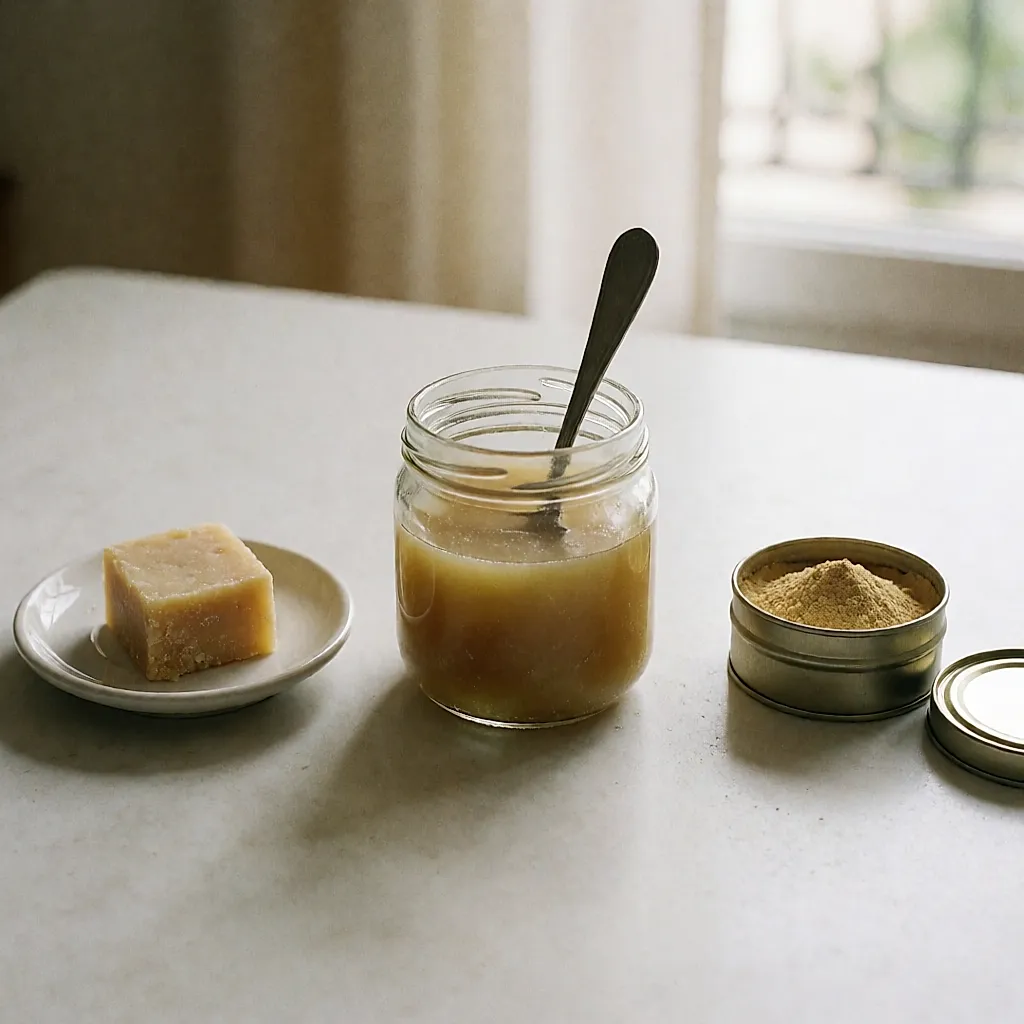
Powder, finally, dissolves fast and is measured by eye, which makes it handy for adjusting a dish at the end of cooking. Its drawback sits on the first line of the list, frequently occupied by salt, closely followed by maltodextrins. As for versions labelled organic or 'no added flavourings', they sometimes change the list — not necessarily the salt level.
The format never wins on its own. What wins is the order of the list: a cube whose salt appears only third tells you more than a generously packaged tub. The price per litre says none of this — it compares volumes of water, not plates.
The method: homemade stock in ice cubes
The real alternative costs next to nothing, provided you accept that it isn't instant. Keep in the freezer the carrot peelings, the greens, a tired leek top, a chicken carcass; cover with cold water, simmer for a good hour, strain. Do not add salt — or very little — while it cooks: that is the whole point of the method. The salt comes back later, by the spoon, under your control, on the plate.
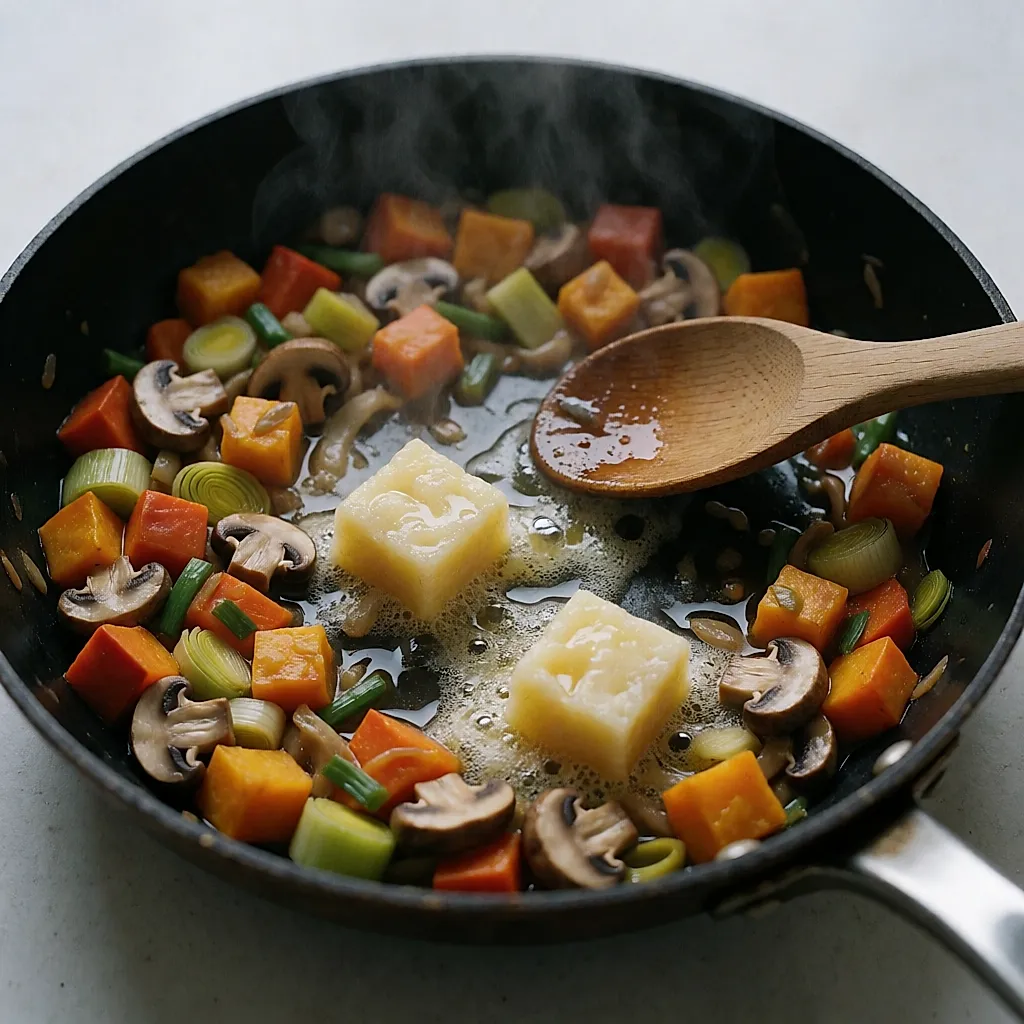
Then there's keeping it. Cooled quickly and put in the fridge, stock keeps a few days; poured into an ice-cube tray, it turns into portions ready to drop into the pan. In practice, count one stock ice cube for a pan of vegetables, two for a risotto — kitchen rules of thumb, to adjust by how concentrated your reduction is. In the freezer, allow two to three months to keep the flavour.
Three words to look for on the list: 'salt' (where is it — right at the top?), 'yeast extract' and 'flavourings' (often there to compensate). And be wary of the 'reduced salt' claim: it is regulated, but it does not guarantee the flavour is achieved without flavour enhancers. If you are on a low-salt diet for health reasons, work out the quantities with a healthcare professional, not with a packet.
Cost
On price, the shelf stays modest: expect to pay roughly £1-£2.50 for a box of six to eight cubes in a supermarket, around £2.50-£4 for a 200g tub of paste, and £1.50-£5 for 100g of powder, depending on the range and where you shop. In a health-food shop or specialist store, versions with no added flavourings go up a notch, sometimes doubling.
Where to look? In the stock and gravy aisle, next to the spices and sauces, in supermarkets; in health-food shops for shorter lists; in a refill shop for powder, sold by weight. Homemade stock costs only what you would have thrown away — plus the electricity for the freezer, to be honest.
The takeaway fits into one second of reading: the first line of the list. It replaces neither medical advice nor a varied diet — it just stops you salting the soup before you have tasted it, literally and figuratively.
Sources
- World Health Organization — Salt reduction: fact sheet.
- EU — Regulation (EU) No 1169/2011 on the provision of food information to consumers.



Comments
Your opinion matters: rate the article, react and reply to comments.
Comments are moderated; AI-assisted comments are flagged. Text emoticons (8-), :-), <3…) are automatically shown as images.