
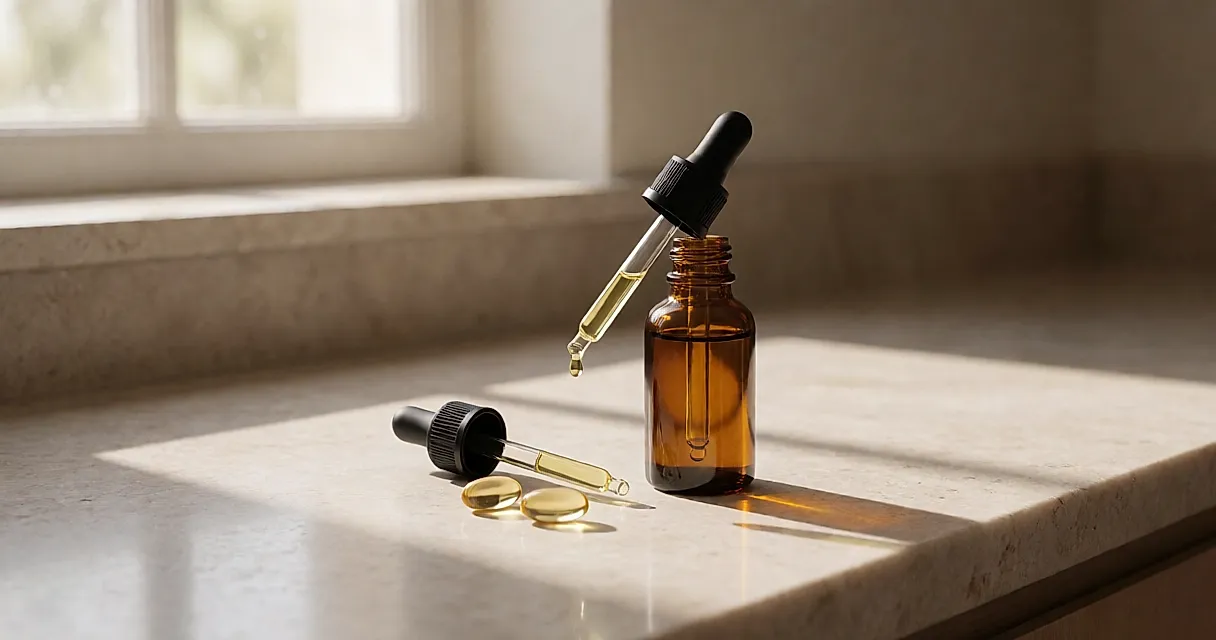
Somewhere in a stainless-steel tank, an invisible microalga is doing the job we once handed to sardines. Fish never made these omega-3s in the first place: they ate them. So why keep the middleman? Because before you choose, there's still a label to decode.
From tank to dropper: where the oil comes from
Microalgae oils sold today mostly come from micro-organisms grown in fermenters, in particular strains of Schizochytrium, which are rich in DHA and EPA. Cultivation happens in a tank with a nutrient medium, controlled temperature and light; extraction and refining follow, then bottling or encapsulation.
That origin isn't a marketing detail. It explains why no fishing is involved: marine omega-3s reach our plates through fish that get them, in turn, from plankton and microalgae at the base of the food chain. We cut out an intermediary. Watch the wording, though: an "algae oil" can also mean extracts of macroalgae (seaweed), whose fatty acid profile is different. If EPA and DHA aren't listed, put the bottle back.
Reading the label like a school report
First move: look for the milligrams of EPA and DHA, listed separately or combined, per capsule or per millilitre. A line saying "microalgae oil: 1,000 mg" tells you nothing about the useful amount — that's the weight of the oil, not of the fatty acids you're interested in. Second move: relate that figure to the number of doses in the pack. Our practical benchmark for adults is 250 mg a day of EPA and DHA combined; then work out what one dose means within your own day.
Traceability comes next: which strain, where it was grown, where it was extracted, who made it. Serious brands publish all this; others stay vague. On certification, organic status is never automatic: where it's claimed, it should carry a recognised organic mark — the EU leaf on imported goods, or a UK certifier such as the Soil Association — and it covers how the algae are grown as well as how the oil is processed. Vitamin E, often on the ingredients list, is there to slow the oil's oxidation.
Three numbers before you buy: the mg of EPA and DHA per dose, the number of doses in the pack, and the price per 100 mg of EPA + DHA. Everything else — the pretty bottle, the nice story — is a bonus, not an argument.
Glass bottle or capsules
Dropper bottles have their fans: you control the dose yourself, and a lemon or mint flavour takes the edge off that low-tide note. Glass is inert, recyclable and frankly nicer to have in a cupboard than a plastic tub. The trade-off is that every time you open it, the oil meets air — and oxygen is what damages fatty acids. A bottle that sits on the shelf for weeks? Not a good idea.
Capsules slip into a bag, leave no aftertaste and need no spoon. Check what the shell is made of: animal gelatine or plant cellulose, depending on your preferences. In principle the two formats are equal; what settles it is how consistently you'll take them.
Storing it and making it a habit
Once opened, keep the bottle in the fridge, tightly closed and away from light; in practice, use it within a few weeks of opening. Tinted or opaque glass shields the oil from UV, though it can't do much beyond that. If the smell turns sharply rancid, don't argue with it: replace it. Capsules, meanwhile, should be kept dry and cool, which in summer often means somewhere other than the kitchen worktop.
Now the habit itself: take it with a meal, ideally. These fatty acids are fat-soluble, and a dish containing some fat helps your body absorb them. In practice, what keeps the habit going is choosing a moment you'll actually remember — lunch rather than the 7am coffee. And one reminder: a supplement doesn't replace fish, walnuts or flaxseed oil, all sources of plant omega-3s.
What it costs
Expect to pay somewhere between £15 and £35 for roughly a month's supply, from a pharmacy, a health food shop or online in the UK. The price climbs with EPA and DHA concentration, organic certification, published traceability and format — a glass bottle costs more to produce than a pouch of capsules. Larger packs bring the cost per dose down, provided you have fridge space and you keep going with them.
The compromise is a fair one: fish oil is usually cheaper. In exchange, the algal version has no fishy smell, doesn't depend on forage fish stocks and suits anyone who doesn't eat seafood. It isn't a guarantee of a perfect footprint — fermentation uses energy and a substrate — but the supply chain doesn't put pressure on fishing.
What we know and what's still unclear
Algal oil supplies DHA and EPA, and the same intake benchmarks apply to those amounts. Beyond that, let's stay measured: a supplement doesn't make up for an unbalanced diet, and whether it's worth taking depends on your own situation. If you're pregnant or breastfeeding, taking anticoagulant medication or living with a long-term condition, speak to a health professional — your GP, midwife or pharmacist — before you start. Two minutes of questions beats six months of doubt.
Bottle or capsules? The real question is elsewhere: which of the two will you still be getting out of the fridge on a Tuesday evening in November, when motivation has melted faster than snow? Choose that one.
Food supplements do not replace a varied, balanced diet and a healthy lifestyle.



Comments
Your opinion matters: rate the article, react and reply to comments.
Comments are moderated; AI-assisted comments are flagged. Text emoticons (8-), :-), <3…) are automatically shown as images.