
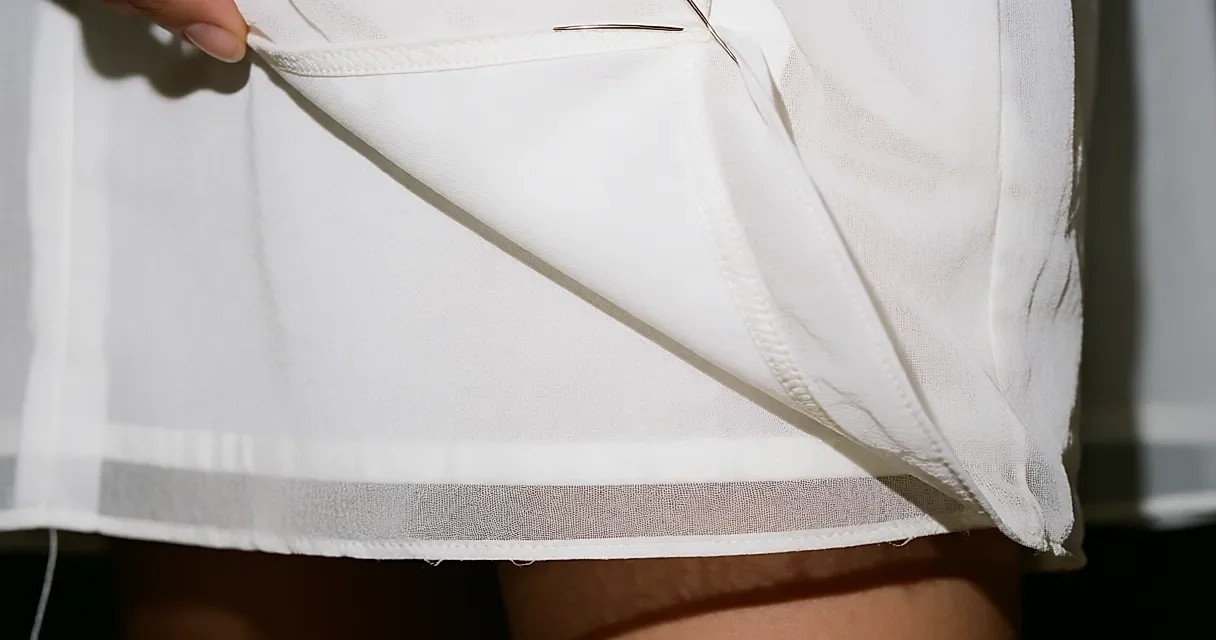
White voile has a rare talent: it hides nothing, yet it dresses everything. At first glance, it is just another dress. At second glance, something more interesting: when sheer fabric covers the whole surface, it stops being a detail and becomes the very fabric of the dress.
When voile becomes the dress itself
On a dress that plays the game wholeheartedly, transparency is not confined to separate pieces. A mesh sleeve, a tulle back, an openwork side panel: those nods still exist, but when voile covers the entire garment, it no longer trims it; it constitutes it. You are no longer looking through a window cut into a garment; the garment itself becomes the window.
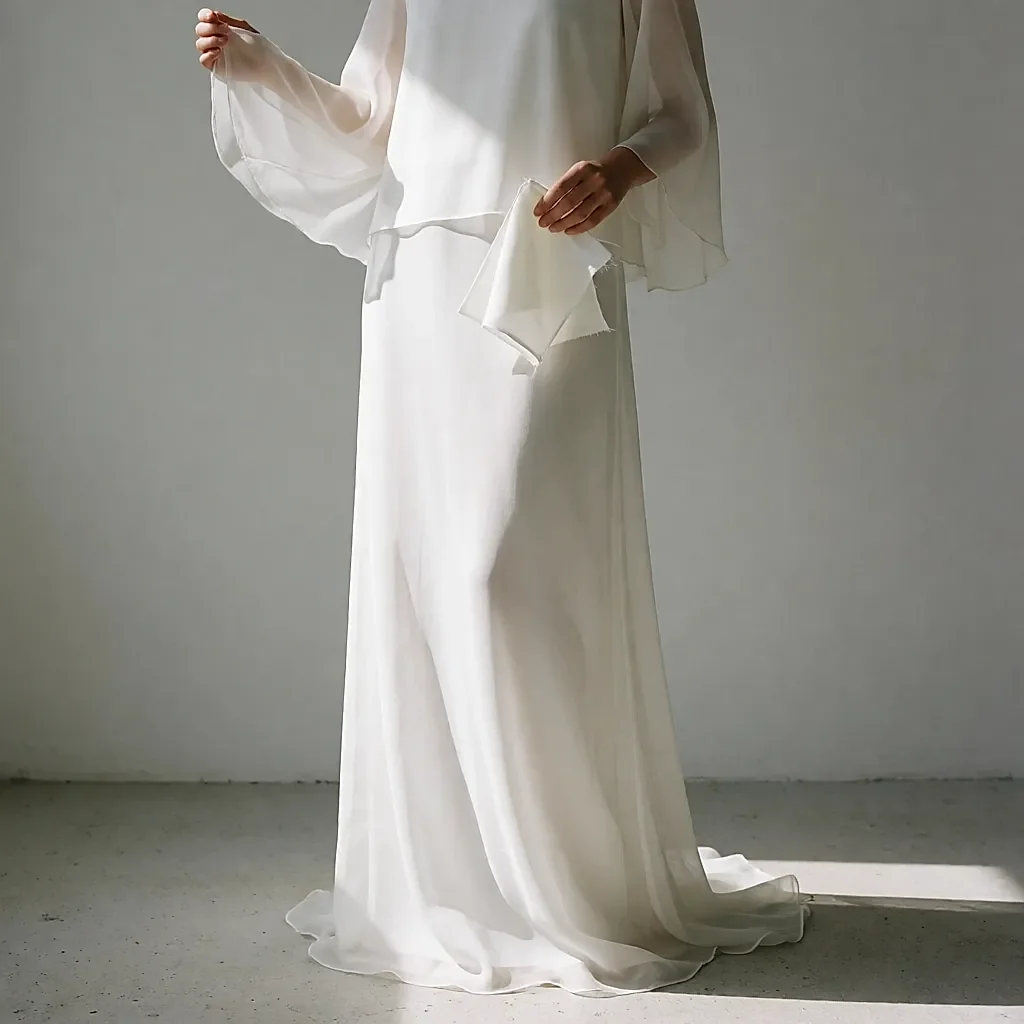
And perhaps that is why the look holds together. Sheer fabric across the whole surface no longer tells you about skin; it tells you about cloth. Between the voile and you there is an opaque layer: a slip, a bodysuit, a long petticoat. Transparency then stops being a reveal and becomes a texture, a haze over an already composed silhouette.
Which leaves the question anyone asks in front of this kind of look: can it be worn in real life? Yes, on one non-negotiable condition: look after what is underneath.
Drape, underlayer and light
Voile has a drape we love precisely because it will not stay put: it glides, lifts as you get out of a car, presses against your leg when you walk fast. In white, that becomes spectacular and demanding. Every fold shows, every seam stands out, a badly set hem can be spotted ten metres away. A weighted hem is often enough to save the line; without it, the dress ends up looking like a sheet drying in the wind.
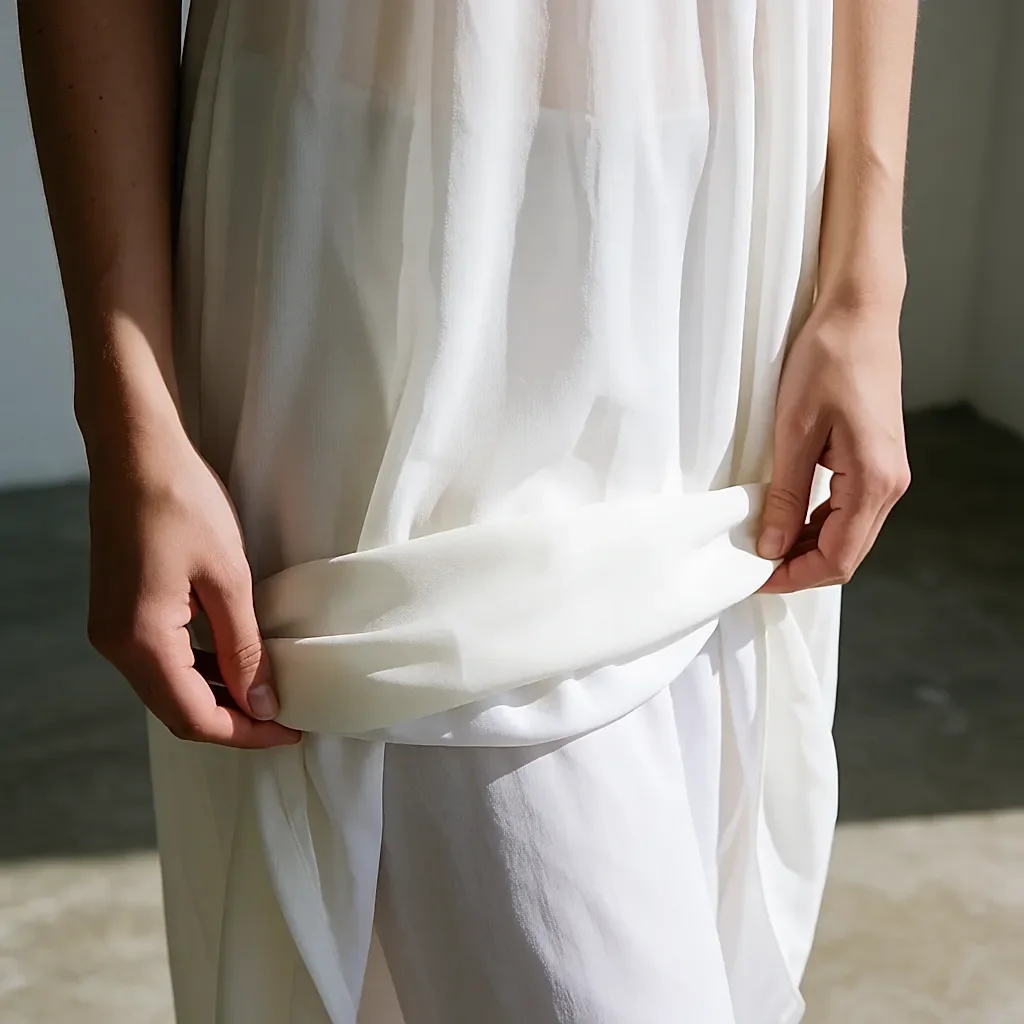
Then comes the opaque underlayer, which decides everything. A matte fabric, no lace, no visible elastic, in a tone close to your skin or decidedly ivory. A patterned slip under white voile? The whole thing instantly looks like a sitting-room curtain. Two different whites, on the other hand, give relief: ivory underneath, optical white on top, and the fabric starts to vibrate.
Three checks before you commit to a voile dress: the fibre composition (silk voile and cotton voile drape differently from synthetic versions, whose exact fibre mix you need to check on the label), the presence of a lining or weighted hem, and whether you can slip a smooth base underneath without the layers fighting each other. If any one of the three is missing, walk away.
Why evening, not midday
It is not just a question of light, but also of dress codes. By day, translucent white flattens: it loses its relief, lets light through without sculpting it, and the garment fades. At night, artificial lighting passes through the voile, picks out the drapes and cuts the silhouette into chiaroscuro; the dress regains its outline.
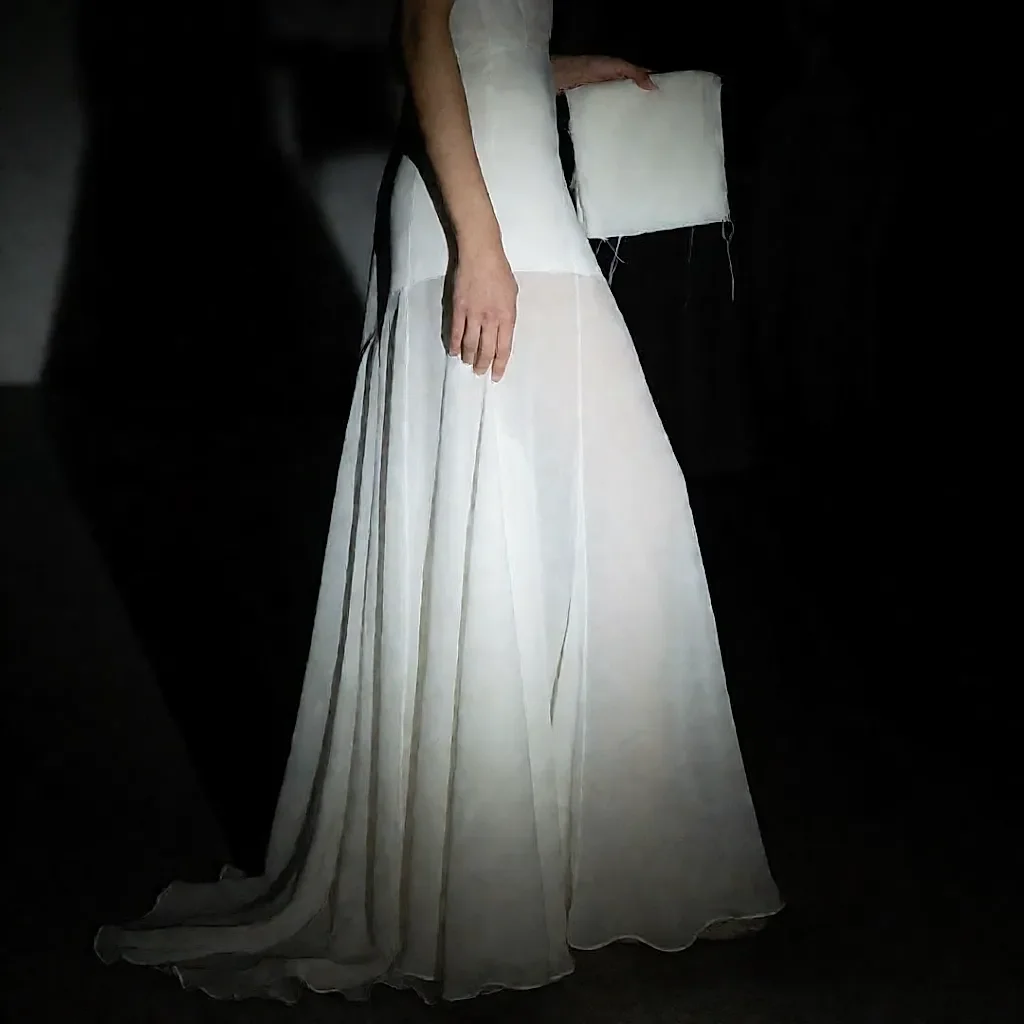
The social calendar does the rest. At eleven in the morning, a fully transparent dress reads like a scheduling mistake; at eight in the evening, it becomes a style decision. In broad daylight, white voile also calls up imagery you may not want: First Communion tulle, or the netting over a garden table. At night those references fade; only the fabric remains, and what a fabric.
Let's be frank: this piece does not suit every occasion. A dinner, a party, an event where you can afford to be looked at, yes. A working lunch, a whole day on your feet: no. And if the idea of checking your underlayer all evening exhausts you in advance, no dress is worth that price.
What to budget
Prices vary widely, and fabric makes the difference. As a rough guide, expect £60–£120 for a lined voile dress from mainstream high-street ready-to-wear; check the label, because many voiles at this price are mostly synthetic. In silk voile, you are more likely to be looking at £180–£400, with softer drape and a better catch of the light.
The opaque base counts towards the bill too: £25–£60 for a smooth cotton or fine-knit slip or bodysuit, less if you already own something that works. And two options that are too often forgotten: evening-dress rental, often £60–£150 for the night, and second-hand, where ceremonial voiles turn up in numbers, sometimes worn only once.
So, do you go for it? For a specific event, with a base already approved in front of the mirror, yes: the dress does the work for you and saves you the jewellery. For everyday wear, keep voile as a detail instead: a sleeve, a panel of skirt, and the illusion is enough.



Comments
Your opinion matters: rate the article, react and reply to comments.
Comments are moderated; AI-assisted comments are flagged. Text emoticons (8-), :-), <3…) are automatically shown as images.