

From April to September, the same scene repeats in designers' studios: a bride steps out of the fitting room, takes three steps, stops dead. Not because she doesn't like the dress — because she no longer knows how to walk in it. Too much volume, too much stiffness, too much decoration. And what if, for 2026, we finally stopped mistaking a wedding dress for a wedding cake?
Good news: the season has heard. The bridal wardrobe has put away the rhinestone crown and left the princess-folklore register behind to move closer to couture. An architectural bodice, silk drape, graphic lace — nothing decorative for decoration's sake. Want to know what's really shifting in a bride's wardrobe? Follow the thread.
A pivotal season for bridal
In 2026, the silhouette that stands out is neither spectacular nor safe: it plays on discreet structure. A bodice that holds, a defined waist, a skirt that falls without stiffness — it all comes down to the cut, not the decoration. The message is clear: a wedding dress can be understated, architectural, almost graphic, without losing any of its solemnity.
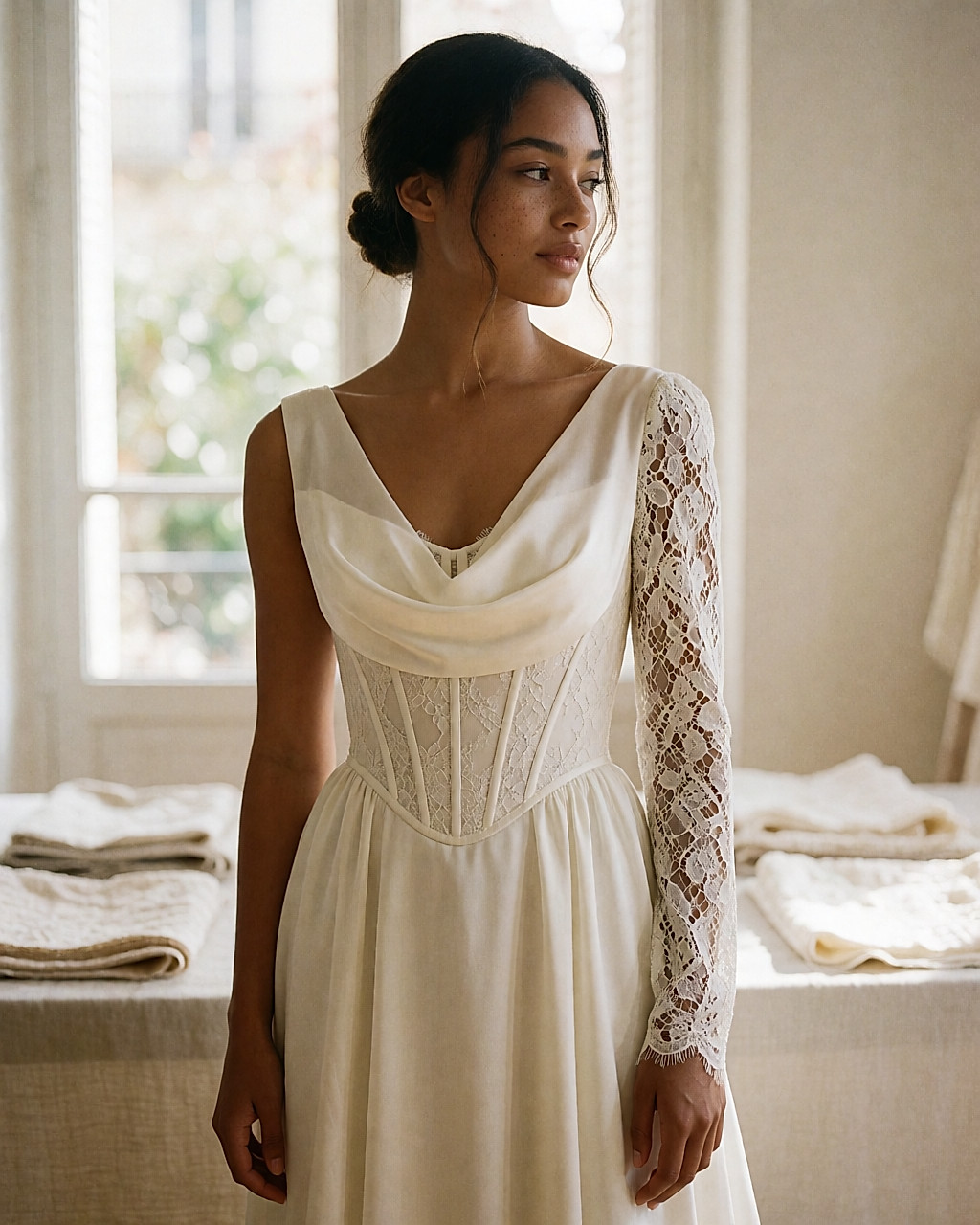
The corset is back, but softened. Visible boning, graphic seams, discreet lacing: wear it under draping or a lace panel, never as armour. Long sleeves are gaining ground too, in open-work lace or fluid crepe, for a covered look that is anything but prudish. Structured bodice, long sleeves, clean drape: it all depends on the cut, not the number of pearls.
Meanwhile, houses continue to offer a much broader range, from sculpted bustiers to romantic draping, via close-fitting pieces that borrow couture's exacting embroidery standards. Suffice to say there is something for every temperament — as long as you're willing to search a little.
Draping: elegance without unnecessary volume
It's the season's most enduring signature. The dresses that define 2026 all play the same tune: a fitted bodice, a panel of fabric rising over the shoulder and flowing into a train, a waist highlighted by a jewel belt, and a skirt that opens without harshness.
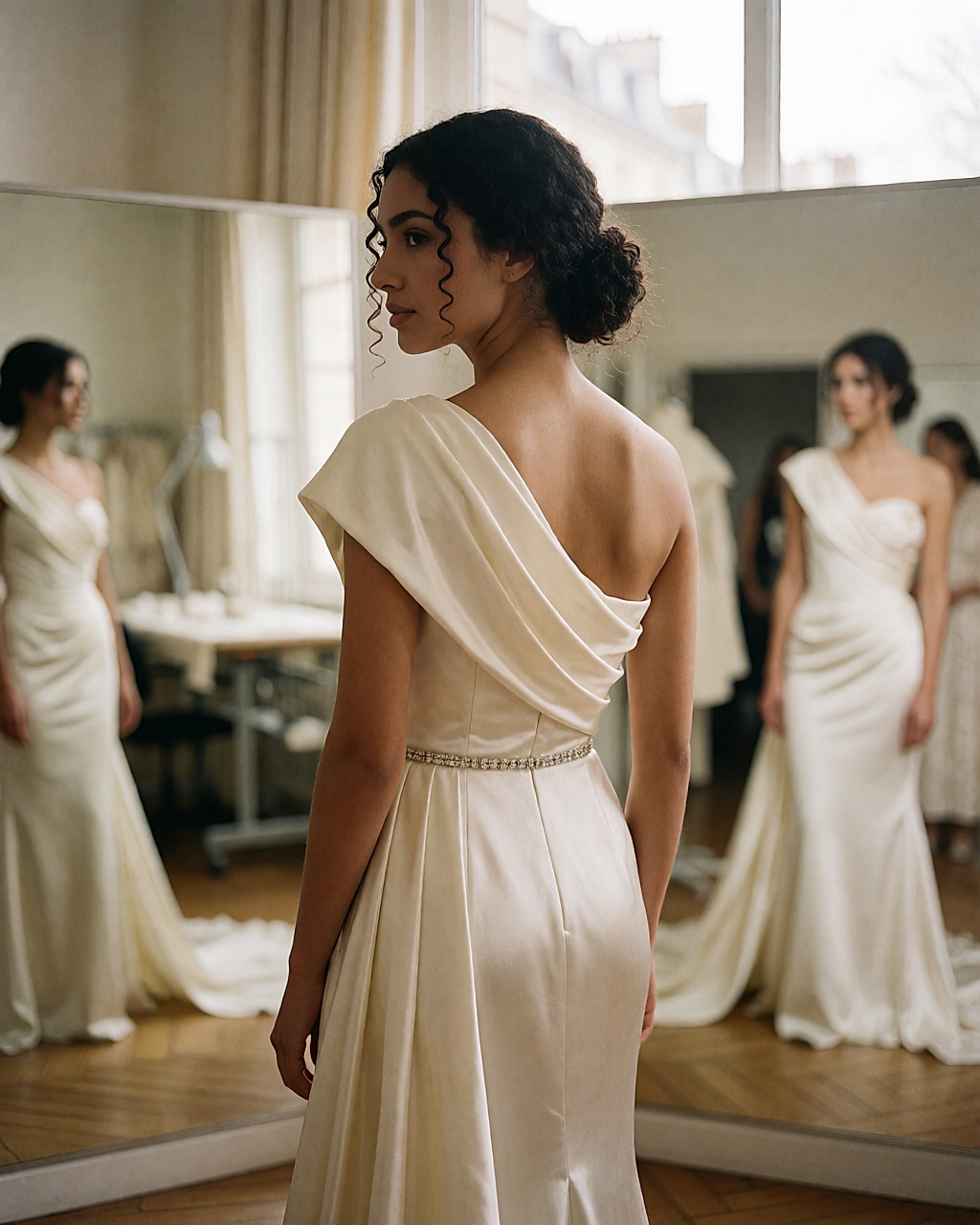
We once spoke of a 'vestal gown'. Today, we're more likely to talk about sculpted draping or a dressed-up corset. The vocabulary evolves, the intention remains the same: to create movement where volume would be superfluous. Why such success, season after season? Because that's exactly what we expect from a statement piece — that it gives you presence without swallowing you up.
And in practice, draping is also the easiest to alter. A well-cut pleat can be taken in, tightened or shortened; all-over embroidery, much less so. At a time when we want to get more value from a dress, that's not a detail: it's the move that changes everything for a more sustainable wardrobe.
Bustier, embroidery and jewel belt
Another recurring motif: the close-to-the-body line. Many bridal designs now pair a structured bustier, fine embroidery and an ornate belt with a full tulle skirt extended by a small train. Mass rhinestones have given way to cut crystal, recycled glass or simple freshwater pearls — more subtle, and often more hard-wearing over time.
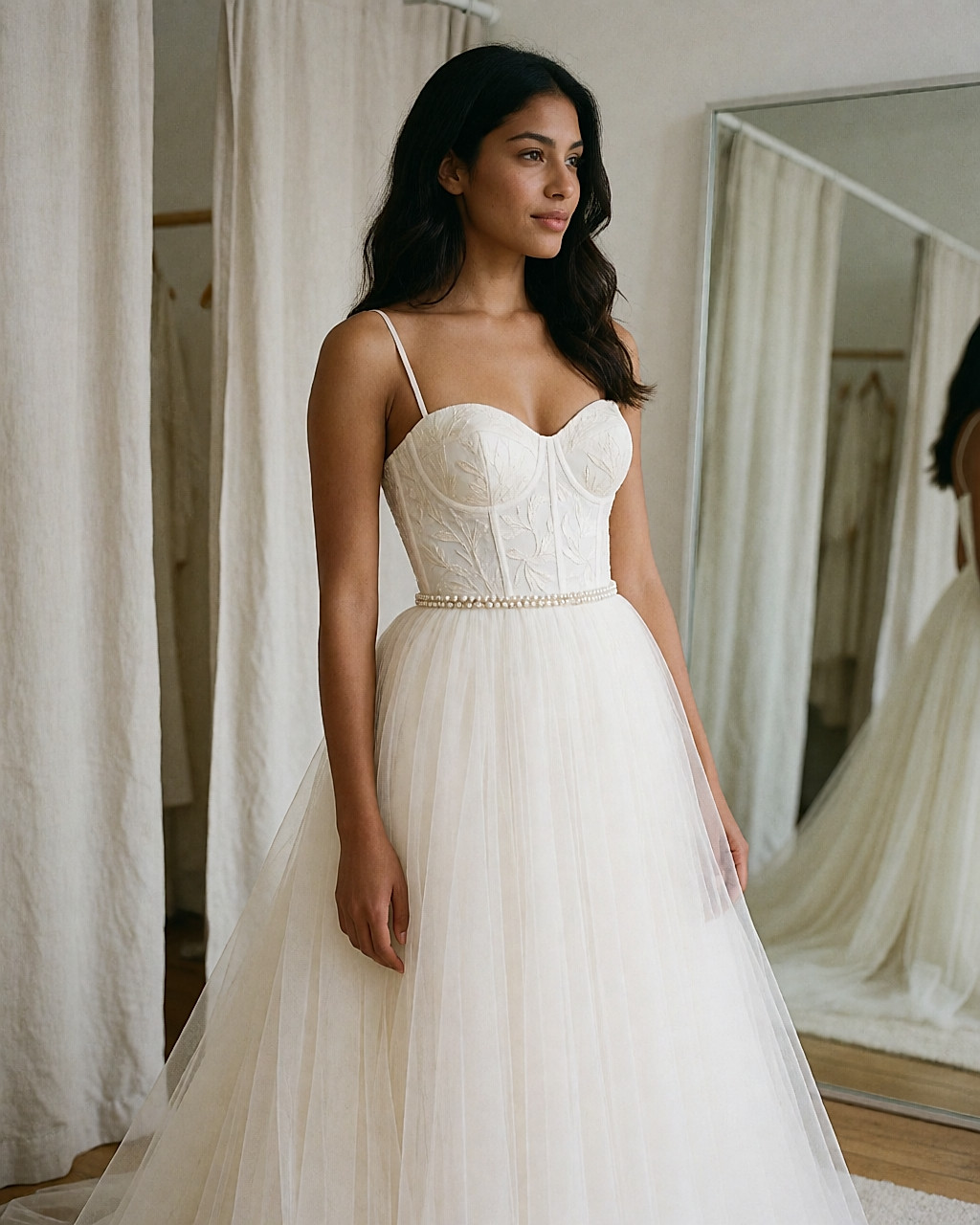
As for belts, they're increasingly detachable: wear them for the ceremony, take them off to dance. The detail seems trivial, but it changes everything. A jewel belt that comes off means a dress that goes from altar to dancefloor without you having to change — and on the comfort front, that's no small thing.
Embroidery as a signature
In several houses, the wedding dress no longer relies on bulk but on precision. The body is close-fitting, sleeves are three-quarter length in open-work lace, the neckline often V-shaped; elsewhere, a fluid skirt with a slit lets you walk and a light train follows the movement. Nothing spectacular, everything in the gesture.
Comparing these pieces to red-carpet looks is no exaggeration: the line between ceremony and walking up the steps has been blurred for a long time. Today, it has practically disappeared, and many brides happily borrow from evening wear.
Minimalism, or quiet luxury
Against these volumes, another school proposes the exact opposite: restraint. An empire waist and fine straps decorated with lace flowers that wrap around the neck, or a dress with no pearls or lace, its only ornament pleats and draping. Some houses also pair white and beige, with a satin skirt supported by tulle petticoats.
This minimalist approach corresponds to what the market calls quiet luxury — pieces you can wear, alter and pass on. In terms of fabric, it's also what ages best: a well-cut drape can be altered, whereas all-over embroidery is far less forgiving. That's a piece you won't regret.
A note of caution: minimalism is unforgiving when it comes to cut. The less decoration there is, the more the fabric's drape shows — but that's no excuse to rush fittings. A badly adjusted dress with no ornament stands out more than generous embroidery, so allow plenty of time in the fitting room.
What to remember from 2026. Keep the structured bodice, defined waist and controlled draping. Leave behind overabundant rhinestones and rigid skirts that stop you walking. A well-cut drape always ages better than overloaded decoration — and is much easier to alter than all-over embroidery.
What has really changed this season
Three shifts are clear.
- Circularity. Designer dress rental and the second-hand market have become firmly established, including on house pieces.
- Manufacturing. Made-to-measure and extended size ranges are no longer exceptions, and several ateliers now work with recycled silk and tulle.
- Rhythm. Bridal capsules are no longer concentrated in autumn; they're spread across the whole year, which leaves less room for seasonal showstoppers.
One thing remains constant: what we remember about a wedding dress is neither its number of pearls nor the sweep of its train, but the way it lets the person wearing it move forward. This season's silhouettes understand that — they free up movement. That's precisely why they'll still be worn.
Budget
On the budget front, start with a broad range and bear in mind that no price is set in stone. In the UK, a ready-to-wear wedding dress often sits between £250 and £800, a mid-range boutique piece more like £900 to £2,500, and a made-to-measure or couture creation upwards of £3,000. Renting a designer dress generally costs between £150 and £600, while second-hand prices vary enormously depending on condition, brand and age of the design.
Several things push the bill up: the city and neighbourhood of the stockist, the length of the train, the fineness of the lace or embroidery, the number of alterations and after-wedding care. You'll find these pieces in specialist boutiques, from a designer, in a couture atelier, but also in high-street chains, consignment shops and on rental or resale platforms. For cleaning, a specialist dry cleaner for delicate textiles generally costs between £60 and £150 depending on the fabric and the work needed — an expense people often forget to budget for.
The right move? Ask for an alterations quote before you commit to your dress: it's very often where the bill spirals without warning. And if a design wins you over but the quote stings, rental often lets you test a cut or a house without committing to a purchase — a good find for the undecided.

Comments
Your opinion matters: rate the article, react and reply to comments.
Comments are moderated; AI-assisted comments are flagged. Text emoticons (8-), :-), <3…) are automatically shown as images.