
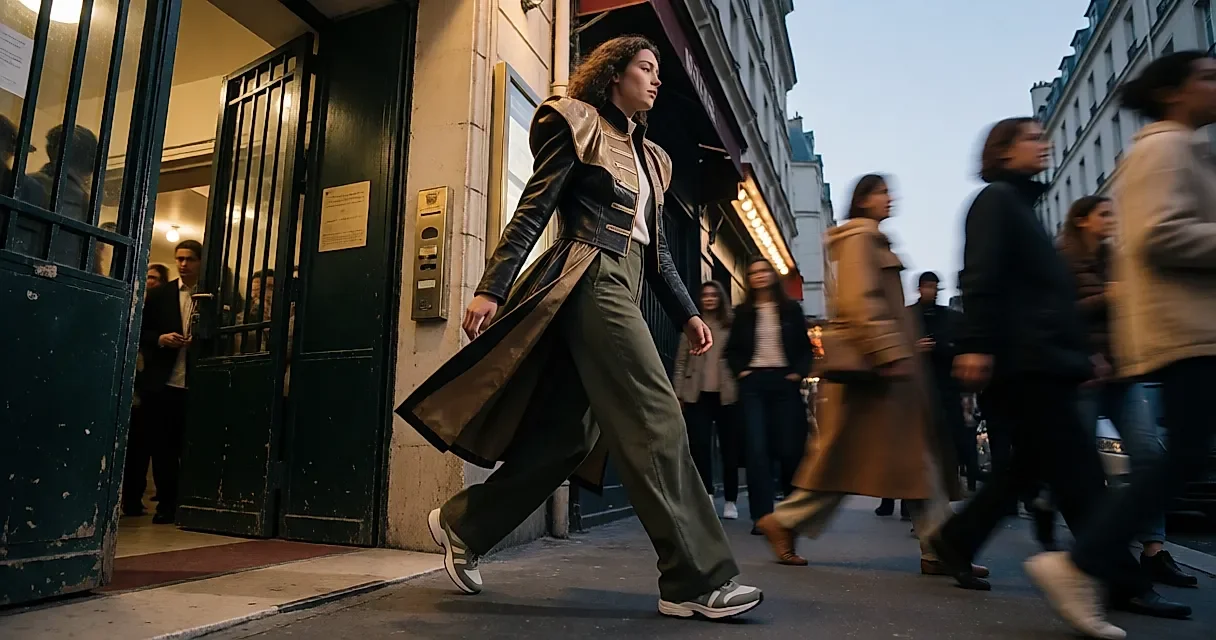
A stage costume is cut for the spotlight, not the Tube. Under a stage light it has to hold for three minutes and read from the back row; on the street it has to last a whole day, sit down, get stained and sometimes blend into the background. Between those two lives sit the spin-off pieces that arrive in shops with the production’s branding never far away, and they need a proper edit before they earn a place in your wardrobe.
What the stage does to fabric
When you first spot a piece inspired by a stage costume, the instinct is to judge it head-on, three metres from the mirror. Yet the difference is at your fingertips: the hand of the fabric, its weight, the way the hem falls when you let it go. Stage satin is often heavy and lined, almost rigid, because it has to throw back light without creasing under the spotlights. The high-street version is sometimes lightened so much that it turns shiny and insubstantial, and marks at the first crease when you sit on the sofa.

Hence the gesture that matters: turn the piece inside out and read the label before you look at the price. The proportion of synthetic fibres is a clue, not a verdict, but the higher it is, the more likely the piece is to shine where you wanted matte and trap heat where you wanted to breathe. A version in wool, silk or matte cotton generally falls better and ages more gracefully. And if the lining scratches or makes the garment slide off your shoulders in the fitting room, it will not soften at home: what bothers you in the cubicle will bother you for two years.
Judge the cut standing up, live your life sitting down
Stage costumes are built for a standing line: high armhole, defined waist, sharp shoulders. On a spin-off piece, those codes look seductive on the hanger and become treacherous in real life. The high armhole turns into a tourniquet as soon as you lift your arms to grab a suitcase; the defined waist becomes a bulge as soon as you sit down. None of it is catastrophic, but it is the kind of detail you cannot see in the mirror and curse on the train.

The test comes down to three movements, done in the fitting room: raise your arms, sit down, cross your arms in front of you. If the shoulder seam rides up or the fabric pulls across your back, the cut was designed for a photograph, not for you. Then look at the finishes: inside seams, a stitched or floating lining, a hem deep enough to be let down one day. This is where the gap between a £50 piece and a £200 piece really shows, far more than in the name on the label.
The piece, not the poster
You need to separate two things that often end up in the same basket: the tour T-shirt, which is a souvenir, and the tailored piece, which is a garment. The first is allowed to be a little rough, because you love it for what it says. The second has to stand up on its own. The question to ask in the mirror is simple: would you wear it if you had never seen the show? If the answer is no, you are buying a poster, which is perfectly fine, but not at the price of a coat.

Then there is the case of very distinctive pieces, the ones with sharp shoulders, sequins or patent leather. They work as statement pieces, worn once a season, with a basic that calms the whole look. This is often where you splurge, and often where you have regrets: how many times a winter will you really bring it out? It is not a bad purchase, it is a purchase about dosage. And as always in fashion, the best find is often what you already own: getting the shoulder-padded jacket out of the wardrobe costs nothing and saves you a returns parcel.
Before you pay, read the care label, then the price label. A piece that needs dry cleaning every second wear completely changes its real cost. Second check: shake it under the shop lights. If it already shines more than you want, it will shine ten times more under an office ceiling.
What to budget
Expect to pay around £30 to £55 for a souvenir T-shirt or sweatshirt sold in an official shop or online around a tour. For a genuinely considered capsule piece, such as a jacket, jumpsuit or dress, the range is more like £80 to £220, depending on fabric and label. Second-hand, where these pieces often land after a single season, it is usually £20 to £60.
Don’t forget alterations: £15 to £40 at a tailor for a hem or taking in a waist, which is excellent value across any wardrobe. Where to look? The official online store for new pieces, resellers and second-hand platforms for sold-out items, local charity shops for good finds at low prices. And check the returns policy: a piece with a lot of personality can be hated in real life.
What really transfers from a stage costume is not the shine: it is the drape, the construction, the idea that a garment can hold a silhouette without you having to think about it. The rest, the sequins, the logo, the souvenir, is decoration. Lovely decoration, perhaps, but it will not keep you warm on the Tube.



Comments
Your opinion matters: rate the article, react and reply to comments.
Comments are moderated; AI-assisted comments are flagged. Text emoticons (8-), :-), <3…) are automatically shown as images.